Pore Clogging Checker: Check Your Skincare Ingredients
A pore clogging checker can help you screen the ingredient list of a cleanser, moisturizer, sunscreen, makeup product, or other cosmetic for ingredients that have been associated with comedogenic potential.
That can be useful if your skin is prone to blackheads, whiteheads, or recurring clogged pores and you are trying to compare products before buying them.
But a checker has an important limitation: a flagged ingredient does not prove that the finished product will clog your pores. Likewise, a product with no flagged ingredients is not guaranteed to be breakout-free.
The best way to use this tool is as a screening step—not as a final diagnosis of whether a product is “safe” or “bad” for your skin.
Table of Contents
Interactive Pore Clogging Checker
Paste the complete ingredient list of your skincare or cosmetic product into the checker.
For the most useful result:
- Find the full ingredient list on the product packaging or official product page.
- Copy the complete list rather than just the highlighted ingredients.
- Paste it into the checker.
- Select Check Ingredients.
- Review any potential pore-clogging ingredients that are flagged.
- Read the explanation and evidence limitations before deciding whether to use the product.
The checker should identify recognized ingredient names and relevant aliases where possible.
A flagged ingredient means that the database contains evidence or historical testing suggesting possible comedogenic activity.
It does not mean the ingredient will definitely cause acne on your skin.
Similarly, if the checker finds nothing concerning, that does not guarantee the complete formula is non-comedogenic.
Pore Clogging Checker: How to Interpret Your Result
A pore clogging checker is most useful when you treat the result as a potential warning rather than a verdict.
Ingredient-level comedogenicity can be affected by concentration, the complete formulation, the product’s texture, how long it remains on the skin, and individual skin response.
For example, an ingredient that produced clogged pores when tested alone at a high concentration may behave very differently when used at a much lower concentration inside a finished moisturizer.
That is why the checker should help you investigate a formula—not automatically tell you whether to buy or discard it.
What Does Pore-Clogging Actually Mean?
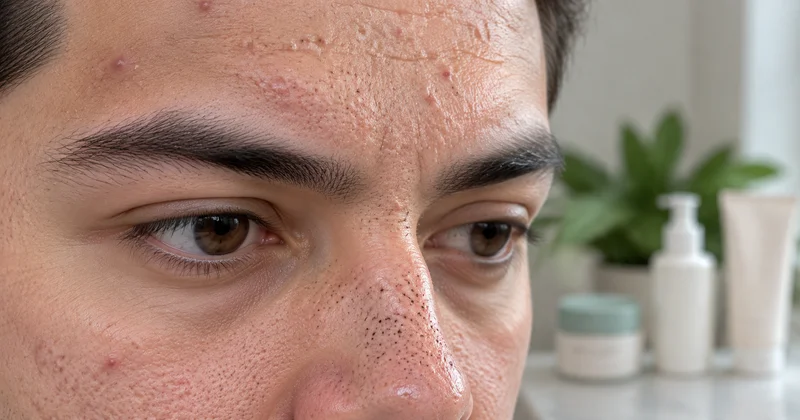
A clogged pore forms when oil and dead skin cells build up inside a hair follicle.
When the pore remains closed, it can form a closed comedo, commonly called a whitehead.
When the pore stays open, the material inside is exposed to air and darkens, producing an open comedo, or blackhead.
The dark appearance of a blackhead is not caused by dirt.
Some cosmetics and skincare products can contribute to clogged pores in certain people, but product ingredients are only one possible factor.
Acne can also be influenced by:
- Hormonal changes.
- Excess oil production.
- Genetics.
- Certain medications.
- Hair products.
- Friction or occlusion.
- Sweat.
- Existing acne that has nothing to do with a newly purchased cosmetic.
This is why an acne causing ingredients checker cannot identify the definitive cause of someone’s acne.
What Is a Comedogenic Rating?
If you have researched skincare ingredients online, you may have seen ingredients ranked on a scale such as 0 to 5.
These numbers are often described as a measure of how likely an ingredient is to clog pores.
The problem is that they can look far more precise than the evidence really is.
Many commonly repeated ratings originated from older laboratory and animal experiments. One historically important method involved applying ingredients to rabbit ears and looking for follicular plugging.
That testing helped identify potentially comedogenic substances, but rabbit skin does not perfectly predict how a modern cosmetic formula will behave on a person’s face.
A rating should therefore be treated as a screening signal, not as a percentage chance that an ingredient will give you acne.
Why Pore-Clogging Ratings Have Important Limitations
Much of the classic evidence came from animal testing
The rabbit-ear model was designed to be very sensitive to ingredients capable of creating follicular plugs.
That sensitivity made it useful for screening, but it also meant that ingredients could appear highly comedogenic under experimental conditions without necessarily producing the same result during normal human cosmetic use.
Researchers have long recognized that results from rabbit testing do not always match human experience.
This is one reason modern pore-checking tools should avoid presenting an old ingredient score as an unquestionable fact.
An ingredient is not the same as a complete formula
This is one of the most important things to understand when using any ingredient checker.
A moisturizer containing one historically flagged ingredient is not equivalent to applying that isolated ingredient directly to the skin.
The finished product may use it at a much lower concentration.
Its behavior can also change depending on:
- The other ingredients in the formula.
- The product base.
- The concentration.
- The way ingredients interact.
- Whether the product is water-based, oil-based, or an emulsion.
- Whether the product is rinsed away or left on the skin.
Human testing of finished cosmetic products has shown that formulas containing ingredients previously considered comedogenic do not necessarily produce comedones as finished products.
That makes simple ingredient blacklists useful for screening but unreliable as absolute rules.
Individual skin response matters
Even two people with acne-prone skin can respond differently to the same moisturizer or foundation.
Products labeled non-comedogenic, oil-free, non-acnegenic, or won’t clog pores are generally useful choices when you are prone to breakouts.
But these labels cannot guarantee that every individual will tolerate the formula.
Your actual skin response still matters.
Does One Flagged Ingredient Mean You Should Avoid the Product?
Not necessarily.
One flagged ingredient should make you look more closely at the formula, but it does not automatically mean the product is a poor choice.
Consider:
- How strong the evidence behind the flag is.
- Whether the evidence came from animal or human testing.
- Whether the complete product has been tested.
- Whether it is a rinse-off or leave-on formula.
- Whether you have already used it successfully.
- Whether clogged pores actually increased after you started it.
- Whether several other products changed at the same time.
If you have been using a product for months without worsening congestion, an old comedogenicity score should not necessarily override your real-world experience.
Rinse-Off vs. Leave-On Products
Product type changes the context of a pore-clogging ingredient.
A cleanser may stay on your face for less than a minute before being rinsed away.
A moisturizer may remain on your skin for hours.
A sunscreen or foundation may stay on your face throughout most of the day.
Hair products can also transfer onto areas such as the forehead, temples, neck, and hairline.
Because the exposure is different, it would be misleading to interpret the same flagged ingredient exactly the same way in every product.
However, that does not mean the checker should invent a different numerical score for cleansers, moisturizers, or makeup unless reliable evidence supports such a calculation.
Use product type as context rather than as a made-up mathematical adjustment.
Non-Comedogenic vs. Pore Checker Results
A product labeled non-comedogenic may sometimes contain an ingredient that appears on an online pore-clogging list.
That does not automatically mean the manufacturer is wrong or that the checker is wrong.
They may be measuring different things.
A pore checker generally looks at individual ingredient evidence.
A finished-product claim relates to the complete formulation.
Those are not the same thing.
For acne-prone skin, choosing products labeled:
- Non-comedogenic.
- Non-acnegenic.
- Oil-free.
- Won’t clog pores.
can still be a useful starting point.
But none of those terms can guarantee that every person’s skin will respond identically.
What If a Product Passes the Checker but I Still Break Out?
A clean result from the checker does not prove that a product cannot be involved in your breakouts.
Several possibilities exist.
The relevant ingredient may not yet be included in the checker’s database.
The complete formula may behave differently from its individual ingredients.
Your skin may be irritated rather than experiencing true comedonal acne.
Another skincare or hair product may be responsible.
Sweat, friction, hormones, or medication may be affecting your acne.
And sometimes bumps that look like acne may have another cause.
Instead of adding more and more products, look at what changed around the time the breakouts began.
If one product repeatedly seems connected to new congestion, you may decide to remove that product while keeping the rest of your routine stable enough to observe what happens.
What If Several Ingredients Are Flagged but My Skin Likes the Product?
You do not need to stop a well-tolerated product solely because an ingredients checker flags several ingredients.
Your experience with the complete formula is important.
If you have used the product consistently without developing new blackheads, whiteheads, or worsening breakouts, an ingredient score alone is weak evidence that you should replace it.
This is especially true when the flag is based mainly on older isolated-ingredient or animal data.
The point of the checker is to help you ask better questions about a formula—not to make every skincare decision for you.
How to Introduce a New Skincare Product More Carefully
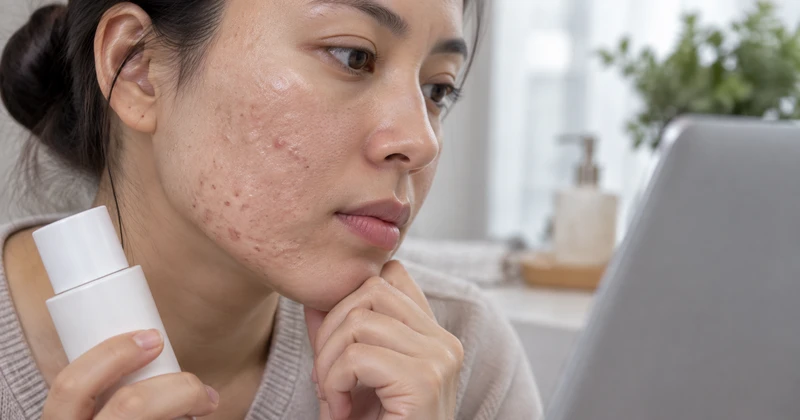
When several new products are introduced at once, it becomes difficult to identify what is helping or causing problems.
A simpler approach is:
- Add one major new product at a time when practical.
- Keep the rest of your routine reasonably consistent.
- Watch areas where you normally develop clogged pores.
- Pay attention to the type of reaction.
- Distinguish new whiteheads or blackheads from redness, burning, itching, or rash.
- Stop using the product if you develop a significant reaction and seek medical advice when needed.
A traditional patch test can sometimes help reveal irritation or allergic reactions.
However, passing a patch test does not prove that a product will never clog pores during regular use across the entire face.
Pore-Clogging Ingredients and Makeup
Makeup can stay on your face for many hours, so formula choice matters when your skin is prone to acne.
Foundation, primer, concealer, cream blush, and other complexion products may all come into contact with acne-prone areas.
Look for makeup labeled:
- Non-comedogenic.
- Oil-free.
- Won’t clog pores.
Removing makeup thoroughly before bed is also important.
If your checker flags one ingredient in a foundation, consider the full formula and your own experience before assuming that ingredient makes the entire product unsuitable.
For more guidance, see our makeup options for breakout-prone skin.
Pore-Clogging Ingredients and Heavy Moisturizers
Rich creams, butters, oils, and balms can feel too occlusive for some acne-prone users.
Others may tolerate them without problems.
That is another reason ingredient reputation should not be treated as a universal rule.
One person may experience clogged pores from a heavy formula while another with very dry acne-prone skin may tolerate the same product.
The complete formula matters more than automatically declaring every oil, butter, fatty alcohol, or ester acne-causing.
Our beef tallow skincare guide explains why judging a finished moisturizer from one individual ingredient can be misleading.
If You Already Have Blackheads and Whiteheads
Checking products can help you identify possible triggers, but it does not remove existing comedones.
Once blackheads and whiteheads have formed, you may need evidence-supported acne treatment rather than more ingredient analysis.
Salicylic acid is commonly used for acne-prone skin because it can help unclog pores. Topical retinoids are another evidence-supported option for comedonal acne.
Beyond Breakouts explains the role of salicylic acid in more detail in our guide to salicylic acid for clogged pores and acne.
The key point is simple:
A pore checker helps evaluate products. It does not treat acne.
When an Ingredient Checker Is Not Enough
Consider professional care if you have:
- Deep, painful pimples.
- Nodules or cysts.
- Acne that is leaving scars.
- Widespread or worsening breakouts.
- Persistent acne despite appropriate over-the-counter care.
- A sudden severe skin reaction.
- Significant itching, swelling, or rash.
- Bumps that may not actually be acne.
- Acne that is causing significant distress.
A dermatologist can help determine whether your concern is acne, another skin condition, a product reaction, or a combination of factors.
Frequently Asked Questions
How accurate is a pore clogging checker?
A pore clogging checker can accurately compare ingredient names with the database it uses, but it cannot accurately predict every individual’s skin response. Much of the traditional comedogenicity evidence comes from isolated-ingredient or older testing models, while complete modern formulas can behave differently.
Does a comedogenic rating of 5 mean an ingredient will cause acne?
No. A high rating indicates that an ingredient produced stronger comedogenic activity under a particular testing method. It does not mean every product containing that ingredient will clog pores or cause acne in every user.
Can a non-comedogenic product still break me out?
Yes. Non-comedogenic labeling is useful for acne-prone skin, but it is not a guarantee. Individual skin response varies, and breakouts can also be influenced by hormones, medication, hair products, friction, sweat, and other factors.
Should I avoid every ingredient flagged by an acne causing ingredients checker?
No. A flag should be interpreted along with the quality of the evidence, the complete formulation, product type, and your own experience. Automatically avoiding every flagged ingredient may cause you to discard products that your skin actually tolerates well.
Can a pore clogger checker tool identify what is causing my acne?
No. A pore clogger checker tool can identify ingredients associated with potential comedogenicity, but it cannot diagnose why you have acne. Product ingredients are only one possible factor, and persistent or severe breakouts may need evaluation by a dermatologist.
The Bottom Line
A pore clogging checker can make ingredient lists easier to evaluate, especially when you are comparing several skincare or makeup products.
Use it to identify potential flags, then look at the quality of the evidence, the complete formula, whether the product is rinse-off or leave-on, and how your skin actually responds.
Remember the two most important rules:
A flagged ingredient does not guarantee a breakout.
No flagged ingredients does not guarantee a product is acne-safe.
Choose non-comedogenic formulas when practical, introduce products carefully if you are prone to clogged pores, and do not let ingredient checking replace evidence-based acne treatment when breakouts are persistent, painful, or scarring.
This checker and article are for educational purposes only. They do not diagnose acne, determine the definitive cause of breakouts, or replace evaluation and care from a qualified healthcare professional.
References:
- American Academy of Dermatology — Acne: Signs and Symptoms. Defines blackheads, whiteheads, and comedones. AAD acne signs and symptoms
- American Academy of Dermatology — 9 Things to Try When Acne Won’t Clear. Covers non-comedogenic, non-acnegenic, oil-free, and “won’t clog pores” labels and notes that individual breakouts can still occur. AAD acne skincare guidance
- American Academy of Dermatology — I Have Acne! Is It Okay to Wear Makeup? Covers acne-friendly makeup labeling and removal. AAD makeup and acne guidance
- Fulton JE Jr, Pay SR, Fulton JE III — Comedogenicity of Current Therapeutic Products, Cosmetics, and Ingredients in the Rabbit Ear. Journal of the American Academy of Dermatology, 1984. PubMed
- Frank SB — Is the Rabbit Ear Model, in Its Present State, Prophetic of Acnegenicity? Journal of the American Academy of Dermatology, 1982. PubMed
- Mills OH Jr, Kligman AM — A Human Model for Assessing Comedogenic Substances. Archives of Dermatology, 1982. PubMed
- Draelos ZD, DiNardo JC — A Re-Evaluation of the Comedogenicity Concept. Human finished-product testing found that formulas containing historically comedogenic ingredients were not necessarily comedogenic as complete products. PubMed
- Sriphojanart T, et al. — Safety Assessment on Comedogenicity of Dermatological Products Containing d-Alpha Tocopheryl Acetate in Asian Subjects: A Double-Blind Randomized Controlled Trial. Human finished-product testing. PubMed