stainless steel comedone extractors: What to Check Before Buying
An extractor kit may promise a quick fix for blackheads, but a shiny metal loop cannot tell you whether a blemish should be squeezed. If you are comparing stainless steel comedone extractors, the most important buying decision comes before choosing a shape or a brand: do you need an extraction tool at all?
Quick answer: Look for a clearly identified tool, a smooth and undamaged head, a secure grip, usable cleaning instructions, and relevant safety warnings. Stainless steel does not establish sterility or safe technique. At-home extraction can injure skin, and dermatologist-performed extraction is generally considered for persistent blackheads or whiteheads that do not respond adequately to acne treatment.
This guide compares construction, maintenance, single tools, and kits—including the reasons to skip a purchase.
Table of Contents
Are stainless steel comedone extractors worth buying?
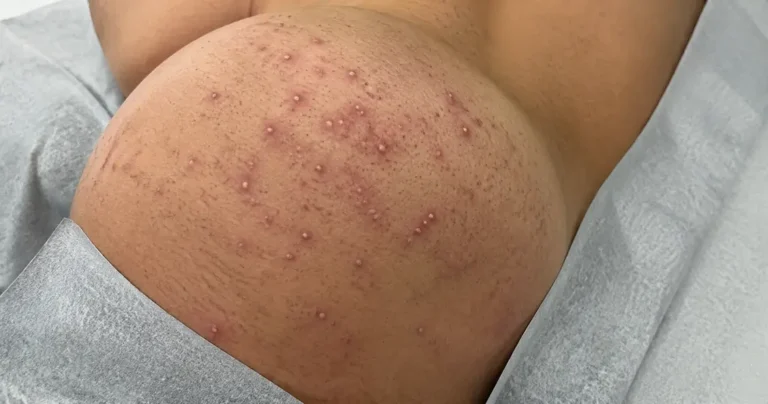
A comedone is a clogged hair follicle: a blackhead is an open comedone, and a whitehead is a closed one. A comedone extractor is a small instrument designed to remove some visible plugs mechanically. It does not stop the oil and skin cells that can lead to new clogged pores.
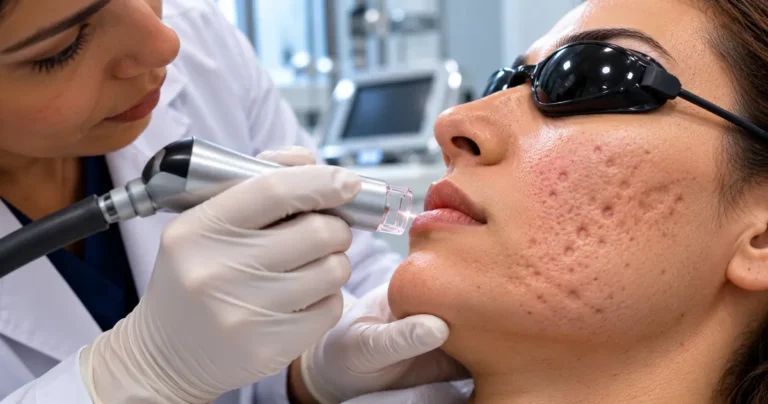
The main limitation is not the metal; it is the procedure. Pressure on the wrong bump, repeated attempts, or handling an inflamed lesion can cause bruising, additional inflammation, infection, discoloration, or scarring. The American Academy of Dermatology (AAD) describes extraction with sterile instruments as a dermatologist-performed option, usually when other treatments have not cleared persistent comedones.
Buying nothing is a sensible choice if your blackheads are mild, your skin is irritated, or a suitable acne treatment is already helping. A routine built around gentle cleansing, an appropriate acne medicine when needed, moisturizer, and sunscreen may address the reason plugs keep forming. Our guide to building a simple acne skincare routine explains that approach.
stainless steel comedone extractors: What to check before paying
Tool listings emphasize shiny metal and impressive names. A useful comparison examines the details you can verify before checkout, starting with the tip that may contact skin.
Compare loop designs, not just the number of ends
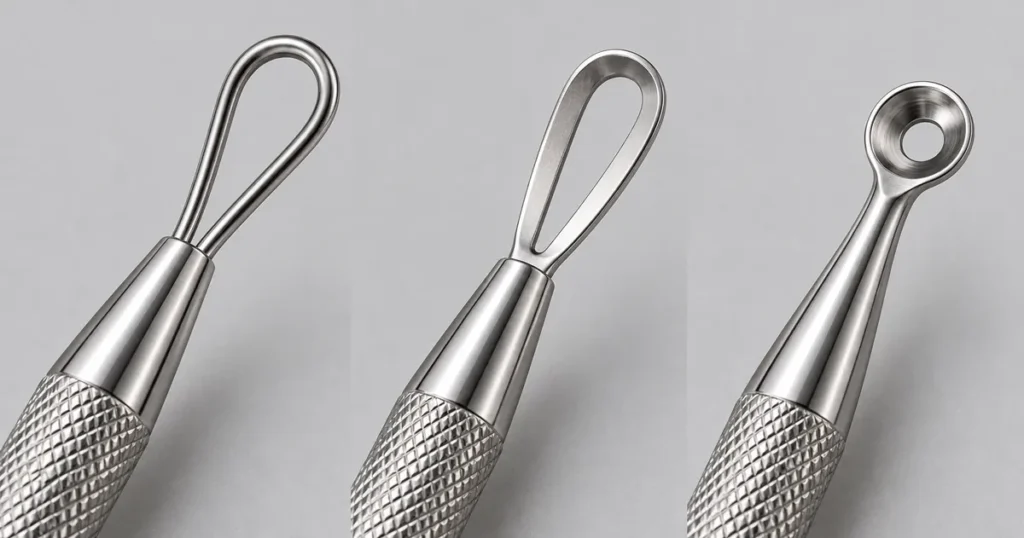
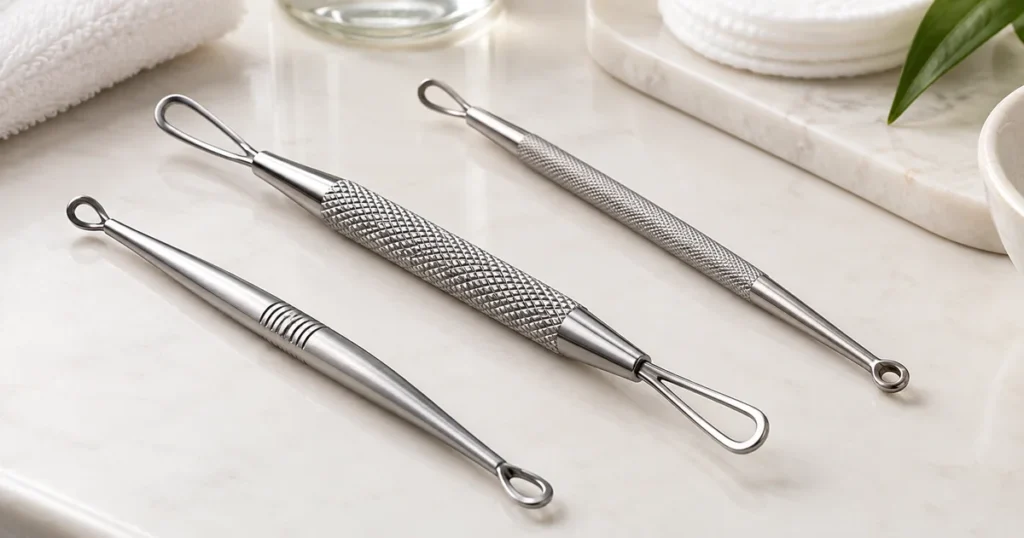
Common shapes include rounded wire loops, longer flattened loops, angled loops, and perforated or spoon-like heads. They are not interchangeable, and a different shape does not make extraction appropriate for every bump. Product images may show the general geometry, but rarely show the finish well enough to establish that the edges are smooth.
A stainless steel blackhead extractor with two different loop ends offers a choice of head shapes in one instrument. That can be easier to evaluate than an assortment of poorly documented attachments. Avoid assuming that a narrow opening is safer, or that a wider loop justifies greater pressure. Among stainless steel comedone extractors, loop geometry is a design difference, not evidence of better outcomes.
⭐Tweezerman Whitehead and Blackhead Remover (2742-R) — Smart Dual-Loop Choice
Looking for a stainless steel extractor with more than one loop design without buying an entire kit? The Tweezerman Whitehead and Blackhead Remover offers two different ends in one compact tool.
Its longer, flat loop and smaller angled loop provide distinct head shapes, while the textured stainless steel handle is designed for a more secure grip.
Why consider it?
- Two loop designs in a single tool.
- Textured handle for improved grip and control.
- Reusable stainless steel construction.
- Manufacturer-provided cleaning and care instructions.
Important: Even a well-designed extractor can damage skin when misused. Avoid attempting extraction on painful, inflamed, or deep acne lesions.
👀 See Product & Check Price on Amazon ➜
Inspect finish, joints, and grip
Look for clear photographs of the actual head, not just a polished handle. Visible burrs, bent loops, rough joins, flaking finish, rust, or an asymmetrical tip are reasons to avoid a tool or request a replacement. Even an initially smooth instrument can become damaged. Any surface defect that makes cleaning difficult is also a concern.
A textured handle may be easier to hold securely, but “no-slip” does not mean injury-proof. Weight, balance, and the space available for the fingers affect handling; these details are hard to judge from photos alone. A secure grip is a purchase criterion, not permission to push harder.
Treat material claims as claims
“Stainless steel,” “surgical steel,” “medical grade,” and “dermatologist tested” are not interchangeable standards. Unless the seller identifies an alloy or provides meaningful documentation, do not infer a particular steel grade, sterility, medical-device status, or comparative safety. Stainless steel can be durable and corrosion-resistant while the finished tool still has a poor tip or inadequate care instructions.
The appeal of stainless steel comedone extractors should not outweigh missing documentation. An identifiable manufacturer and accessible instructions are more useful than a grand claim printed on the package.
Cleaning stainless steel comedone extractors: What instructions should say
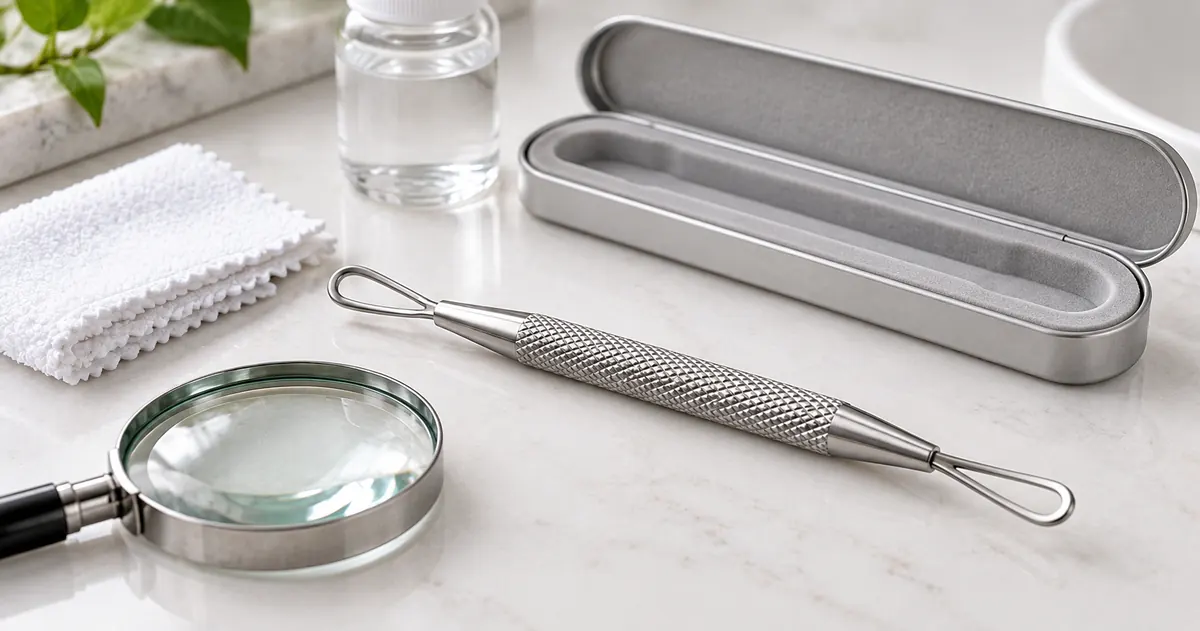
Reusable tools make hygiene part of the purchase decision. Before ordering, look for instructions that explain which cleaning products are compatible with the metal, how the item should be dried and stored, and when visible damage means it should no longer be used.
Cleaning, disinfection, and sterilization are different
| Term | What it means | What it does not prove |
|---|---|---|
| Cleaning | Removes visible residue and other material | That microorganisms have all been killed |
| Disinfection | Reduces or destroys many microorganisms using an appropriate process | Sterility |
| Sterilization | Uses a validated process intended to eliminate all forms of microbial life | That an instrument remains sterile after uncontrolled handling |
The CDC stresses cleaning before disinfection or sterilization for healthcare instruments and checking for defects that prevent adequate reprocessing. Those are professional infection-control principles, not a set of home extraction instructions. A seller’s directions to wipe with alcohol or use soap and water must not be described as achieving medical sterility simply because the seller uses the word “sterilize.”
Different stainless steel comedone extractors can have different care requirements. Ask yourself whether the guidance is understandable, specific to that model, and compatible with its construction. Do not share instruments between people or assume a carrying case makes an inadequately processed tool hygienic.
Warning signs before purchase
Avoid listings that offer no care guidance, promise “100% sterile forever,” give no intended-use restrictions, or encourage puncturing closed bumps with an included needle. A damaged or rusty head is not fixed by cleaning. If you cannot determine whether the instrument can be maintained adequately, that uncertainty weighs against buying it.
stainless steel comedone extractors: Single tool or full kit?
For stainless steel comedone extractors, a bigger kit is not automatically a better deal. A single tool is easier to inspect and leaves fewer parts to maintain. A kit offers multiple shapes but may include sharp lancets and attachments the buyer neither needs nor knows how to use safely.
| Decision point | Single extractor | Multi-tool kit |
|---|---|---|
| Variety | Limited to one design or two ends | Several heads, sometimes pointed attachments |
| Practical value | Easier to judge one documented tool | Depends on whether you need each piece |
| Maintenance | Fewer surfaces and pieces | More parts to inspect, clean, and store |
| Safety | Still depends on lesion and handling | More tools do not reduce risk |
| Price comparison | Compare cost against one useful tool | Don’t mistake a low cost per piece for value |
A single-tool example with another head design
If you prefer a single, dedicated extractor, compare its documentation with the more complex kits rather than assuming fewer parts guarantees quality. The manufacturer should make it easy to identify exactly what you are buying.
⭐ Seki EDGE Blackhead Remover (SS-801) — Simple Single-Tool Alternative
Prefer a dedicated blackhead extractor instead of a multi-piece kit? The Seki EDGE Blackhead Remover SS-801 offers a straightforward stainless steel design for shoppers who want to avoid paying for numerous unnecessary attachments.
Made in Japan according to the product listing, this reusable tool features two different hole sizes in a single instrument.
Why consider it?
- Single-tool design instead of a large kit.
- Stainless steel construction.
- Two hole sizes for comparing head geometry.
- An alternative for buyers who prefer fewer accessories.
Important: Check the exact product’s cleaning instructions and current availability before purchasing. Its construction does not guarantee safe home extraction or prevent skin damage.
👀 View Seki EDGE & Check Current Price ➜
Extra tips don’t necessarily improve value
A kit containing a lancet, pointed needle, or very sharp attachment adds a different hazard from a blunt loop. The presence of a tool does not make puncturing or opening pimples at home appropriate. Do not treat a kit as a substitute for clinical training or professional infection control.
For stainless steel comedone extractors, compare the cost of the components you would actually consider, the availability of replacement or manufacturer support, and any return restrictions. Live prices and stock can change; an unverified bargain price is not a useful buying fact.
Three stainless steel comedone extractors to compare by design
The three named options in this guide illustrate different purchase decisions, not a clinical ranking. The dual-loop Tweezerman model illustrates head variety; the Seki EDGE model illustrates single-tool shopping; the following alternative is different enough that its warnings deserve special attention.
Alternative tip geometry and specific warnings
A tool with a tweezer-like head raises different questions from a traditional loop, particularly where the tips are narrow or pointed. Read the limitations on the exact model before treating a different design as an advantage.
👀 Tweezerman Blackhead Extractor (1290-R) — Alternative Tip Design
Not interested in traditional loop extractors? The Tweezerman Blackhead Extractor 1290-R features a distinctive curved, tweezer-like head rather than a conventional wire loop.
Its stainless steel construction and specialized tip design make it an alternative worth comparing when evaluating different extractor shapes.
Why consider it?
- Distinctive curved tip geometry.
- Reusable stainless steel construction.
- Compact single-instrument design.
- Manufacturer instructions with specific intended-use restrictions.
Important: This tool is intended for visible blackheads, not whiteheads, painful pimples, cystic acne, or inflamed and broken skin. Its narrow tips require particular caution, and professional extraction remains the safer choice for difficult lesions.
⭐ See Tweezerman Blackhead Extractor on Amazon ➜
All three have identifiable product pages, but current Amazon US purchasing availability, prices, and all variants require final verification. None was personally tested for this article. The absence of a hands-on finish inspection also means no comparative durability or workmanship ranking is justified.
When not to use a comedone extractor
Do not use a home tool on painful red pimples, deep nodules, cysts, open or broken skin, sunburned areas, a spreading rash, or bumps whose cause is uncertain. Trying to open deep acne yourself raises the risk of injury and infection. Some manufacturer instructions also exclude sensitive areas around the eyes or lips.
A tiny forehead bump is not necessarily a blackhead or closed comedone. It could reflect folliculitis, irritation, milia, or another condition. If the diagnosis is unclear, understand the possible causes of small forehead bumps before treating the bump as something to remove.
For stainless steel comedone extractors, there is no design feature that makes puncturing deep or uncertain lesions an appropriate home procedure. Stop considering extraction as a next step if it would involve force, sharp instruments, or repeated manipulation of the same spot. Professional assessment is more appropriate for painful, persistent, widespread, or scarring acne.
Professional acne extraction vs home tools
The professional alternative to stainless steel comedone extractors bought for home use is not simply a more expensive tool. A dermatologist can identify the lesion, decide whether extraction is appropriate, and use sterile instruments with trained technique. The AAD describes medical extraction as generally reserved for blackheads and whiteheads not adequately cleared by other acne treatments. That is different from buying a cosmetic instrument and following a short online video.
Professional extraction can remove an existing comedone, but it does not permanently prevent another one from forming. That requires attention to the underlying acne. Depending on the skin and lesion type, evidence-supported options may include topical retinoids and salicylic acid; these require appropriate use and can cause irritation.
For recurring clogged pores, see our article on treating blackheads and whiteheads with salicylic acid. Readers whose acne is deep, painful, or leaving scars should seek a dermatologist rather than buy an instrument with more attachments.
Final checklist before buying stainless steel comedone extractors
Use this checklist to make a purchase decision rather than judge a tool by its shine:
- Need: Would an acne treatment or professional appointment better address the problem?
- Identity: Is the exact manufacturer and model clear?
- Head: Are the shape and intended use explained without promises of effortless extraction?
- Finish: Are there any visible defects, rough edges, or corrosion?
- Grip: Is the handle documented and practical, without exaggerated safety guarantees?
- Care: Can you find credible, model-specific cleaning and storage instructions?
- Warnings: Are restrictions on inflamed, damaged, or sensitive skin explicit?
- Value: Are you paying for a genuinely useful design, not unnecessary sharp attachments?
- Verification: Have you checked the actual seller, return policy, and current price?
The option to leave the tool unpurchased is a successful result of this checklist. Stainless steel comedone extractors are not required equipment for an effective acne routine.
Frequently Asked Questions
1. Are all stainless steel comedone extractors surgical grade?
No. A listing saying stainless steel does not verify its precise alloy, medical-device classification, or sterility. “Surgical grade” can also be vague marketing language without an identified standard. Ask for supporting specifications if the material claim is central to your purchase.
2. Can a blackhead extractor permanently remove blackheads?
No. An extraction may physically remove an existing plug, but another can develop. A consistent acne plan can help manage recurring congestion. Removing a plug is different from permanently changing pore function.
3. Is a double-loop extractor better than a single-loop tool?
Not automatically. For stainless steel comedone extractors, two head shapes may provide flexibility, but neither establishes safe use or better clinical results. Compare workmanship, warnings, cleaning requirements, and whether you need the second head at all.
4. Can I use a comedone extractor on a painful pimple?
Do not use a home extractor on deep, painful, or inflamed acne. Pressure, picking, and puncturing can worsen inflammation and increase the risk of scarring or infection. Ask a dermatologist about appropriate treatment if the lesion is severe or persistent.
5. Should I replace a tool if a loop becomes bent or rusty?
Yes. Do not continue using a visibly damaged instrument. Corrosion, rough edges, and compromised joints may injure skin or make cleaning unreliable. Manufacturer-approved care does not repair a damaged surface.
Conclusion
The best comparison of stainless steel comedone extractors begins with whether you need one at all. If you still want to evaluate a tool, focus on the head, finish, grip, manufacturer instructions, and clear limitations—not kit size or promises of “professional” quality. For recurring comedones or persistent lesions, an appropriate acne treatment or dermatologist visit may offer a more useful next step.
This article is educational and is not a diagnosis, professional extraction training, or a substitute for advice from a qualified healthcare professional.
References
- American Academy of Dermatology — Pimple Popping: Why Only a Dermatologist Should Do It
- American Academy of Dermatology — How to Treat Different Types of Acne
- American Academy of Dermatology — Acne: Diagnosis and Treatment
- American Academy of Dermatology — What Can Clear Severe Acne?
- Centers for Disease Control and Prevention — Recommendations for Disinfection and Sterilization in Healthcare Facilities
- Tweezerman — Whitehead and Blackhead Remover
- Seki EDGE — Blackhead Remover SS-801
- Tweezerman — Blackhead Extractor