Does Tretinoin Work on Acne Scars? What It Can and Can’t Improve
If you are asking Does Tretinoin Work on Acne Scars, the first thing to identify is what acne actually left behind. Flat brown or gray marks are different from permanent dents in the skin, and those problems do not respond to tretinoin in the same way.
Quick answer: Tretinoin may help post-acne dark marks, active acne, and some mild uneven texture become less noticeable over time. It is much less likely to substantially correct deep ice-pick, boxcar, tethered rolling, or raised scars by itself. Its most established role is treating acne, which can also help prevent new scars from forming.
Table of Contents
Does Tretinoin Work on Acne Scars or Just Dark Marks?
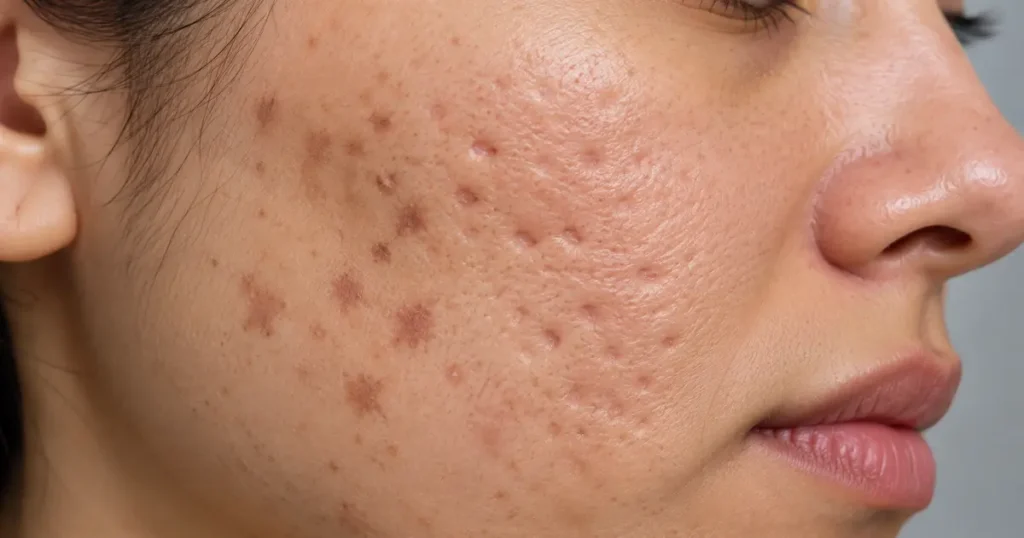
This distinction matters because many people call any discoloration left after acne a “scar.”
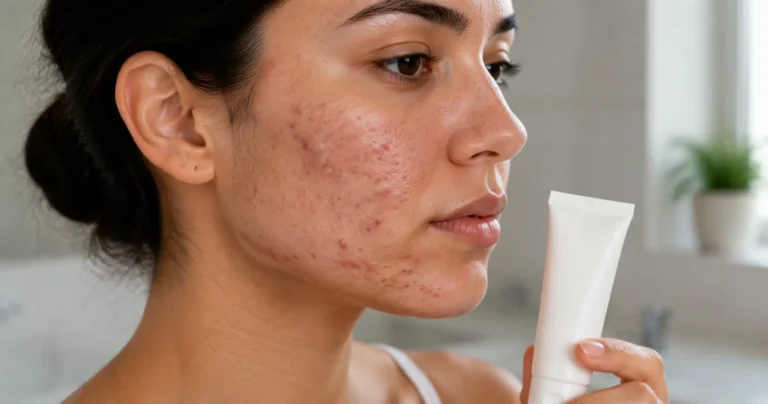
A true acne scar changes the structure of the skin. It may leave an indentation, a broader depression, uneven rolling texture, or a raised area.
A post-acne dark mark, on the other hand, may be post-inflammatory hyperpigmentation, or PIH. The skin is still flat, but excess pigment remains after inflammation. Retinoids can help with dark spots as well as acne and skin texture, according to the American Academy of Dermatology.
Post-Inflammatory Hyperpigmentation
PIH may look brown, tan, gray, or darker than the surrounding skin. It is especially common after inflamed acne and can be more persistent in deeper skin tones.
Because PIH is not a dent or loss of skin structure, topical treatment has more realistic potential to improve it than it does a deep pitted scar.
If flat discoloration is your main concern, see our guide to tretinoin for dark spots. It explains post-inflammatory pigmentation separately from true scarring.
Post-Acne Redness
Some flat acne marks are predominantly red or pink rather than brown. These are also different from indented scars.
Tretinoin may improve the overall condition of acne-prone skin, but persistent redness has different underlying biology from excess pigment. Do not assume that a treatment that helps brown PIH will work equally well for lingering red marks.
True Acne Scars
True scars involve changes in collagen and the structure of the skin.
The most common depressed or atrophic scars include:
- Ice-pick scars
- Boxcar scars
- Rolling scars
Raised scars involve excess scar tissue and need a different treatment strategy.
AAD guidance states that a topical retinoid can make mild acne scarring less noticeable, but more established depressed scars often need procedures or combined treatment.
| What you see | What it may represent | Realistic role for tretinoin |
|---|---|---|
| Flat brown, tan, or gray mark | Post-inflammatory hyperpigmentation | May gradually help pigmentation |
| Very mild shallow unevenness | Mild texture or scarring | May make it somewhat less noticeable |
| Deep narrow pit | Ice-pick scar | Limited topical improvement |
| Broad depressed area | Boxcar scar | Limited when moderate or deep |
| Wavy or tethered depression | Rolling scar | Usually needs more than topical treatment |
| Raised, firm scar | Hypertrophic or keloid-type scar | Different treatment approach needed |
This table cannot diagnose a scar type. Scar depth, shape, skin tone, active acne, and other factors can change which treatment is appropriate.
How Does Tretinoin Work on Acne Scars and Skin Texture?
Tretinoin is a topical prescription retinoid. Its established U.S. indication is acne vulgaris. Current labeling for Retin-A states that it is indicated for topical treatment of acne and that long-term safety and effectiveness for other disorders have not been established.
For acne, tretinoin affects follicular cell turnover and helps reduce formation of microcomedones—the early plugs that can become blackheads, whiteheads, and inflammatory lesions.
Retinoids can also influence epidermal renewal, fibroblast activity, pigmentation, and collagen remodeling. A 2026 review of topical retinoids concluded that the drug class has a role in acne treatment, scar prevention, and improvement of some atrophic scars, while also emphasizing that the evidence varies among individual retinoids, formulations, and studies.
That is important because a plausible collagen-remodeling mechanism does not mean a topical cream can rebuild every deep scar.
What Current Evidence Actually Supports
There are three levels of evidence to keep separate.
First, tretinoin has strong established evidence for acne treatment. That matters because fewer inflammatory breakouts can mean fewer opportunities for additional scars to form.
Second, dermatology guidance supports topical retinoids for mild scarring. AAD specifically says a retinoid or salicylic acid can make mild acne scarring less noticeable.
Third, modern retinoid scar research does not all involve tretinoin. For example, a randomized controlled trial found improvement in atrophic acne scars with trifarotene, another topical retinoid. That study cannot simply be converted into a tretinoin result.
This distinction matters when you see precise percentages online. A study involving trifarotene, adapalene, or another retinoid does not automatically prove that tretinoin produces the same percentage of improvement.
Does Tretinoin Work on Acne Scars That Are Pitted or Deep?
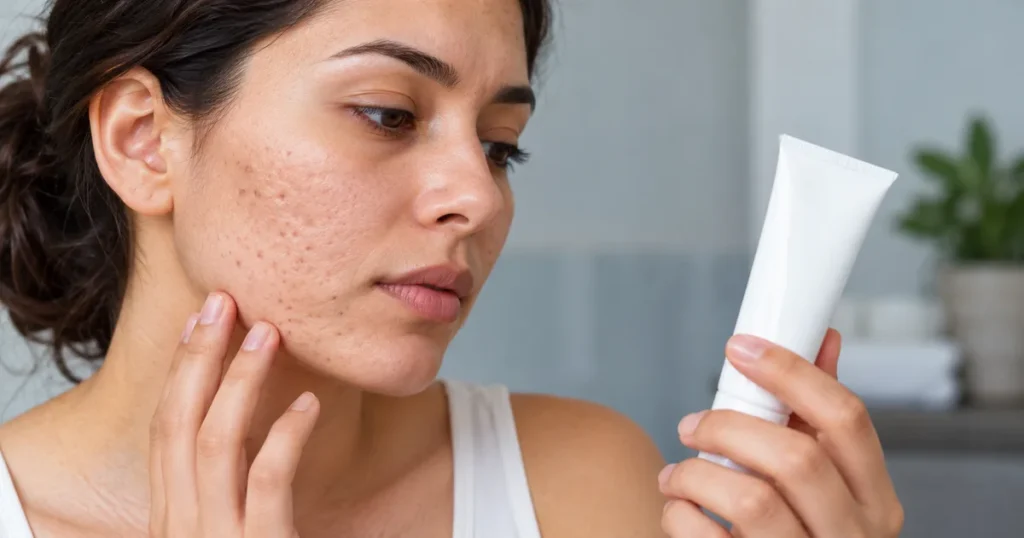
Tretinoin is unlikely to be enough by itself for deep structural acne scars.
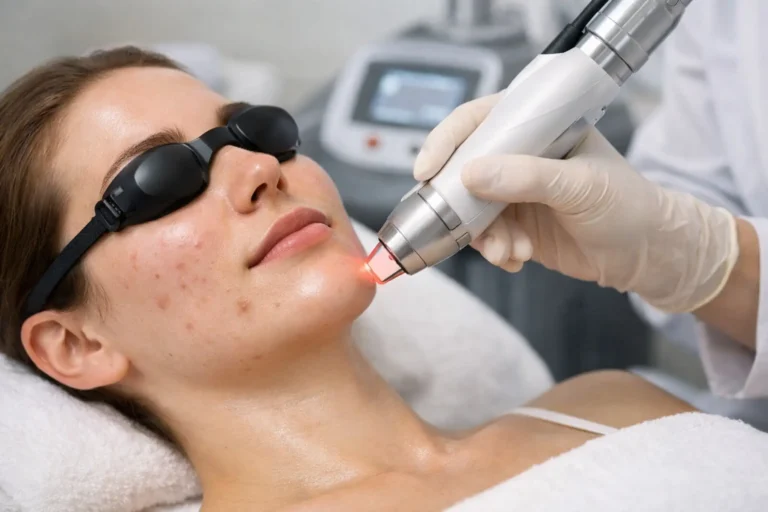
AAD guidance explains that treatment for depressed acne scars often involves procedures, scar surgery, medication applied to the skin, or a combination. The best approach depends on scar type and severity.
Ice-Pick Scars
Ice-pick scars are narrow but extend deeper into the skin.
Because the structural change reaches below the surface, improving cell turnover at the top of the skin cannot reliably reconstruct all of the missing tissue. A dermatologist may recommend a more targeted scar procedure when these scars are prominent.
Boxcar Scars
Boxcar scars are broader depressions with relatively defined edges.
Very shallow texture may look somewhat smoother as the surrounding skin improves, but deeper boxcar scars generally have more structural loss than a topical treatment can correct.
Rolling Scars
Rolling scars can create a wave-like surface because fibrous bands may tether the skin downward.
When tethering contributes to the depression, simply increasing surface turnover does not release those bands. Dermatologists may use approaches such as scar surgery or other procedures as part of an individualized treatment plan.
Raised Scars
Raised hypertrophic scars and keloids involve excess scar tissue rather than lost tissue.
AAD discusses treatments such as corticosteroid injections, lasers, and other scar-directed approaches for raised scars. A topical acne retinoid should not be presented as the standard solution for this scar type.
Where Tretinoin May Help Most
Tretinoin has the most practical value when the problem includes:
- Active acne that is still creating new marks or scars
- Flat post-inflammatory hyperpigmentation
- Mild surface unevenness
- Very shallow scarring
- A long-term dermatologist-directed acne plan
For someone with ongoing breakouts, acne control may actually be the most important scar-related benefit.
So, Does Tretinoin Work on Acne Scars when the scarring is mild? It may make shallow texture or mild scarring less noticeable over time, but expectations should remain much more conservative for deeper structural scars.
AAD recommends controlling active acne before focusing heavily on scar procedures because stopping new breakouts helps prevent additional scarring.
That means tretinoin does not need to erase an old ice-pick scar to be useful. Preventing repeated inflammatory lesions that might create new scars can have substantial long-term value.
Preventing New Acne Scars May Matter More Than Treating Old Ones
Scars are easier to prevent than to fully reverse after structural damage has occurred.
AAD notes that treating acne early can reduce the risk of scars, and severe inflammatory acne carries a particularly important scarring risk. Even mild acne can scar when lesions are repeatedly picked.
If you still have active breakouts, see our guide to how tretinoin treats active acne. Treating active acne and preventing additional inflammation should usually come before aggressively targeting old texture.
Other useful habits include:
- Avoid picking or squeezing pimples.
- Follow your prescribed acne treatment consistently.
- Use non-irritating skin care.
- Protect your skin from excessive sun exposure.
- Seek professional treatment for deep, painful, or repeatedly scarring acne.
Preventing five new scars can be more meaningful than trying to force a topical product to remove one deep old scar.
How Long Could Tretinoin Take to Improve Marks or Mild Scarring?
Tretinoin works gradually.
If you are still asking Does Tretinoin Work on Acne Scars after only a few weeks, it is generally too early to judge slow changes in pigmentation or mild texture. Acne control, pigment fading, and structural remodeling do not necessarily happen on the same timeline.
Current tretinoin labeling also warns that acne can temporarily appear worse during the early treatment period and that improvement develops with continued appropriate use.
For established scars, there is no responsible universal promise such as “your scars will improve in exactly 12 weeks.”
Results depend on:
- Whether the concern is pigment or structure
- Scar depth
- Scar type
- How long active acne continues
- Skin tolerance
- The tretinoin formulation prescribed
- Other treatments being used
Assess progress over months rather than checking individual scars every day.
Why More Tretinoin Is Not Better for Acne Scars
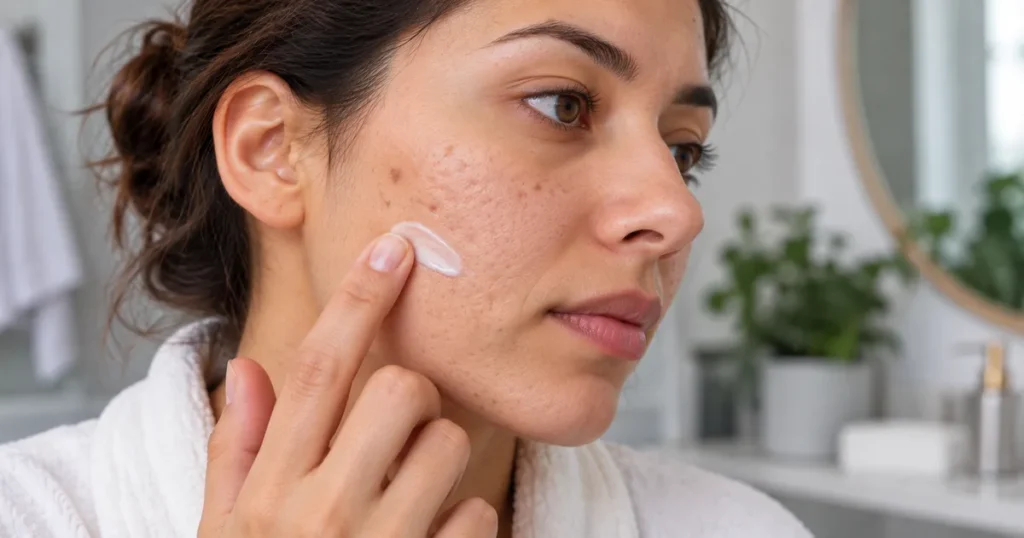
Increasing the amount, concentration, or frequency on your own does not guarantee faster scar improvement.
Current tretinoin labeling warns that topical use can cause substantial redness, peeling, and irritation. It also recommends minimizing excessive sunlight and using sun protection because treated skin may be more susceptible to sunburn.
Excessive irritation can leave skin looking redder, rougher, and more uneven—the opposite of what someone treating post-acne changes usually wants.
Do not independently increase a prescription strength because scars are slow to change. Follow the instructions for the actual tretinoin product and speak with the prescriber if the treatment is difficult to tolerate or results are not meeting expectations.
People who are pregnant, think they may be pregnant, are planning pregnancy, or are breastfeeding should also discuss tretinoin with their healthcare professional.
When Tretinoin Is Not Enough for Acne Scars
Deep or established scars often need a treatment selected for their shape and depth.
AAD lists several options that dermatologists may use for depressed scars, including:
- Microneedling
- Laser treatment
- Chemical peels
- Fillers
- Radiofrequency
- Scar surgery
- Combination treatment
A dermatologist may use more than one method because different scars on the same face can need different approaches.
For example, a person may have shallow boxcar scars that respond to resurfacing plus tethered rolling scars that require a different intervention. A single cream cannot account for all of those structural differences.
If you want to understand where topical care reaches its limit, see our guide to what acne-scar treatments can realistically do at home before deciding whether professional treatment is worth discussing.
Scar treatment should also account for skin tone. The risk of post-inflammatory pigment changes after some procedures can vary, so professional treatment selection matters.
Frequently Asked Questions
Can tretinoin completely remove acne scars?
Tretinoin should not be expected to completely erase established structural acne scars.
It may make mild scarring less noticeable and can help with acne, pigmentation, and general texture. Deep ice-pick, boxcar, rolling, or raised scars often require scar-specific procedures for more meaningful change.
Can old acne scars still improve with tretinoin?
The age of a scar is only one part of the picture.
Scar type and depth are usually more useful for setting expectations. A shallow irregularity may have more topical improvement potential than a deep tethered scar, even if both have existed for years.
A dermatologist can assess scar morphology and recommend whether topical treatment, a procedure, or a combination makes sense.
Is tretinoin better for acne scars or dark spots?
Expectations are generally more favorable for acne control and flat post-inflammatory pigmentation than for deep structural scarring.
AAD includes retinoids among ingredients that can help fade dark spots and notes that retinoids can make mild acne scars less noticeable. Deep scars, however, often require targeted procedures.
Can tretinoin make acne scars look worse at first?
Tretinoin can cause dryness, redness, peeling, irritation, and temporary early worsening of acne. These changes may temporarily make texture or discoloration look more noticeable, but that is different from tretinoin physically deepening an established scar.
Severe or persistent irritation should be discussed with the prescriber rather than treated as proof that the medication is “working.”
Should I use tretinoin or get microneedling for acne scars?
It is not always an either-or decision.
Tretinoin may be useful for controlling active acne, pigmentation, and mild texture, while microneedling is one dermatologist-used option for depressed scars. The right plan depends on scar type, active acne, skin characteristics, current medications, and treatment goals.
Conclusion
So, Does Tretinoin Work on Acne Scars? It can contribute to improvement when the main problems are post-acne pigmentation, ongoing acne, or relatively mild textural changes, but its limits become much more important with deep structural scars.
Flat pigmentation, active acne, and mild texture have more realistic potential for improvement with topical treatment. Deep pitted, tethered, or raised scars usually need a different strategy.
The strongest reason to use tretinoin remains its established role in acne treatment. For someone still breaking out, preventing future inflammation and additional scars may be just as important as trying to improve the scars already present.
If you have significant pitted scarring, raised scars, ongoing scar-forming acne, or uncertainty about what type of mark you have, a dermatologist can help match the treatment to the actual scar structure.
Medical disclaimer: This article is for educational purposes only. Tretinoin is a prescription medication in the United States. This information does not provide a diagnosis or individualized prescription and is not a substitute for care from a qualified healthcare professional.
References
- American Academy of Dermatology. Acne scars: Consultation and treatment
- American Academy of Dermatology. 7 reasons to treat acne early
- American Academy of Dermatology. How to fade dark spots in darker skin tones
- U.S. National Library of Medicine, DailyMed. Retin-A (tretinoin) cream and gel — prescribing information
- U.S. National Library of Medicine, DailyMed. Tretinoin cream — current drug information
- Tobiasz A, Jankowska-Konsur A, Nowicka D. Topical Retinoids in Acne Vulgaris and Acne Scars—From Monotherapy to Combining Regimens. Pharmaceuticals. 2026.
- Schleicher SM, et al. Trifarotene Reduces Risk for Atrophic Acne Scars: Results from a Phase 4 Controlled Study.