Baby Acne Breast Milk: Does It Help and Is It Safe?
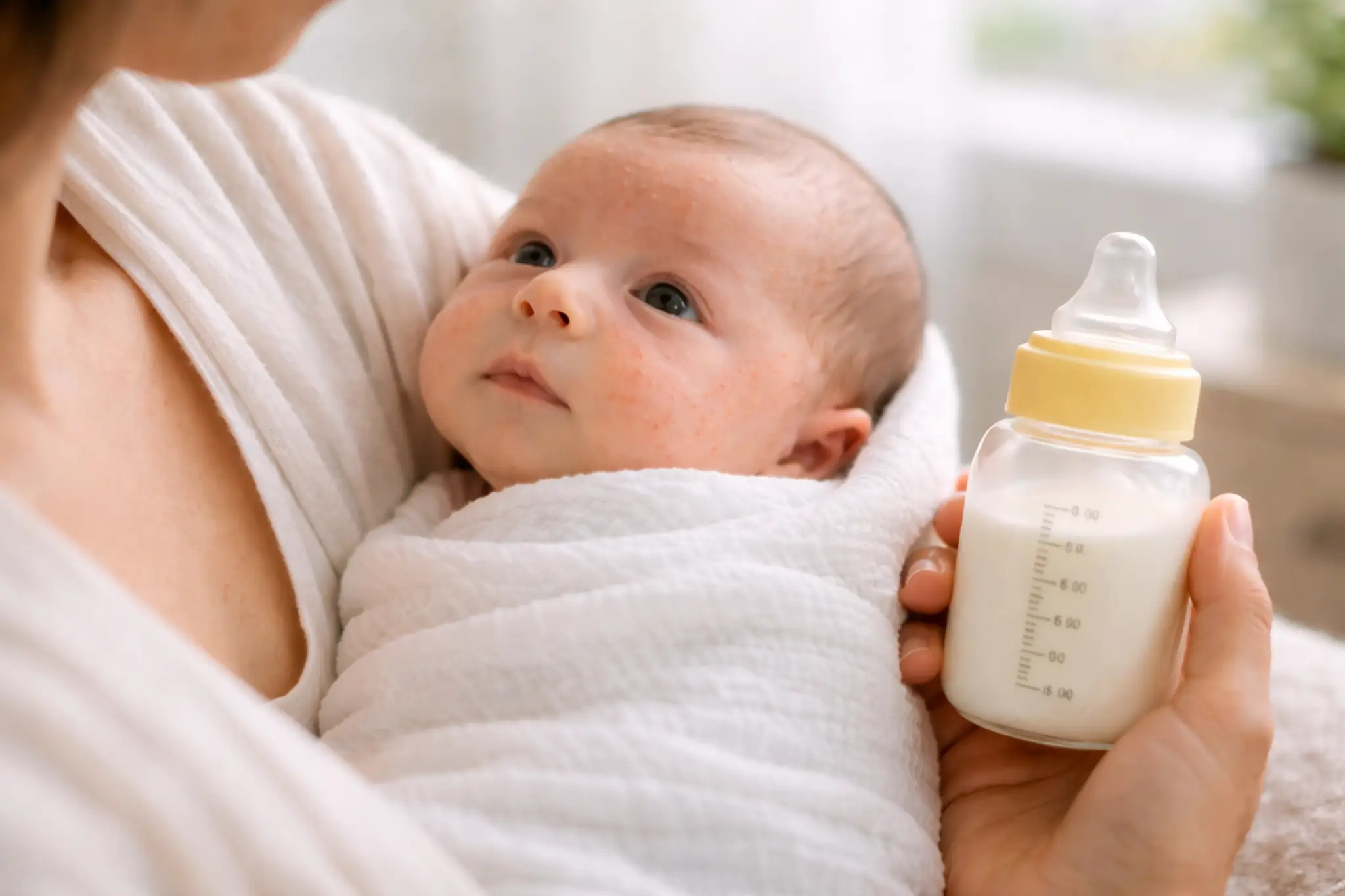
Seeing pimples on a newborn’s cheeks can make a simple home remedy sound appealing. Baby Acne Breast Milk is a common search because parents often hear that dabbing a little breast milk on the rash may help. Human milk contains biologically active components, but that alone does not make it a proven acne treatment.
Quick answer: There is no strong clinical evidence showing that topical breast milk reliably clears baby acne. The American Academy of Pediatrics’ HealthyChildren.org says a few drops may help, while other medical sources emphasize that typical newborn acne usually clears on its own. Gentle cleansing and avoiding unnecessary products remain the more established approach.
Table of Contents
Baby Acne Breast Milk: Does It Actually Help?
The evidence is limited. HealthyChildren.org says that drops of breast milk applied to the rash may help, but it does not cite a clinical trial demonstrating that breast milk reliably treats neonatal acne.
At the same time, Cleveland Clinic describes baby acne as a temporary condition that usually disappears without medical treatment. This makes anecdotal results difficult to interpret.
If a parent starts applying breast milk and the bumps improve a few days later, the improvement may have happened naturally. Baby acne often fades over time without an active treatment.
The most accurate conclusion is therefore not that breast milk definitely works or that it can never help. The better conclusion is that direct evidence is insufficient, while spontaneous improvement and gentle skin care are much better established.
Why the Idea Sounds Plausible
Human breast milk contains antibodies, antimicrobial proteins such as lactoferrin, fats, and other biologically active components.
Those properties have made topical human milk interesting to researchers studying some infant skin conditions. But biological plausibility is only the beginning of the evidence question.
A substance can have antimicrobial or anti-inflammatory properties without being proven to treat every skin condition. Newborn acne, diaper dermatitis, eczema, and an infected rash have different causes and should not be treated as if they are interchangeable.
Baby Acne Breast Milk: What Does the Research Really Show?
Research exists on topical human milk, but most available clinical studies have examined conditions other than neonatal acne.
That distinction is important.
| Evidence | What it tells us | What it does not prove |
|---|---|---|
| HealthyChildren.org says breast milk may help | Some pediatric guidance considers it a possible low-intensity option | That it reliably clears baby acne |
| Randomized diaper-rash studies | Human milk has been tested topically on infant skin | That acne responds in the same way |
| Eczema research | Human milk has been studied for another inflammatory skin condition | That it treats neonatal acne |
| Baby acne often resolves naturally | Improvement with time is expected | That improvement after milk application was caused by the milk |
Diaper-Rash Studies Are Not Baby-Acne Studies
A randomized clinical trial published in 2013 compared topical human breast milk with 1% hydrocortisone for acute diaper dermatitis. Both groups improved, with no significant difference in total rash scores on days three and seven.
A 2026 randomized trial examined breast milk combined with zinc oxide compared with zinc oxide alone for diaper dermatitis. The study reported faster lesion resolution in the combination group, while the researchers also called for larger trials.
These findings are interesting, but neither trial studied neonatal acne.
Diaper dermatitis occurs in a different body area, under different environmental conditions, and through different mechanisms. It would therefore be misleading to use diaper-rash research as proof that breast milk clears facial pimples in a newborn.
What Eczema Research Tells Us
Research in eczema also shows why condition-specific evidence matters.
A small randomized controlled pilot study compared fresh human milk with an emollient on atopic eczema spots in young children and did not demonstrate a clear treatment effect from human milk.
That does not prove breast milk has no potential skin benefits. It simply shows that biologically interesting substances still need to be tested for the specific condition being discussed.
Baby Acne Breast Milk: Is It Safe to Put on a Newborn’s Face?
Breast milk naturally comes into contact with a baby’s lips, chin, and cheeks during feeding. That does not mean repeated topical application is necessary to treat facial bumps.
The bigger safety concern is making sure a home remedy does not irritate delicate skin or delay evaluation of a rash that is not actually baby acne.
Cleveland Clinic recommends gently washing baby acne with warm water, avoiding scrubbing, and cleaning food, milk, drool, or vomit residue from the skin when necessary.
Avoid experimenting on areas that are:
- Open or bleeding
- Crusted
- Oozing
- Markedly swollen
- Blistered
- Very tender
- Showing signs of possible infection
Those findings deserve professional advice rather than repeated home treatment.
What About Milk Left on the Skin After Feeding?
Milk, drool, and spit-up commonly touch a newborn’s face.
If residue remains around the mouth, cheeks, or chin, clean it gently with lukewarm water and a soft cloth when needed. Pat rather than scrub the skin.
Routine feeding contact is different from repeatedly coating the face with milk as a treatment.
Why Baby Acne Often Improves Without Breast Milk
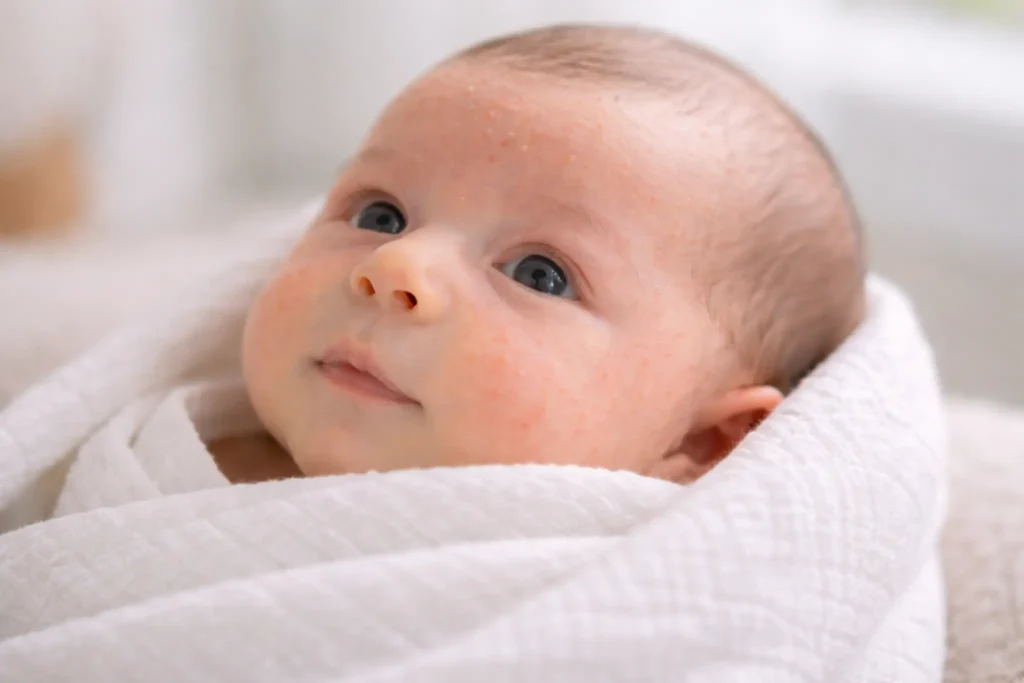
One of the biggest reasons home remedies can appear successful is that baby acne usually improves naturally.
Cleveland Clinic describes the condition as temporary and says it often clears without treatment. HealthyChildren.org similarly explains that the typical newborn pimply rash generally disappears on its own.
This creates what researchers call a causation problem.
Imagine a baby’s acne would naturally begin improving on Friday. If a parent starts applying breast milk on Wednesday, the timing may make it look as though the remedy caused the improvement.
That experience may feel convincing, but it does not tell us what would have happened without the treatment.
Controlled studies are needed to separate natural improvement from a genuine treatment effect.
What to Do Instead of Relying on Breast Milk for Baby Acne
Most mild newborn acne does not require an elaborate skin-care routine.
If you want a complete overview rather than an evidence review of one home remedy, our guide to safe baby acne treatments covers gentle cleansing, what to avoid, common look-alike rashes, and when to contact a pediatrician.
Clean the Skin Gently
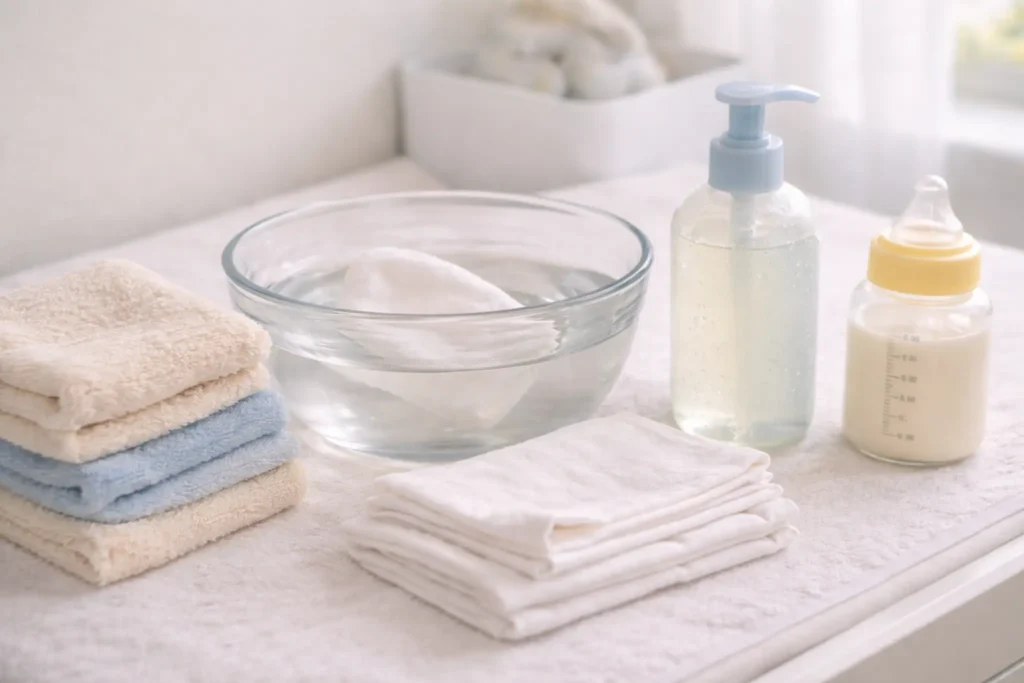
Use lukewarm water and, when necessary, a mild baby cleanser.
Avoid:
- Rough washcloths
- Cleansing brushes
- Scrubs
- Frequent washing
- Harsh soaps
- Repeated rubbing
HealthyChildren.org recommends gentle face washing for the typical newborn pimply rash.
Pat the skin dry instead of rubbing it.
Do Not Squeeze the Bumps
Do not pop, scratch, or squeeze acne-like bumps on a newborn’s face.
Picking can irritate the skin and may make the area look more inflamed.
Avoid Adult Acne Treatments
Do not use adult acne products on a newborn unless a qualified healthcare professional specifically recommends them.
That includes:
- Benzoyl peroxide
- Salicylic acid
- Adapalene
- Tretinoin
- Strong exfoliating acids
- Acne patches
- Chemical peels
Newborn facial eruptions are not simply adult acne occurring on smaller skin.
Skip Aggressive Home Remedies
Avoid lemon juice, vinegar, toothpaste, essential oils, harsh herbal mixtures, and abrasive treatments.
“Natural” does not automatically mean suitable for newborn skin.
The same standard should apply when considering breast milk for baby acne: popularity and natural origin are not substitutes for condition-specific evidence.
Give Typical Baby Acne Time
If the baby otherwise seems healthy and the eruption resembles uncomplicated newborn acne, observation and gentle care may be enough.
If the rash becomes more inflamed, spreads, develops unusual features, or fails to settle, ask a healthcare professional to look at it rather than trying several new remedies.
Could It Be Something Other Than Baby Acne?
Not every group of facial bumps in a newborn is acne.
That is another reason to be cautious about treating based only on appearance.
Neonatal Cephalic Pustulosis
DermNet describes neonatal cephalic pustulosis as an eruption of small papules and pustules on the face or scalp, commonly appearing during the first few weeks of life.
Unlike classic acne, it generally lacks comedones such as blackheads and whiteheads.
It often resolves without treatment.
Milia
Tiny white facial bumps can be milia rather than acne.
Milia are small keratin-filled cysts and usually disappear without acne treatment.
Eczema or Irritation
Eczema and irritant rashes may look drier, rougher, more scaly, or more diffusely red than typical baby acne.
Drool, spit-up, cleansing products, wipes, and repeated moisture around the mouth can also irritate delicate skin.
Infantile Acne
Age matters.
DermNet distinguishes neonatal acne from infantile acne. Infantile acne generally appears later and can include blackheads, whiteheads, inflamed papules, pustules, nodules, or cysts.
More severe infantile acne can occasionally scar and may require medical treatment.
When to Ask a Pediatrician About Baby Acne
Typical mild newborn acne often improves with time, but not every facial rash should simply be watched indefinitely.
Ask a pediatrician or another qualified healthcare professional when:
- The rash keeps getting worse.
- The diagnosis is uncertain.
- Bumps spread widely.
- Skin becomes crusted or starts oozing.
- Blisters appear.
- There is significant swelling.
- The area appears unusually painful or tender.
- The baby has a fever.
- Feeding becomes difficult.
- The baby seems unusually unwell or irritable.
- Deep nodules or cysts develop.
- Scarring starts to appear.
Cleveland Clinic recommends professional evaluation when baby acne does not clear as expected or when additional concerning symptoms appear.
A home remedy should never delay appropriate medical evaluation.
Frequently Asked Questions
Can breast milk clear baby pimples overnight?
There is no evidence showing that breast milk reliably clears neonatal acne overnight.
Baby acne normally improves gradually, so promises of overnight results are not realistic.
How often should I put breast milk on baby acne?
There is no clinically established application frequency because Baby Acne Breast Milk is not an approved or evidence-based neonatal acne treatment.
HealthyChildren.org says drops of breast milk may help, but it does not provide a validated dose, schedule, or treatment duration.
If you are considering repeated application, asking your pediatrician is more reliable than following an arbitrary online schedule.
Can breast milk make baby acne worse?
Direct research answering this question is limited.
Breast milk is not generally considered a harsh substance, but repeatedly leaving moisture or residue on already irritated facial skin may not provide any benefit.
If the rash becomes redder, crusted, swollen, wet, or noticeably more irritated after anything is applied, stop experimenting and seek medical advice.
Is breast milk better than washing baby acne with water?
There are no good comparative trials showing that breast milk is more effective than gentle cleansing for neonatal acne.
Mainstream medical guidance supports gentle washing and allowing typical baby acne time to resolve naturally.
Does breastfeeding cause baby acne?
There is no reason to stop breastfeeding because a newborn develops typical baby acne.
Baby acne is a temporary skin condition and normally does not require changing how the baby is fed.
If you have concerns about feeding or a facial rash, discuss them with your baby’s healthcare professional.
Conclusion
The evidence behind Baby Acne Breast Milk is much weaker than the popularity of the remedy may suggest.
Some pediatric guidance says breast milk may help, but there are no strong clinical trials showing that topical human milk reliably clears neonatal acne. Research involving diaper dermatitis or eczema should not be presented as if it directly proves an acne benefit.
For typical mild baby acne, gentle cleansing, minimal products, and patience remain better established. If the rash is persistent, worsening, unusual, or accompanied by other symptoms, ask a pediatrician to confirm what you are actually treating before trying more remedies.
Medical disclaimer: This article is for educational purposes only. It cannot diagnose a newborn rash or replace individualized advice and care from a qualified pediatric healthcare professional.
References:
- American Academy of Pediatrics / HealthyChildren.org — Your Baby’s First Month: Growth & Physical Appearance.
https://www.healthychildren.org/English/ages-stages/baby/Pages/First-Month-Physical-Appearance-and-Growth.aspx - Cleveland Clinic — Baby Acne: Causes & Treatments.
https://my.clevelandclinic.org/health/diseases/17822-baby-acne - DermNet — Acne in Children.
https://dermnetnz.org/topics/acne-in-children - DermNet — Neonatal Cephalic Pustulosis.
https://dermnetnz.org/topics/neonatal-cephalic-pustulosis - Aghaei et al. — Topical Breast Milk plus Zinc Oxide Versus Zinc Oxide Alone for Diaper Rash in Infants Under 1 Year: A Randomized Clinical Trial. PubMed.
https://pubmed.ncbi.nlm.nih.gov/41204732/ - Ahmadzadeh et al. — Comparison of the Effect of Human Milk and Topical Hydrocortisone 1% on Diaper Dermatitis. PubMed.
https://pubmed.ncbi.nlm.nih.gov/23600719/ - Berents et al. — Topical Treatment With Fresh Human Milk Versus Emollient on Atopic Eczema Spots in Young Children. PubMed.
https://pubmed.ncbi.nlm.nih.gov/25935520/