Acne Skin Care Products: What You Actually Need in a Routine
Shopping for acne skin care products can make a simple problem look like a 10-step project. Cleansers, toners, pads, serums, spot gels, masks, moisturizers, and sunscreens can all be labeled for acne-prone skin, but that does not mean you need all of them.
For most people building an over-the-counter routine, the useful framework is simpler: cleanse gently, choose one main acne treatment that matches the type of breakouts you have, moisturize enough to keep the routine tolerable, and use broad-spectrum SPF 30 or higher during the day. Extra products should earn their place by doing a job those steps do not already cover.
Table of Contents
Acne Skin Care Products: The Four Jobs Your Routine Needs to Cover
The easiest way to compare acne skin care products is by function rather than brand. A routine usually needs four jobs covered:
| Routine job | Product category | Main purpose |
|---|---|---|
| Cleanse | Gentle or medicated cleanser | Remove sweat, oil, makeup, sunscreen, and debris |
| Treat | One main acne active | Target clogged pores and/or inflammatory acne |
| Moisturize | Non-comedogenic moisturizer | Reduce dryness and improve treatment tolerance |
| Protect | Broad-spectrum SPF 30+ sunscreen | Protect skin from UV exposure and help limit worsening of post-acne discoloration |
Not every step needs an acne active. A moisturizer and sunscreen may support an acne routine without directly treating pimples. That distinction matters because stacking actives in every step can increase dryness, burning, peeling, and the temptation to abandon the routine.
If you are deciding between individual products and a boxed regimen, our guide to whether a complete acne kit is actually worth buying explains what to look for before paying for a multi-step system.
Start With Your Breakout Type Before You Shop
Before choosing a treatment product, look at the type of breakouts you are trying to manage.
Mostly blackheads and whiteheads: Salicylic acid is often a practical OTC option because it helps unclog pores. Adapalene can also be useful for comedonal acne.
Mostly red, inflamed pimples: Benzoyl peroxide is commonly used because it reduces acne-associated bacteria and helps inflammatory lesions.
A mix of clogged pores and recurring pimples: A topical retinoid such as adapalene may make sense because it helps prevent clogged pores and reduce inflammation. Some people eventually use more than one treatment mechanism, but adding everything at once makes it harder to judge both benefit and irritation.
Acne plus lingering dark marks: Azelaic acid can be relevant because it is used for acne and can also help with post-inflammatory discoloration.
The American Academy of Dermatology’s current acne guideline recommends or supports several topical approaches, including benzoyl peroxide, topical retinoids, salicylic acid, and azelaic acid. Which one belongs in your routine depends on the acne pattern, skin sensitivity, and what else you already use.
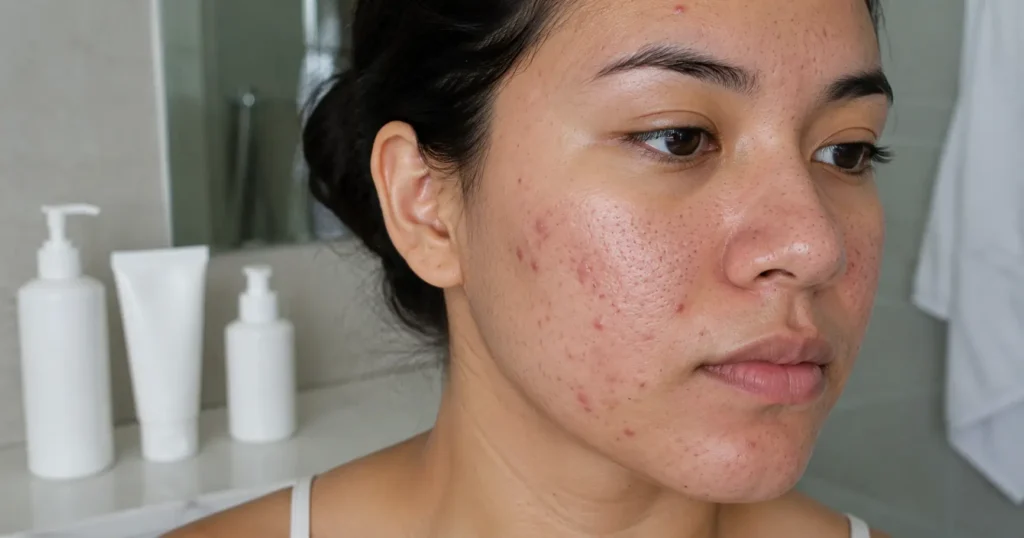
Acne Skin Care Products for Blackheads, Whiteheads, and Oily Congestion
When clogged pores, blackheads, whiteheads, and oily congestion are the main issue, salicylic acid is one of the most useful acne skin care products to consider. It exfoliates inside the follicle and helps loosen the material involved in clogged pores.
A salicylic acid cleanser gives you short contact and can be an easier starting point if you want treatment built into the cleansing step. A leave-on product stays on the skin longer, which may be useful for persistent congestion but can also increase irritation.
The key is not to duplicate the same job across your entire routine. If your cleanser already contains salicylic acid, you do not automatically need a salicylic toner, salicylic pads, and a salicylic serum too.
For a deeper comparison of rinse-off and leave-on formats, read how salicylic acid works for clogged pores.
If clogged pores and oiliness are your main problem, a salicylic-acid cleanser can combine cleansing and one acne-treatment step without automatically adding a separate toner.
Affiliate disclosure: This article may contain affiliate links. Beyond Breakouts may earn a commission from qualifying purchases at no additional cost to you. As an Amazon Associate, we earn from qualifying purchases.
Want One Cleanser That Also Targets Clogged Pores? 🫧
CeraVe Acne Control Cleanser contains 2% salicylic acid and is formulated for oily, acne-prone skin. CeraVe also lists niacinamide, three ceramides, and oil-absorbing clay in the current U.S. formula. The product is labeled non-comedogenic and free of added fragrance.
✅ 2% salicylic acid acne treatment
✅ Non-comedogenic and free of added fragrance
✅ Ceramides and niacinamide included in the formula
Because salicylic acid can dry or irritate skin, be cautious about pairing it with several other exfoliating or drying products at the same time.
👉 Check CeraVe Acne Control Cleanser on Amazon
Acne Skin Care Products for Red, Inflamed Pimples
For red papules and pustules, benzoyl peroxide is one of the better-supported acne skin care products. It reduces acne-associated bacteria and is strongly recommended in current AAD acne guidance.
Benzoyl peroxide comes in washes and leave-on gels or creams. A wash may be easier for people who want shorter skin contact, while a leave-on product provides longer exposure. Either format can cause dryness, peeling, burning, or irritation, and benzoyl peroxide can bleach towels, pillowcases, clothing, and hair.
Higher strength is not automatically the best starting point. AAD consumer guidance notes that 2.5% benzoyl peroxide can be a reasonable place to start for mild pimples because stronger products may increase irritation.
If you want to compare cleansers, gels, and strengths before buying, see our guide to benzoyl peroxide product formats and strengths.
A useful rule is to avoid buying a benzoyl peroxide wash, benzoyl peroxide spot gel, and another benzoyl peroxide treatment simply because they all promise clearer skin. Choose the format that fills the treatment role with the least unnecessary duplication.
In March 2025, the FDA reported results from testing 95 benzoyl peroxide acne products for benzene. More than 90% had undetectable or extremely low levels, while a limited number were recalled at the retail level. That is a reason to follow current recall information and storage directions, not a reason to assume all benzoyl peroxide products are unsafe.
Where Adapalene Fits in an Acne Routine
Adapalene is an over-the-counter topical retinoid in the United States and is one of the evidence-supported treatments for acne. Retinoids help unclog pores, reduce inflammation, and prevent new comedones from forming.
Unlike a random spot treatment applied only after a pimple appears, adapalene is generally used across acne-prone areas according to its label or clinician guidance. It can cause dryness, peeling, and irritation, especially when first introduced.
This is one reason to keep the rest of the routine simple. If you are using adapalene, an exfoliating toner, a strong salicylic acid cleanser, an AHA serum, and a benzoyl peroxide spot product may be more irritation than your skin needs.
Pregnancy changes the decision around retinoids. If you are pregnant, trying to become pregnant, or unsure whether a medication is appropriate, ask a qualified healthcare professional rather than starting or changing a retinoid routine on your own.
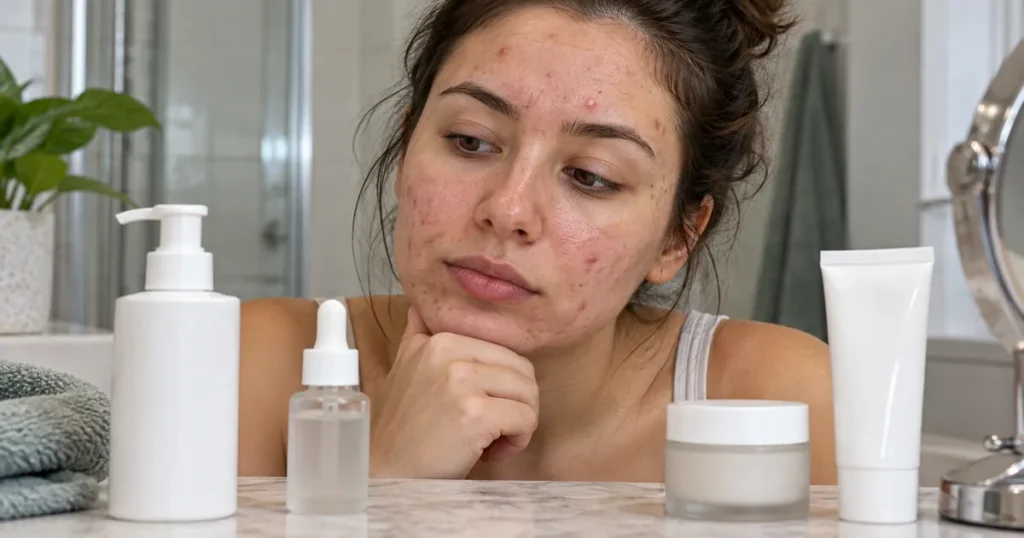
Acne Skin Care Products That Support Treatment: Moisturizer and Sunscreen
Some of the most useful acne skin care products do not directly kill bacteria or unclog pores. Their job is to make the treatment step easier to tolerate and to protect the skin.
Moisturizer Is Not the Enemy of Acne-Prone Skin
Benzoyl peroxide, salicylic acid, adapalene, tretinoin, and other acne treatments can dry or irritate skin. The AAD specifically notes that moisturizer can help people tolerate these treatments and recommends looking for labels such as oil-free, non-comedogenic, or won’t clog pores.
Choose texture according to your skin rather than assuming oily skin must skip moisturizer. A lightweight lotion may suit oily or combination skin, while drier skin may prefer something richer. Useful moisturizing ingredients can include glycerin, hyaluronic acid, ceramides, and squalane.
A non-comedogenic moisturizer can make an acne routine easier to tolerate, especially when treatment leaves the skin dry or irritated.
Need Hydration Without Adding Another Acne Active? 💧
Vanicream Daily Facial Moisturizer is a lightweight, non-greasy moisturizer formulated with squalane, glycerin, hyaluronic acid, and five ceramides. Vanicream currently describes it as non-comedogenic and suitable for sensitive skin.
✅ Non-comedogenic and non-greasy
✅ Five ceramides plus hyaluronic acid
✅ No botanical extracts or essential oils
It does not treat acne directly. Its role is hydration and support, which can be useful when your actual acne treatment is drying or irritating.
👉 Check Vanicream Daily Facial Moisturizer on Amazon
Sunscreen Is Part of Acne Care, Not an Optional Extra
AAD recommends broad-spectrum, water-resistant sunscreen with SPF 30 or higher and suggests choosing a product labeled non-comedogenic or won’t clog pores. Some acne medications can also make skin more sensitive to ultraviolet exposure.
A sunscreen does not need an acne active. Its job is protection. That matters even more if your breakouts leave red or brown marks, because ultraviolet exposure can make post-inflammatory discoloration harder to manage.
Texture is personal. Some acne-prone skin prefers fluid or gel sunscreens, while dry skin may tolerate a cream better. The most useful sunscreen is one you can apply in an adequate amount and use consistently.
Acne Skin Care Products You Probably Do Not Need by Default
The most expensive part of buying acne skin care products is often the group of optional products that get treated like mandatory steps.
You do not automatically need:
- An acne toner
- An astringent
- A physical scrub
- A cleansing brush
- Multiple exfoliating serums
- Several spot treatments
- A clay mask every few days
- Salicylic acid in the cleanser, toner, pads, and serum at the same time
AAD skincare guidance specifically recommends gentle products and warns that astringents, some toners, exfoliants, over-washing, and scrubbing can irritate acne-prone skin.
Toner is a good example. A hydrating toner may be pleasant, but it is not a medically required step in a basic acne routine. An exfoliating toner may add a useful treatment mechanism in some routines, but if your cleanser or leave-on treatment already supplies that same active, the toner can become redundant.
Do not judge a routine by how many bottles are on the shelf. Judge it by whether each product has a distinct job.
How to Build a Simple Morning and Night Routine
A practical routine using acne skin care products should be simple enough that you can follow it consistently.
Example A: Mainly Blackheads, Whiteheads, and Congestion
Morning
- Gentle cleanser or a tolerated salicylic acid cleanser.
- Moisturizer if needed.
- Broad-spectrum SPF 30+ sunscreen.
Evening
- Gentle cleanser.
- One chosen treatment if you are not already relying on a medicated wash as your main active.
- Moisturizer.
Example B: Mainly Red, Inflamed Pimples
Morning
- Gentle cleanser.
- Moisturizer if needed.
- Broad-spectrum SPF 30+ sunscreen.
Evening
- Benzoyl peroxide wash or another appropriately chosen benzoyl peroxide treatment.
- Moisturizer.
These examples are frameworks, not personalized prescriptions. If you use a prescription treatment, follow the prescriber’s directions before adding OTC actives around it.
Do not add a second or third treatment because the first has not worked in four days. AAD advises giving acne products time to work and notes that trying too many products can stress and irritate skin.
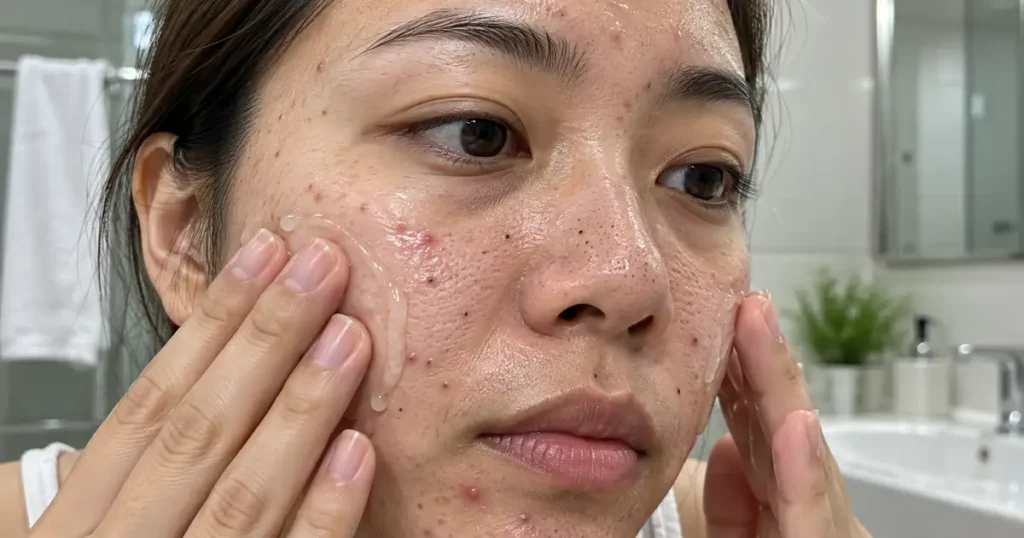
How to Choose Acne Skin Care Products Without Falling for Marketing
When comparing acne skin care products, ignore the size of the front-label promise for a moment and inspect what the product actually does.
Use this checklist:
- What job does it perform? Cleanse, treat, moisturize, or protect?
- Is it a cosmetic or an OTC acne drug? A Drug Facts panel tells you when a U.S. product is being sold as an OTC acne medication.
- What is the active ingredient? Salicylic acid, benzoyl peroxide, adapalene, or something else?
- Does the active fit your breakout pattern?
- Are you already using the same active in another product?
- Does the label say non-comedogenic, oil-free, or won’t clog pores?
- Is fragrance relevant to your own sensitivity?
- Does it combine several exfoliating or drying actives?
- Can you realistically use it consistently?
- Can you verify the current formula and directions from the manufacturer or package?
If you want another layer of screening, you can screen a product’s ingredient list. Treat a pore-clogging checker as a screening tool, not a guarantee: a flagged ingredient does not prove the finished formula will break you out, and an unflagged list cannot promise that it will not.
The same caution applies to “non-comedogenic.” It is useful labeling, but individual skin response still varies.
When Acne Skin Care Products Are Not Enough
Over-the-counter acne skin care products are most appropriate for mild acne that you can identify and manage safely at home. They have limits.
See a dermatologist or another qualified healthcare professional if acne is:
- Deep or nodular
- Painful
- Rapidly worsening
- Leaving scars
- Widespread
- Causing significant distress
- Not improving with appropriate OTC care
- Difficult to distinguish from another skin condition
AAD guidance specifically notes that deep, painful nodules and cysts often need dermatologist treatment and can leave permanent scars.
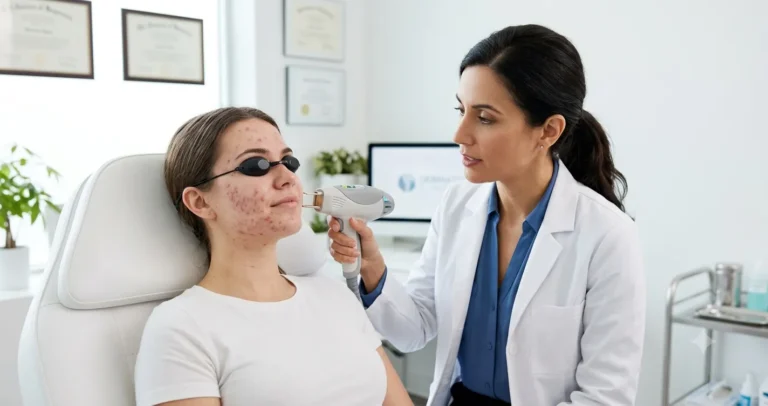
Professional care does not simply mean “stronger skincare.” A clinician can confirm whether the problem is acne, assess severity, review medications and health factors, and recommend treatments that are not available in the skincare aisle.
Frequently Asked Questions
Which acne skin care products should I buy first?
Start with four roles rather than an entire branded line: a gentle cleanser, one acne treatment that fits your main breakout type, a moisturizer if your skin becomes dry or irritated, and broad-spectrum SPF 30+ sunscreen during the day. Add another product only when it performs a different, useful job.
Is salicylic acid or benzoyl peroxide better for acne?
Neither is universally better. Salicylic acid is particularly useful for clogged pores, blackheads, and whiteheads, while benzoyl peroxide is a strong option for red inflammatory pimples. Mixed acne may eventually need more than one treatment mechanism, but introduce products carefully instead of starting several new actives together.
Do I need an acne toner?
Usually not as a default step. Toner can be optional. If it contains an exfoliating active already present in your cleanser or treatment, it may simply duplicate exposure and increase irritation. A gentle cleanser, appropriate treatment, moisturizer, and sunscreen cover the main jobs in a basic routine.
Can moisturizer make acne worse?
Some products can contribute to breakouts in some people, but acne-prone skin does not need to avoid moisturizer altogether. Look for non-comedogenic, oil-free, or won’t-clog-pores labeling when useful, and choose a texture your skin tolerates. Moisturizer can be especially helpful when acne medication causes dryness.
How long should I try an acne routine before buying something new?
Do not judge a routine after only a few days unless you are having a concerning reaction. AAD recommends giving an acne treatment about six to eight weeks to show some improvement and cautions that constantly switching products can irritate the skin. If acne is painful, scarring, severe, or not responding appropriately, get professional advice instead of simply buying stronger products.
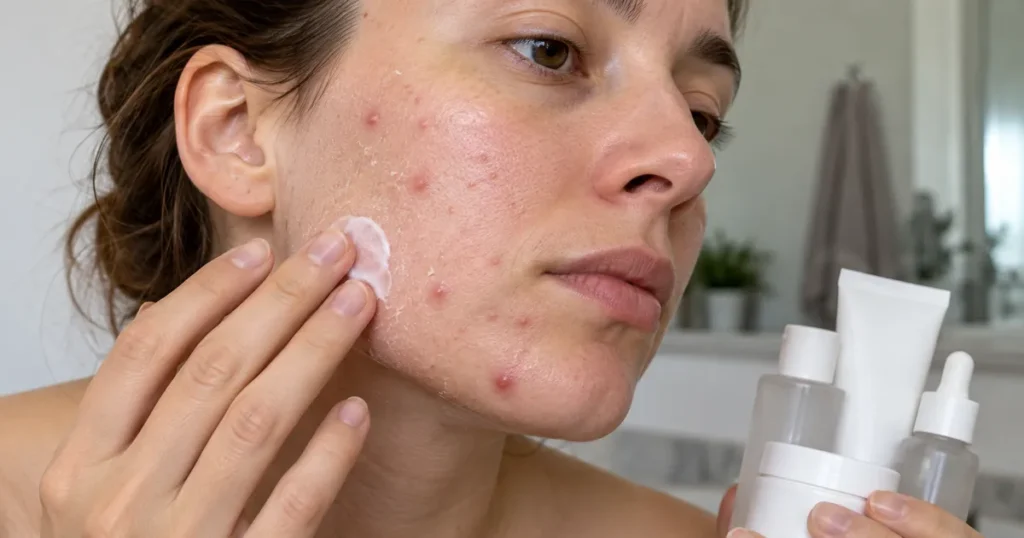
Conclusion
The best acne skin care products are not automatically the products with the strongest percentages, biggest promises, or most steps.
Build the routine by job:
Cleanse → Treat → Moisturize → Protect
Choose the treatment according to the kind of acne you are trying to manage, then keep the rest of the routine supportive enough that you can use that treatment consistently. If you cannot explain what a new bottle adds that your existing routine does not already do, you may not need it.
If your acne is deep, painful, scar-forming, difficult to identify, or not improving with appropriate OTC care, move beyond product shopping and get a professional assessment.
This article is for educational purposes only and is not a diagnosis or a substitute for care from a qualified healthcare professional.
References:
- American Academy of Dermatology — Acne Clinical Guideline
- American Academy of Dermatology — Adult Acne Treatment Dermatologists Recommend
- American Academy of Dermatology — Acne: Tips for Managing
- American Academy of Dermatology — Moisturizer: Why You May Need It If You Have Acne
- American Academy of Dermatology — How to Treat Different Types of Acne
- U.S. Food and Drug Administration — Limited Voluntary Recalls After Benzoyl Peroxide Product Testing
- CeraVe — Acne Control Cleanser
- Vanicream — Daily Facial Moisturizer