Laser Scar Removal Near Me: What to Know Before Booking
Searching for laser scar removal near me usually means you are getting close to booking a consultation or procedure. You may already be comparing clinics, CO2 laser, fractional resurfacing, treatment packages, downtime, and prices.
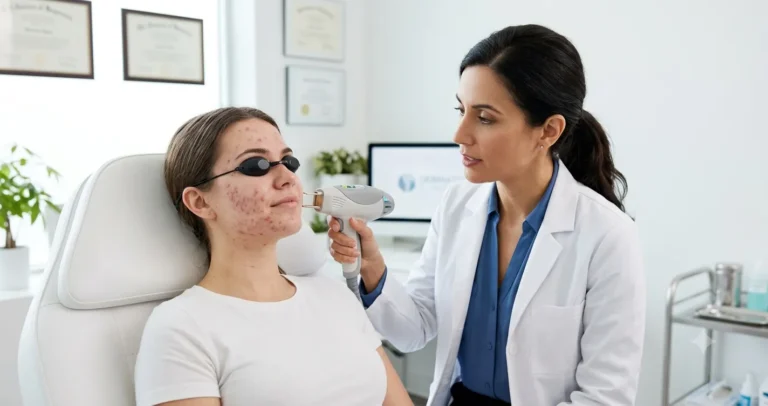
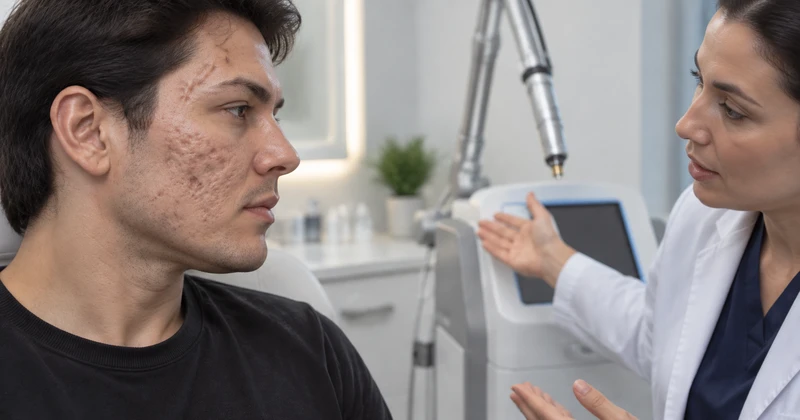
But “laser scar removal” is not one standardized procedure, and laser treatment does not guarantee that a scar will disappear. Different lasers work at different depths and intensities, and the right choice depends on the scar pattern, skin tone, medical history, active acne, treatment goals, and provider experience. The American Academy of Dermatology (AAD) specifically recommends a medical consultation before laser scar treatment.
Before paying for the closest laser package, understand exactly what is being offered—and why.
Table of Contents
Laser Scar Removal Near Me: What Should You Check First?
Before booking laser scar treatment, ask what exact laser is being proposed, whether it is ablative or non-ablative, whether treatment is fractional, why it fits your scar pattern, who performs it, what experience that person has with your skin tone, what risks and downtime apply, and whether another scar procedure may also be needed.
AAD emphasizes that laser results depend substantially on the skill of the person performing the procedure.
Is Laser Actually Appropriate for Your Scar?
Laser can be useful for certain scars, but the word “scar” covers several different problems.
Depressed acne scars
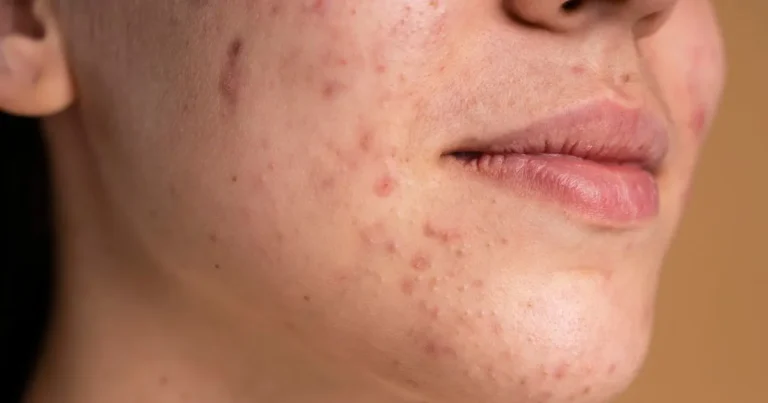
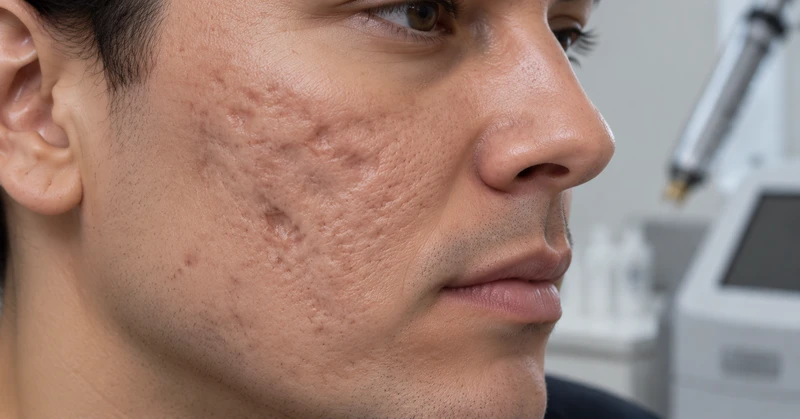
Depressed scars sit below the surrounding skin. Acne can leave rolling, boxcar, ice-pick, or mixed patterns.
AAD includes laser resurfacing among the professional treatments that can make selected depressed acne scars less noticeable. As the skin heals after resurfacing, collagen and elastin production can help improve surface texture.
That does not mean every depression responds equally well to the same laser.
Deep, narrow scars or scars tethered to deeper tissue may lead a dermatologist to discuss another procedure, either instead of laser or as part of a combination plan.
For a broader comparison, see Beyond Breakouts’ guide to professional treatments for different acne scar types.
Raised scars
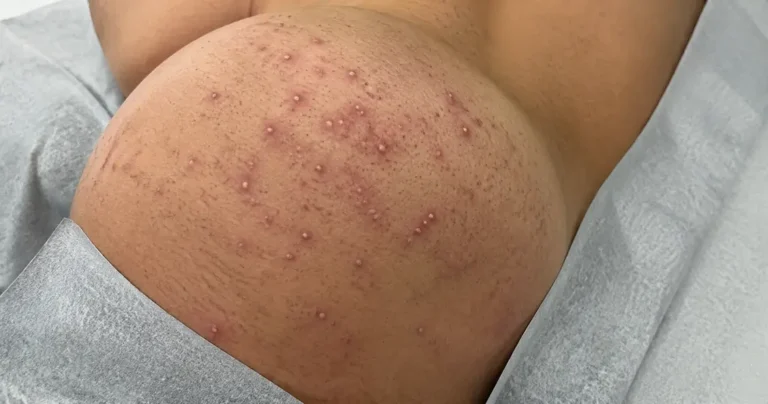
Raised acne scars involve excess scar tissue rather than lost volume.
AAD notes that laser may have a role in treating some hypertrophic, papular, or keloid-type scars, but raised scars frequently require a different strategy that can involve injections, medication, freezing, surgery, laser, or combinations.
Do not assume a resurfacing package marketed for pitted scars is automatically appropriate for a raised scar.
Flat post-acne marks
Flat red, pink, brown, or gray areas after acne may represent post-inflammatory color changes rather than structural scarring.
If your concern is mainly color and the skin surface is still smooth, the treatment discussion can be different from treatment for pitted texture. A proper evaluation can prevent you from paying for aggressive resurfacing when the main issue is pigment rather than scar depth.
What Does “Laser Scar Removal” Actually Mean?
The phrase sounds more complete than the realistic medical goal.
AAD states that laser treatment can make a scar less noticeable, but it cannot make a scar disappear completely.
Depending on the laser, treatment may:
- Remove controlled portions of the skin surface.
- Heat deeper tissue to stimulate remodeling.
- Treat microscopic columns while leaving surrounding areas untreated.
- Reduce certain differences in texture or color.
- Be combined with another scar procedure.
That is why two clinics both advertising “laser scar removal” may actually be offering very different procedures.
Ablative vs. Non-Ablative Laser: The Basic Difference
One of the first useful questions to ask is whether the proposed treatment is ablative or non-ablative.
| Approach | Basic idea | Main trade-off |
|---|---|---|
| Ablative laser | Removes controlled layers of the skin while promoting remodeling | More intensive treatment with greater recovery needs |
| Non-ablative laser | Delivers energy beneath the surface without removing the outer skin in the same way | Usually less recovery but improvement may be more gradual |
| Fractional treatment | Treats microscopic zones rather than the entire surface uniformly | Can balance treatment intensity with healing |
ASDS describes ablative resurfacing as removing upper layers of scarred skin while also heating deeper layers to support collagen production. Non-ablative approaches work differently and generally have a lighter recovery profile.
Importantly, fractional does not simply mean “non-ablative.” Fractional delivery can be used with different laser categories.
What About CO2 and Erbium Lasers?
CO2 and erbium are common names you may see while comparing local clinics.
ASDS lists carbon dioxide (CO2) and erbium among common resurfacing laser types. CO2 systems are used for scars and other skin concerns, while erbium lasers can also remove controlled layers of skin.
But the laser name alone is not enough to choose treatment.
You still need to know:
- Whether it is fractional.
- How aggressive the planned treatment is.
- What scar characteristic the provider is targeting.
- How the plan accounts for your skin tone.
- What recovery is expected.
- Who controls the settings and performs the procedure.
A clinic advertising a well-known laser does not automatically have the best treatment plan.
Fractional Laser for Acne Scars
Fractional treatment delivers laser energy through many small treatment zones instead of treating every point of the skin surface equally.
This approach is intended to create controlled areas of treatment surrounded by skin that can participate in healing. Fractional technology can be used in different laser systems, so “fractional laser” still does not tell you everything about treatment intensity or expected downtime.
Ask the clinic whether its fractional treatment is ablative or non-ablative and what that means for your particular procedure.
Which Acne Scars May Need More Than Laser?
Laser can remodel the skin surface, but not every acne scar is purely a resurfacing problem.
AAD describes several other professional approaches for depressed acne scars, including scar surgery, fillers, microneedling, radiofrequency, chemical peels, and combinations. It also notes that a dermatologist may surgically lift a depressed scar from underlying tissue and then use another treatment afterward.
This matters with mixed or tethered scarring.
If a clinic recommends laser for every scar you have, ask:
- Are any scars tethered?
- Are some scars too deep for laser alone?
- Would another technique address part of the problem better?
- Is laser meant to be the first step or the finishing step?
You are not trying to choose the procedure yourself. You are checking whether the provider can explain the structure of the treatment plan.
Why Provider Skill Matters More Than the Laser Brand
Device marketing is everywhere, but AAD’s laser guidance puts major emphasis on the person using the device.
AAD states that laser results depend largely on the skill of the person performing treatment and warns that inadequate medical expertise can lead to poor results or harm.
Before booking, ask:
- Who performs the laser procedure?
- What professional qualifications do they have?
- How frequently do they treat acne scars?
- How often do they use this specific laser?
- How do they manage complications?
- Who provides medical follow-up?
A medical consultation should also happen before anyone commits you to a treatment plan.
If treatment is promised before someone has properly evaluated the scar, that is a strong reason to slow down.
Skin Tone and Laser Scar Treatment
Laser treatment is not automatically limited to one skin tone, but pigment risk deserves serious attention.
AAD states that lasers can be used on all skin types while noting that darker skin has a greater tendency to develop burns or dark marks after some laser procedures. It recommends working with a board-certified dermatologist experienced in treating darker skin with lasers.
Relevant questions include:
- How often do you perform this procedure on my skin tone?
- What is my risk of post-inflammatory hyperpigmentation?
- Is hypopigmentation possible?
- Why was this device chosen?
- How will treatment intensity be adjusted?
- What is the plan if pigment changes develop?
AAD also warns that cosmetic procedures can sometimes cause lighter or darker areas in brown or Black skin.
Experience with similar skin tones should therefore be part of your clinic comparison, not an afterthought.
What Should Happen Before Laser Treatment?
A proper pre-treatment visit should include more than a quick sales conversation.
AAD recommends a medical consultation and says the clinician needs to consider the scar, skin type, overall health, medications, supplements, and treatment expectations. You should also tell the clinician about medical conditions and a history of cold sores where relevant.
Your consultation may cover:
- Scar type and depth.
- Current acne activity.
- Previous acne and scar treatments.
- Current skincare.
- Medications and supplements.
- Medical conditions.
- Cold sore history.
- Smoking.
- Sun exposure or tanning.
- Pigment-change history.
- Realistic expected improvement.
- Recovery requirements.
Do not stop medications, supplements, or prescription skincare on your own because you read that they can matter before laser treatment. Bring an accurate list to the treating clinician and follow individualized medical instructions.
Questions to Ask About the Laser Itself
Before you book, get specific.
Ask:
- What exact laser or device are you using?
- Is it ablative or non-ablative?
- Is the treatment fractional?
- Why does this laser fit my scar pattern?
- What level of treatment intensity are you proposing?
- Could another scar procedure be needed?
- Which risks are most relevant to my skin?
- What recovery should I realistically expect?
- How many treatments are you proposing, and why?
- Who will actually perform the procedure?
If the clinic cannot answer the first few questions clearly, a second opinion may be worthwhile.
How Much Downtime Can Laser Scar Treatment Require?
There is no single recovery period for all laser scar treatment.
Recovery changes with laser type, treatment depth, treatment area, and individual healing. Ablative resurfacing can involve considerably more healing than a lighter non-ablative treatment.
ASDS describes swelling, stinging, peeling, crusting, redness, and other recovery effects after different laser treatments, while non-ablative laser improvement may occur with much less downtime.
Instead of asking only, “How many days of downtime?”, ask what downtime means for this exact treatment:
- How long might visible redness last?
- Is swelling expected?
- Will the skin peel or crust?
- When can makeup be used?
- When can you exercise?
- What sun restrictions apply?
- When can you comfortably return to work or social activities?
For a deeper look at recovery and realistic changes, see what acne scar laser results can look like before and after treatment.
How Many Laser Sessions Might You Need?
No universal session number applies to every laser or scar.
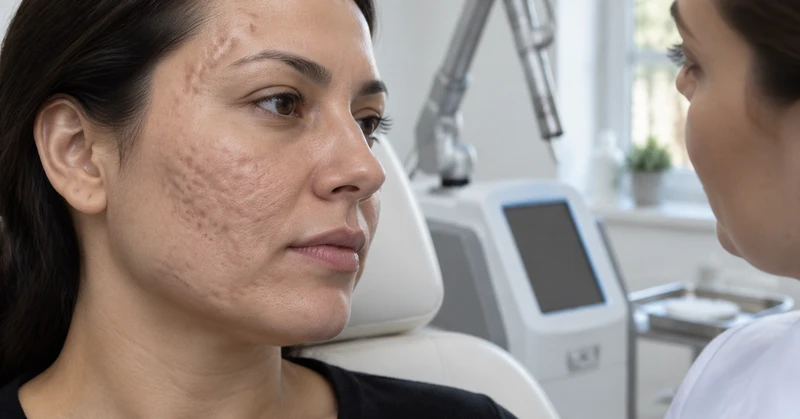
AAD notes that some lasers require more treatment sessions than others and that a series is often needed with non-ablative laser treatment.
Your plan can vary based on:
- Scar type.
- Scar depth.
- Treatment area.
- Laser type.
- Treatment intensity.
- Skin response.
- Desired improvement.
- Whether other procedures are being combined.
If a clinic sells a fixed package before assessing you, ask why that exact number of sessions was selected.
What Risks Should Be Discussed Before Booking?
Laser scar treatment is a medical or procedural intervention, not a risk-free facial.
ASDS lists possible risks such as:
- Pain.
- Swelling.
- Discoloration.
- Bleeding.
- Infection.
- Crusting.
- Additional scarring.
The likelihood and importance of each risk depend on the laser, treatment intensity, skin characteristics, medical history, provider skill, and aftercare.
A responsible consultation should discuss both likely temporary effects and less common but more significant complications.
Sun Exposure Matters More Than Many People Realize
AAD warns that a tan or sunburn can make laser treatment unsafe and increase the risk of burns or discoloration. Sun protection is also important while treated skin heals.
That makes timing relevant if you are booking around a beach trip, outdoor vacation, or prolonged sun exposure.
Ask the provider about:
- How much sun avoidance is required before treatment.
- When treatment must be postponed because of tanning.
- Post-treatment sunscreen requirements.
- How long extra sun protection is needed.
AAD’s acne-scar aftercare guidance also emphasizes broad-spectrum, water-resistant SPF 30+ after treatment and avoiding excessive sun exposure while healing.
What About Active Acne?
If you are still developing significant breakouts, scar treatment may not be the first priority.
AAD states that when acne breakouts are present, a scar-treatment plan commonly begins by controlling active acne to reduce inflammation and help prevent new scars.
That does not mean every person with an occasional pimple is automatically excluded from every laser procedure. It means current acne should be part of the medical assessment.
Laser treatment aimed at active acne is also not identical to laser resurfacing aimed at established scars. Beyond Breakouts explains that distinction in its guide to laser acne treatment.
How to Compare Laser Scar Removal Near Me Prices
Local prices can differ substantially, so a single national number is not very useful.
Instead, compare what each quote actually includes:
- Consultation.
- Treatment area.
- Exact laser.
- Treatment intensity.
- Numbing or anesthesia.
- Number of sessions proposed.
- Follow-up.
- Aftercare.
- Combination procedures.
- Maintenance if applicable.
- Policy for complications or extra visits.
A cheaper single session is not necessarily a cheaper complete plan if another clinic expects fewer treatments—or if the cheaper treatment is not appropriate in the first place.
Beyond Breakouts has a separate guide to what affects acne scar laser treatment cost.
Before-and-After Photos: 5 Questions to Ask
Clinic photos can be helpful, but they do not predict your result.
Ask:
- Were the photos taken under similar lighting and camera angles?
- How many laser sessions did this patient receive?
- Was laser the only treatment used?
- Is the scar pattern similar to mine?
- Is the patient’s skin tone reasonably comparable to mine?
Also ask how long after treatment the “after” photo was taken. Laser improvement may continue as tissue remodels, so timing can change how results look. ASDS notes that meaningful changes may take weeks or months to become apparent with some laser/light treatments.
Laser vs. Another Acne Scar Procedure
Laser is one tool among several.
| Situation to discuss | Laser may have a role | Another procedure may also be discussed |
|---|---|---|
| Uneven surface texture | Yes | Microneedling or RF microneedling |
| Tethered depressed scars | Resurfacing may help part of the appearance | Scar release/subcision |
| Selected volume loss | May complement treatment | Filler |
| Mixed depressed scars | May be part of the plan | Multiple techniques |
| Raised scar | Certain laser approaches may help | Injection or other raised-scar treatment |
AAD’s treatment guidance supports an individualized, sometimes combination-based approach rather than one procedure for every scar.
Red Flags Before Booking Laser Scar Treatment
Consider getting another opinion if a clinic:
- Guarantees complete scar removal.
- Offers treatment before a proper consultation.
- Cannot identify the exact device being used.
- Cannot explain why that laser fits your scar.
- Says one laser is best for everyone.
- Does not discuss skin-tone considerations.
- Avoids discussing risks.
- Cannot identify who performs the treatment.
- Has no clear follow-up or complication plan.
- Pressures you to purchase a package immediately.
The newest or most aggressively advertised device is not automatically the most appropriate one.
A Laser Booking Checklist
Before paying for treatment, make sure you understand:
- What type of scar is being treated.
- Which exact laser is planned.
- Whether it is ablative or non-ablative.
- Whether it is fractional.
- Why laser is being recommended.
- Who performs the procedure.
- The provider’s relevant experience.
- Skin-tone and pigment risks.
- Expected recovery.
- Why the proposed number of sessions makes sense.
- Whether another procedure may be required.
- Total expected cost.
- Follow-up and complication care.
- What level of improvement is realistic.
If several of those answers remain unclear, you may not yet have enough information to book confidently.
Frequently Asked Questions
How do I find safe laser scar removal near me?
When looking for laser scar removal near me, prioritize qualified professionals who provide a medical evaluation before treatment and regularly perform laser procedures for scars. Verify who will operate the device, ask about experience with your skin tone and scar pattern, and make sure the clinic can clearly explain the laser, risks, alternatives, recovery, and follow-up plan.
Is CO2 laser the best laser for acne scars?
Not for everyone. CO2 resurfacing can be useful for selected acne scars, but treatment choice depends on scar pattern, depth, skin tone, downtime tolerance, medical history, and provider judgment. The name or strength of a laser does not make it universally superior to other lasers or non-laser scar procedures.
Is laser scar removal permanent?
Laser-induced remodeling can produce lasting improvement in scar appearance, but the scar is not guaranteed to disappear completely and skin continues to change with aging. Some people also need multiple treatments or combination procedures. Be cautious with clinics that equate “long-lasting improvement” with guaranteed permanent scar elimination.
How many laser sessions do acne scars need?
There is no universal number. Some non-ablative approaches often involve a series, while other treatments use different schedules. The number depends on the scar, laser, treatment intensity, goals, and response. Ask your provider why a particular series is being proposed rather than assuming every package is standard.
Is laser treatment safe for darker skin tones?
Laser can be used in darker skin, but pigment changes and burns can be a greater concern with some treatments. AAD recommends choosing a board-certified dermatologist experienced in laser treatment for darker skin. The device, settings, treatment intensity, and aftercare should be selected with that risk in mind.
The Bottom Line
When searching for laser scar removal near me, do not simply book the closest clinic or the most impressive machine.
Find out exactly which laser is being offered, whether it fits the scar problem, who performs the treatment, how the plan accounts for your skin tone, what downtime and risks apply, why the proposed number of sessions makes sense, and what the full treatment is expected to cost.
Laser can be a useful part of acne-scar treatment, but it is not a guaranteed scar eraser and it is not the right tool for every scar. A good consultation should make the treatment rationale clearer—not pressure you into buying a package.
This article is for educational purposes only. It does not diagnose acne scars or determine whether laser treatment is appropriate for an individual reader. A qualified healthcare professional can examine your skin, review your medical history, and discuss appropriate treatment options.
References:
- American Academy of Dermatology — 10 Things to Know Before Having Laser Treatment for Your Scar. Covers realistic expectations, provider skill, medical consultation, sun exposure, repeat treatment, and combination treatment. AAD laser scar guidance
- American Academy of Dermatology — Acne Scars: Consultation and Treatment. Covers individualized scar assessment, active acne, laser resurfacing, microneedling, surgery, fillers, and combination treatment. AAD acne scar treatment guidance
- American Academy of Dermatology — Skin Conditions That Lasers Can Treat. Covers laser use across skin types, pigment risk in darker skin, provider expertise, and sun protection. AAD laser and skin-type guidance
- American Academy of Dermatology — Acne Scars: How to Care for Your Skin After Treatment. Covers post-procedure sunscreen and sun protection. AAD acne scar aftercare guidance
- American Society for Dermatologic Surgery — Laser Therapy for Acne Scars. Covers procedural context, preparation, possible risks, and recovery. ASDS laser therapy for acne scars
- American Society for Dermatologic Surgery — Laser Resurfacing for Acne Scars. Covers ablative resurfacing, collagen remodeling, risks, and recovery. ASDS laser resurfacing guidance