How Do Pimple Patches Work? Hydrocolloid Science, Best Uses & Limits
If you have ever peeled off a pimple patch and found a white, swollen center, it is easy to assume the sticker “pulled everything out.” But how do pimple patches work in reality? Most standard patches are made from hydrocolloid, a moisture-absorbing wound-dressing material that can collect fluid from a surface-level blemish while covering it from picking, friction, and outside irritation.
The short answer is simple: a hydrocolloid patch works best when there is fluid close to the skin surface. It can absorb exudate from a whitehead or an opened pimple and create a protected environment while the area heals. It is much less useful for a deep, closed nodule or cyst because the patch sits on top of the skin rather than reaching inflammation far below it.
Table of Contents
How Do Pimple Patches Work on a Pimple?
Most plain pimple patches have two basic jobs: absorb fluid and protect the spot.
Hydrocolloid contains water-attracting materials that interact with moisture from the lesion. As the patch absorbs that fluid, the hydrocolloid swells and forms a soft gel. At the same time, the outer layer acts as a physical cover over the blemish.
This means a patch can help in three practical ways:
- It absorbs fluid that has reached the surface.
- It keeps the area covered while it heals.
- It makes it harder to touch, squeeze, or pick the spot.
That third benefit is easy to underestimate. If you ask how do pimple patches work beyond absorption, the physical barrier is part of the answer. Picking can increase inflammation, break the skin barrier, and raise the chance of lingering marks or scarring.
A small patch gives your fingers something to encounter before they reach the blemish itself.
What a hydrocolloid patch does not do is act like a vacuum deep inside the pore. It cannot physically pull out an entire comedone, erase a clogged follicle, or reach a deep acne nodule beneath intact skin.
How Do Pimple Patches Work With Hydrocolloid?
Hydrocolloid was used in wound care long before it became a skincare trend. The material is hydrophilic, meaning it attracts water. When it contacts wound fluid or exudate, it absorbs moisture and forms a gel-like layer.
A typical hydrocolloid dressing has an inner absorbent layer and an outer protective layer. That design helps maintain a moist, covered environment while reducing direct exposure to friction and repeated touching.
A 2025 dermatology review described hydrocolloids as absorptive, hydrating, and protective dressings, while also noting that acne-specific evidence is still much smaller than the wound-care literature.
Why a Moist Environment Can Help
An opened or draining blemish is a small disrupted area of skin. Constantly drying it, touching it, or reopening it can interfere with recovery.
Hydrocolloid keeps the area covered while managing excess fluid. That does not mean “more moisture is always better,” and it does not turn a patch into an acne medication. The benefit comes from creating a controlled environment over a very small lesion.
The Barrier Effect Matters Too
A patch is also a mechanical shield. It can reduce:
- Picking and squeezing
- Fingernail trauma
- Friction from masks, clothing, or bedding
- Repeated touching during the day
The American Academy of Dermatology notes that hydrocolloid patches can protect the skin and support healing.
What Does a Pimple Patch Actually Pull Out?
If the question is how do pimple patches work when they seem to “pull” material from a blemish, the most accurate answer is surface-accessible fluid.
That fluid may include exudate from an inflamed lesion, pus from a pustule, oil, and moisture from an opened or draining blemish. The exact mix varies from one spot to another.
The phrase “pulls out all the gunk” is convenient marketing language, but it can be misleading. Hydrocolloid does not reach down into the follicle and remove the entire acne plug from below intact skin.
Why Does a Pimple Patch Turn White?
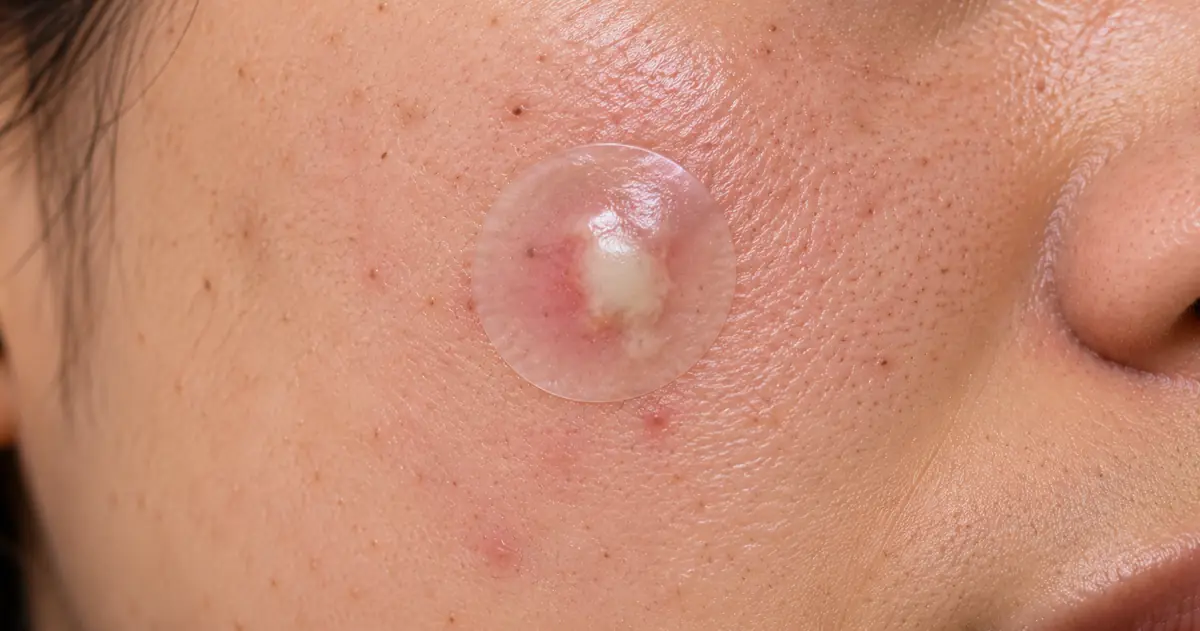
The white or opaque center usually appears because the hydrocolloid has absorbed moisture and swollen into a gel.
So when you remove a patch and see a white circle, that does not necessarily mean it extracted an entire pore blockage. Some of that visible change is simply hydrated hydrocolloid.
This is a useful clue for understanding how do pimple patches work: the visible white center mainly tells you the material interacted with moisture. It does not prove the pimple has been completely emptied or “detoxed.”
Which Pimples Give Hydrocolloid Something to Absorb?
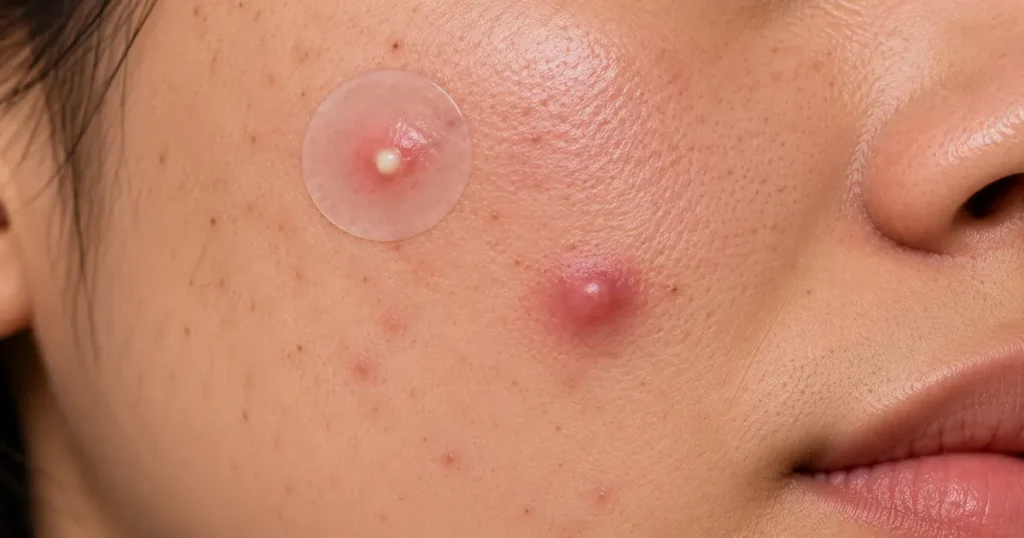
To understand how do pimple patches work better on some pimples than others, look at where the moisture is. The best match is usually a blemish where fluid is already available near the surface.
Whiteheads and Pustules
A whitehead or pustule with visible surface fluid gives hydrocolloid something it can actually contact.
These lesions are often the most satisfying to patch because the material may become visibly opaque after several hours. The patch can also protect the lesion from squeezing while the area settles.
Open or Recently Popped Pimples
If a blemish has already opened, hydrocolloid can absorb draining fluid and cover the disrupted skin.
That does not mean you should intentionally pop pimples to make patches “work better.” Squeezing can push inflammation deeper, damage surrounding tissue, and increase the risk of marks or scars.
A patch is better viewed as damage control if the lesion has already opened.
Inflamed Papules
A red, tender papule may have little or no surface fluid. A plain patch may still protect it from touching, but you may see much less absorption.
That difference helps explain why one patch turns completely white while another looks almost unchanged the next morning.
How Do Pimple Patches Work on Deep or Cystic Acne?
Plain hydrocolloid has a major limitation: it sits on the surface.
A deep nodule or cyst develops farther down in the skin, often without an opening that allows fluid to reach the patch. Because of that, a standard hydrocolloid sticker cannot directly absorb the deep inflammatory material.
A patch may still help you avoid touching the area, but that is different from treating the deeper acne process. Cleveland Clinic similarly describes pimple patches as limited tools for overall acne management and most useful for certain surface-level or opened lesions.
If you repeatedly develop large, painful, deep pimples or acne that is leaving scars, professional evaluation is more appropriate than repeatedly covering them with stickers.
What About Blackheads?
Blackheads are open comedones made of oil and dead skin cells within a follicle. They usually do not contain the kind of free surface fluid that hydrocolloid absorbs well.
That is why a plain patch may do very little to a blackhead. Ingredients that help unclog pores, such as salicylic acid or a topical retinoid, address a different part of acne biology.
For a clearer comparison of common over-the-counter acne actives, see our guide to benzoyl peroxide vs salicylic acid.
Plain Hydrocolloid vs Medicated Pimple Patches
Not every acne patch uses the same mechanism. That matters when comparing products and asking how do pimple patches work with added acne ingredients.
Plain Hydrocolloid Patches
A plain hydrocolloid patch mainly provides:
- Fluid absorption
- A protective cover
- Reduced picking
- A moist healing environment
For many people, the simplicity is part of the appeal because there is no additional acne active to irritate already-inflamed skin.
Salicylic Acid Patches
Some patches add salicylic acid. That ingredient can help loosen dead skin cells involved in clogged pores, but it also adds irritation potential.
If the patch contains salicylic acid, any benefit is no longer coming from hydrocolloid alone. You are using a combined product with both a dressing function and an acne active.
Tea Tree Oil and Other Added Ingredients
Some patches include tea tree oil, botanical extracts, niacinamide, or other ingredients.
More ingredients do not automatically make a patch more effective. A 2025 hydrocolloid review noted that medicated acne patches are common, but evidence proving that added compounds improve outcomes over hydrocolloid alone remains limited.
If your skin is sensitive, fragrance, essential oils, acids, and repeated adhesive exposure may be more likely to cause irritation.
What About Microneedle Pimple Patches?
Microneedle or microdart patches are different from flat hydrocolloid dots.
They contain tiny dissolving projections designed to deliver ingredients through the outer skin surface. Depending on the product, those projections may contain salicylic acid, niacinamide, hyaluronic acid, or other compounds.
Their mechanism is therefore not the same as how do pimple patches work when the product is a standard hydrocolloid sticker. A plain hydrocolloid patch manages accessible moisture at the surface; a microneedle patch attempts localized ingredient delivery.
Evidence varies by technology and formula, so a microneedle patch should not be assumed to work simply because hydrocolloid patches are useful for certain surface lesions.
How to Use a Pimple Patch Correctly
Correct application is simple, but a few mistakes can make the patch fall off or irritate the skin. Even if you understand how do pimple patches work, poor adhesion can stop the hydrocolloid from contacting the lesion properly.
- Cleanse gently. Remove makeup, sunscreen, oil, and surface debris.
- Dry the area completely. Hydrocolloid adhesive sticks poorly to wet or oily skin.
- Choose the right size. The patch should fully cover the blemish.
- Apply it before oily skincare. Heavy creams underneath can reduce adhesion.
- Leave it on for the time listed on the product label.
- Remove it gently. Do not rip it off fragile or irritated skin.
- Replace it only if needed. Repeated removal can bother sensitive skin.
Cleveland Clinic also recommends applying patches to clean, dry skin and following the manufacturer’s wear-time directions.
How Long Should You Leave a Pimple Patch On?
There is no single medically correct wear time for every patch.
Many products are designed for several hours or overnight, but thickness, adhesive, ingredients, and manufacturer instructions differ. The safest approach is to follow the specific label rather than assuming every hydrocolloid sticker should stay on for the same number of hours.
If a plain patch becomes opaque and swollen, it may have absorbed fluid. Some brands advise replacing a saturated patch, while others give a fixed wear time.
Longer is not automatically better. If the skin under or around the patch becomes itchy, painful, very red, or irritated, remove it.
Can Pimple Patches Irritate Skin?
Yes. Hydrocolloid itself is often well tolerated, but the complete patch includes adhesive, and some products contain additional active ingredients.
Possible problems include:
- Adhesive irritation
- Redness where the patch edge sits
- Skin stripping from repeated removal
- Irritation from salicylic acid or essential oils
- Sensitivity to a specific patch material
The 2025 dermatology review advises extra caution with repeated application and removal in people with sensitive or thin skin because repeated stripping can disrupt the outer skin barrier.
If every patch leaves a persistent red outline, itching, blistering, or worsening irritation, stop using that product.
What Does the Evidence Actually Show?
Pimple patches are popular, but the acne-specific evidence base is still relatively small.
A 2006 randomized double-blind pilot trial enrolled 20 people with mild to moderate acne and found that a hydrocolloid acne dressing improved acne severity and inflammation more than ordinary skin tape during the short study period. The sample was small, so it is better viewed as encouraging early evidence than definitive proof.
A 2025 narrative review identified only a few acne studies despite the widespread use of hydrocolloid patches. The review concluded that the absorptive and protective properties are biologically plausible for exudative acne lesions, but more controlled clinical research is needed.
So, how do pimple patches work according to the strongest current explanation? Mainly as localized hydrocolloid dressings that absorb accessible moisture and protect an individual lesion.
Asking how do pimple patches work is therefore different from asking whether patches can treat acne as a whole.
Their evidence base is not comparable to that for established acne medications used to prevent and treat recurring acne.
How Do Pimple Patches Work Without Treating the Cause of Acne?
This distinction is important: managing one pimple is not the same as treating acne.
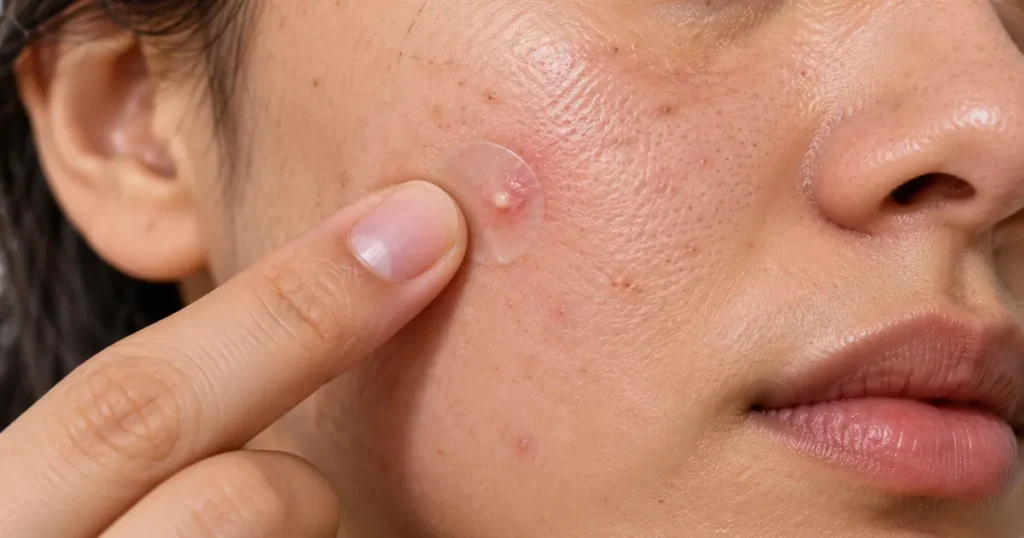
Pimple patches can be useful spot tools, but they do not stop follicles from repeatedly clogging, normalize skin-cell turnover throughout an acne-prone area, or provide comprehensive treatment for widespread inflammatory acne.
Established over-the-counter acne ingredients do different jobs. Salicylic acid can help unclog pores, benzoyl peroxide can reduce acne-related bacteria and inflammation, and adapalene helps prevent comedones and new lesions over time.
That is why someone who needs patches every day may benefit more from looking at the overall acne pattern than simply buying more stickers.
Our guide to salicylic acid and acne treatment explains where a pore-clearing active fits when blackheads, whiteheads, or recurring clogged pores are the bigger problem.
Frequently Asked Questions
What Is the White Stuff on a Pimple Patch?
The white center is usually hydrocolloid that has absorbed moisture and swollen into a gel, mixed with fluid from the blemish.
It is not proof that the patch pulled out an entire clogged pore or every bit of material inside the pimple.
Do Pimple Patches Work on Unpopped Pimples?
They can help some surface-level unpopped pimples, especially when fluid is close to the surface.
On a closed papule or deeper lesion, a plain patch may mainly provide protection from touching rather than dramatic absorption.
Can You Put a Pimple Patch on a Popped Pimple?
If a pimple has already opened, a hydrocolloid patch can absorb drainage and protect the disrupted skin.
However, intentionally popping pimples is not recommended because squeezing can worsen inflammation and increase the chance of marks or scars.
How Do Pimple Patches Work on Cystic Acne?
How do pimple patches work on cystic acne is mostly a question of depth: standard hydrocolloid stays at the surface, while cystic or nodular inflammation is deeper.
The patch may stop you from touching the area, but it cannot directly absorb material trapped deep beneath intact skin.
Can a Pimple Patch Prevent Acne?
No. A hydrocolloid patch manages an individual lesion; it does not prevent the biological processes that repeatedly create clogged pores and inflamed acne.
If breakouts are frequent, widespread, painful, or scarring, a broader acne-treatment plan is more appropriate.
Conclusion
Understanding how do pimple patches work makes it easier to use them for the right job. Hydrocolloid absorbs fluid that is accessible near the surface, forms a gel, covers the blemish, and helps keep your fingers away.
That makes patches especially practical for surface-level whiteheads, pustules, or already-open lesions. They are much less capable of changing a deep closed nodule, clearing blackheads, or preventing future acne.
Think of a pimple patch as a small spot-management tool rather than a complete acne treatment. If you keep developing deep, painful, widespread, or scarring acne, treating the underlying acne pattern matters more than repeatedly covering individual lesions.
This article is for educational purposes only and is not a diagnosis or a substitute for care from a qualified healthcare professional.
References:
- Cleveland Clinic — Can Pimple Patches Make a Zit Go Away?
- American Academy of Dermatology — How to Treat a Deep, Painful Pimple at Home
- Journal of Clinical Medicine — Narrative Review of the Use of Hydrocolloids in Dermatology: Applications and Benefits
- PubMed — A Pilot Study on Efficacy Treatment of Acne Vulgaris Using Hydrocolloid Acne Dressing