On the Spot Acne Treatment: Neutrogena 2.5% Benzoyl Peroxide Review
If you are considering on the spot acne treatment, the product name can make it sound as though you should place a tiny dot of cream only on an individual pimple. The current Neutrogena On-the-Spot Acne Treatment is a leave-on acne medication containing 2.5% benzoyl peroxide, but its Drug Facts directions actually say to apply a thin layer over the entire affected area.
That distinction matters because acne often starts before every pimple becomes visible.
Quick answer: Neutrogena On-the-Spot is a straightforward 2.5% benzoyl peroxide treatment. That concentration is within the FDA’s permitted OTC range and is also the strength the American Academy of Dermatology recommends as a sensible starting point for mild inflammatory pimples when benzoyl peroxide is appropriate. It can still cause dryness, peeling, burning, and fabric bleaching.
Table of Contents
What Is On the Spot Acne Treatment and What Is in It?
The current product is Neutrogena On-the-Spot Acne Treatment Vanishing Formula. Its active ingredient is:
Benzoyl peroxide 2.5%
DailyMed lists it as an OTC acne medication packaged by Kenvue Brands LLC. The current label was revised in May 2025.
FDA’s OTC acne monograph permits benzoyl peroxide at concentrations from 2.5% to 10%. This means the product uses the lowest benzoyl peroxide concentration allowed under that monograph, but “lowest concentration” does not mean ineffective.
The current inactive ingredients listed on DailyMed are:
- Water
- Carbomer
- Ethylhexylglycerin
- Sodium hydroxide
- Chlorphenesin
- Disodium EDTA
- Laureth-4
- Hypromellose
These ingredients form and stabilize the cream. They are not additional acne medications.
Is It Fragrance-Free?
The current DailyMed inactive-ingredient list does not list fragrance. That is useful for readers who prefer simpler formulas, but it does not guarantee that highly sensitive skin will tolerate the product. The label specifically says not to use it if you have very sensitive skin or are sensitive to benzoyl peroxide.
How Does On the Spot Acne Treatment Work on Pimples?
The main reason on the spot acne treatment can make sense for inflammatory breakouts is benzoyl peroxide.
Benzoyl peroxide is an established acne medication. Current AAD guidance identifies it as particularly useful for mild pimples, while its acne guideline strongly recommends benzoyl peroxide among topical acne therapies.
Red, Inflamed Pimples
This is the most logical use case.
Benzoyl peroxide is particularly relevant when acne consists of:
- Red papules
- Small inflammatory pimples
- Pustules
- Mild inflammatory breakouts
It reduces acne-associated bacteria and helps reduce inflammation. A 2.5% leave-on product can therefore be a reasonable starting option when inflammatory acne is mild enough for OTC treatment.
What About Blackheads and Whiteheads?
If most of your breakouts are blackheads, whiteheads, or recurring clogged pores, salicylic acid or a topical retinoid may fit the pattern better.
AAD guidance describes salicylic acid as especially useful for whiteheads and blackheads because it exfoliates and helps unclog pores.
If you are unsure which acne pattern you have, our comparison of benzoyl peroxide vs salicylic acid explains why the two ingredients do different jobs.
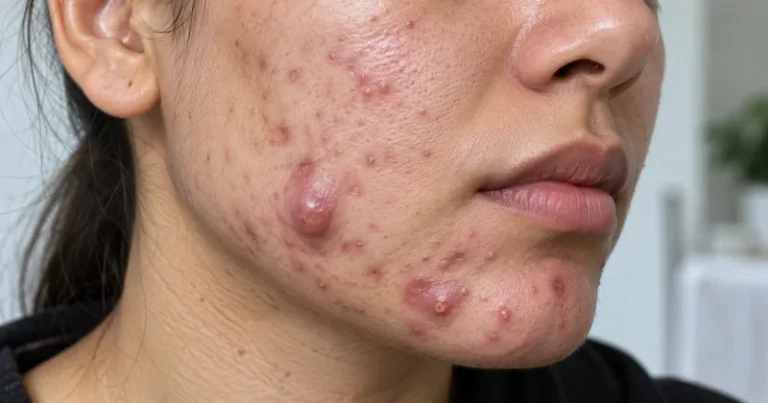
What About Deep Cystic or Nodular Acne?
A simple OTC on the spot acne treatment is not a complete strategy for recurring deep, painful acne.
AAD advises professional treatment when acne produces large, painful pimples deep in the skin or is leaving scars because ordinary OTC care may not be enough.
If you repeatedly get deep lumps under the skin, our guide to why deep acne forms and why a spot treatment may be too limited explains the difference between superficial pimples and nodular or cystic acne.
Is 2.5% On the Spot Acne Treatment Strong Enough?
Yes, 2.5% can be a clinically reasonable benzoyl peroxide strength. Stronger does not automatically mean better.
FDA permits OTC benzoyl peroxide between 2.5% and 10%, but AAD specifically recommends beginning with 2.5% when appropriate because this can reduce problems such as dryness, irritation, and burning.
That makes the strength of on the spot acne treatment one of its advantages rather than an obvious weakness.
| Benzoyl peroxide concentration | Potential advantage | Main trade-off |
|---|---|---|
| 2.5% | Lower-strength starting option | Can still dry or irritate skin |
| 5% | Higher benzoyl peroxide concentration | Potential for more irritation |
| 10% | Highest concentration permitted in the OTC monograph | Greater risk of dryness and irritation |
The percentage alone should not decide which product you choose. Product format, lesion type, treatment area, frequency, and skin tolerance all matter.
A 10% gel that you cannot tolerate consistently may be less useful in practice than a 2.5% product you can use according to its label.
How to Use On the Spot Acne Treatment According to the Label
The current Drug Facts directions are more important than assumptions based on the product name.
DailyMed instructs users to:
- Clean the skin before application.
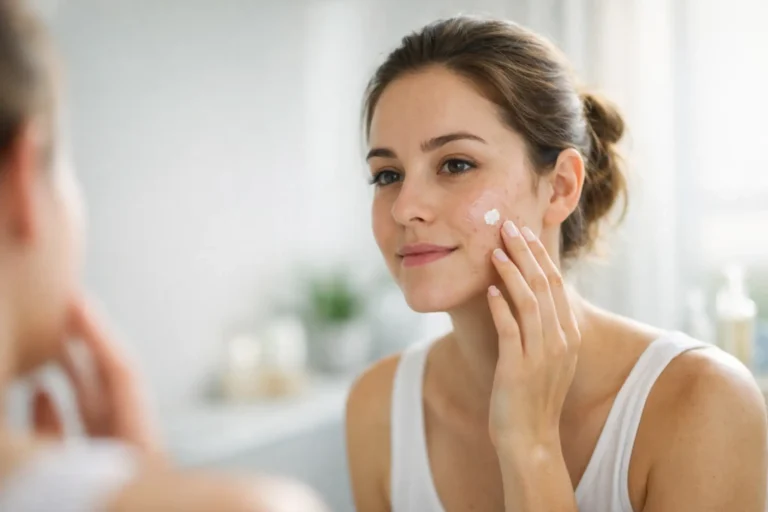
- Cover the entire affected area with a thin layer.
- Start with one application daily because excessive dryness can occur.
- Increase gradually only if needed or directed by a doctor.
- Reduce frequency if bothersome peeling or dryness develops.
“Spot Treatment” Does Not Necessarily Mean One Tiny Dot
This is probably the most useful detail in the entire on the spot acne treatment review.
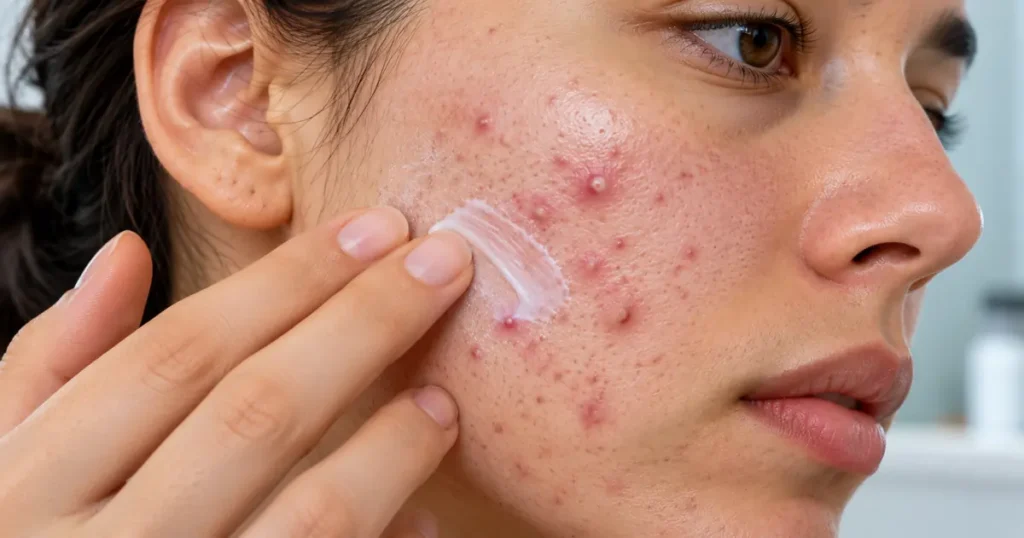
The official instructions do not say to place a large blob only on the visible center of each pimple. They say to cover the entire affected area with a thin layer.
AAD gives similar general acne advice: applying acne medication across acne-prone skin can treat existing lesions while helping address breakouts developing in the same area.
That does not mean covering your whole face unnecessarily. If you have one isolated pimple, the affected area may be small. If several inflamed pimples repeatedly appear across the same cheek or chin zone, treating only the most obvious bump may be too narrow.
How Often Should It Be Used?
The label allows one to three applications per day, but specifically says to start once daily because excessive drying can occur. If dryness or peeling becomes bothersome, the label advises reducing application frequency.
This is label information, not a personalized regimen. Follow the package you actually purchase because formulations and directions can change.
Eyes, Lips, and Mouth
Avoid contact with:
- Eyes
- Lips
- Mouth
This is explicitly stated in the current Drug Facts warnings.
What About Sunscreen?
The current benzoyl peroxide label advises avoiding unnecessary sun exposure and using sunscreen. It also instructs users going outside to apply sunscreen after the medication.
On the Spot Acne Treatment Side Effects and Warnings
Even at 2.5%, on the spot acne treatment can irritate skin.
The current Drug Facts list possible irritation including:
- Redness
- Burning
- Itching
- Peeling
- Possible swelling
If irritation becomes severe, the label instructs users to stop use and ask a doctor.
Dryness and Peeling
Dryness is not proof that benzoyl peroxide is working better.
Applying more product or increasing frequency faster than your skin tolerates can make treatment harder to continue. AAD similarly emphasizes starting with a lower benzoyl peroxide concentration to reduce irritation.
Benzoyl Peroxide Can Bleach Fabric and Hair
This is not a minor theoretical warning. Benzoyl peroxide can bleach:
- Towels
- Pillowcases
- Shirts
- Bedding
- Dyed fabrics
- Hair
The current On-the-Spot label explicitly warns users to avoid contact with hair and dyed fabrics.
Using white or light-colored towels and allowing the cream to dry before your skin touches fabric may reduce accidental bleaching, although it cannot guarantee that staining will never happen.
Using Other Acne Medications at the Same Time
DailyMed states that dryness and irritation are more likely when another topical acne medication is used at the same time. If irritation occurs, its Drug Facts direct users to use only one topical acne medication at a time.
That is especially relevant if your routine already contains:
- Another benzoyl peroxide product
- Salicylic acid
- A retinoid
- Strong exfoliating acids
- Multiple acne leave-on products
More acne actives do not automatically produce faster clearing.
Does On the Spot Acne Treatment Work Better Than Stronger Benzoyl Peroxide?
There is no good reason to assume that on the spot acne treatment is inferior solely because it contains 2.5% benzoyl peroxide.
The AAD recommends starting with a 2.5% product when benzoyl peroxide is appropriate because higher strengths can increase dryness and irritation. FDA’s monograph confirms that 2.5% is a recognized OTC acne concentration.
The useful question is therefore not:
“What is the strongest benzoyl peroxide I can buy?”
It is:
“What strength and format match my acne while remaining tolerable enough to use consistently?”
If you want to compare this 2.5% cream with other products and concentrations containing benzoyl peroxide, our broader guide explains washes, leave-on treatments, and the OTC strength range.
Who Is On the Spot Acne Treatment Most Likely to Suit?
A product-specific review is most useful when it explains who the formula fits rather than declaring it universally good or bad.
It May Make Sense If:
- You get mild red inflammatory pimples.
- You want a 2.5% benzoyl peroxide leave-on cream.
- You prefer starting with a lower concentration.
- Stronger benzoyl peroxide products have been too drying.
- You understand that consistency matters more than applying a thick layer.
It May Be Less Suitable as a Stand-Alone Choice If:
- Blackheads and whiteheads are your dominant concern.
- You have acne across a large recurring area and need a prevention-focused routine.
- You have deep nodules or cyst-like lesions.
- Acne is leaving scars.
- You have very sensitive skin.
- You know you are sensitive to benzoyl peroxide.
If the product does not match your breakout pattern, our guide to how Neutrogena acne treatments differ by active ingredient compares the brand’s salicylic acid, benzoyl peroxide, and adapalene options.
Is Neutrogena On the Spot Acne Treatment Worth Buying?
The product has a straightforward advantage: it gives you an established acne active at a concentration the AAD specifically identifies as a good benzoyl peroxide starting point.
It also has clear limitations.
What it offers:
- Evidence-supported benzoyl peroxide
- 2.5% concentration
- Leave-on cream format
- Relatively short inactive-ingredient list
- Current OTC Drug Facts labeling
What to consider:
- Dryness and irritation
- Fabric and hair bleaching
- Limited usefulness for deep acne
- Not the most targeted choice for predominantly blackhead/whitehead acne
- Spot-focused positioning may be too limited for frequently recurring acne across a larger area
Whether on the spot acne treatment is worth buying therefore depends on whether you specifically need a simple 2.5% benzoyl peroxide treatment for mild inflammatory acne.
Brand recognition alone is not a reason to choose it, and a higher benzoyl peroxide percentage is not automatically a reason to reject it.
Recommended Benzoyl Peroxide Options
🏆 Neutrogena On-The-Spot Acne Treatment — Best Match for This Guide
A simple leave-on treatment with 2.5% benzoyl peroxide, ideal for mild red and inflamed pimples without immediately jumping to a stronger concentration.
Best for: Mild inflammatory pimples
Active ingredient: 2.5% benzoyl peroxide
💰 Acne.org Treatment 2.5% Benzoyl Peroxide — Best Larger-Size Alternative
A 2.5% benzoyl peroxide treatment available in larger sizes, making it more practical for people treating a wider acne-prone area rather than only occasional individual pimples.
Best for: Regular benzoyl peroxide users who want a larger-format treatment
Active ingredient: 2.5% benzoyl peroxide
Frequently Asked Questions
Does on the spot acne treatment contain benzoyl peroxide?
Yes. The current Neutrogena on the spot acne treatment contains 2.5% benzoyl peroxide as its active acne medication. DailyMed’s current Drug Facts confirm that concentration.
Is 2.5% benzoyl peroxide enough for pimples?
It can be. AAD guidance specifically recommends starting with 2.5% benzoyl peroxide when appropriate for mild pimples because higher percentages can cause more dryness, irritation, or burning.
Should I put Neutrogena On-the-Spot only on the pimple?
The current Drug Facts say to cover the entire affected area with a thin layer, not simply place a thick dot on the visible center of one pimple. The size of that affected area depends on where your acne occurs.
Can Neutrogena On-the-Spot bleach clothes or towels?
Yes. Benzoyl peroxide can bleach dyed fabrics and hair. The current product label explicitly warns users to avoid contact with both.
Can On-the-Spot Acne Treatment help cystic acne?
An OTC benzoyl peroxide cream may be useful for superficial inflammatory acne, but recurrent deep, painful, or scar-forming acne generally needs more than a simple spot treatment. AAD recommends dermatologist care when pimples are large, painful, deep, or leaving scars.
Conclusion
Neutrogena on the spot acne treatment is a straightforward 2.5% benzoyl peroxide leave-on medication for acne. The lower concentration should not be dismissed as weak: it falls within the FDA OTC acne range, and AAD specifically identifies 2.5% as a sensible starting concentration for mild pimples when benzoyl peroxide is appropriate.
Its biggest practical limitations are dryness, irritation, and bleaching of hair or dyed fabrics. Just as importantly, the official label says to apply a thin layer over the affected area, so the product name should not be interpreted as permission to repeatedly pile cream onto one pimple.
For recurring, deep, painful, or scar-forming acne, moving to a broader evidence-based acne plan or professional evaluation makes more sense than simply choosing a stronger spot treatment.
Medical disclaimer: This article is educational and is not a diagnosis or a substitute for care from a qualified healthcare professional.
References:
- U.S. National Library of Medicine, DailyMed — Neutrogena On-the-Spot Acne Treatment Drug Facts View DailyMed label
- U.S. Food and Drug Administration — OTC Monograph M006: Topical Acne Drug Products for OTC Human Use View FDA monograph
- American Academy of Dermatology — Adult acne treatment dermatologists recommend View AAD guidance