Does Peanut Butter Cause Acne? What the Evidence Really Shows
If you have noticed a breakout after eating peanut butter, it is reasonable to wonder: Does Peanut Butter Cause Acne or is the timing just a coincidence? The answer is not as simple as blaming one food. Peanut butter has not been established as a universal acne trigger, and the strongest diet-acne evidence points elsewhere.
Quick answer: Current research does not show that peanut butter directly causes acne in most people. Better-supported dietary links involve high-glycemic eating patterns and, in some populations, cow’s milk or whey protein. If peanut butter repeatedly seems connected to your breakouts, test that pattern carefully instead of assuming one meal caused one pimple.
Table of Contents
Does Peanut Butter Cause Acne? What Direct Evidence Shows
The direct evidence is weak. Researchers have studied diet and acne extensively, but controlled studies specifically testing peanut butter as a cause of breakouts are lacking. That matters because a theory about an ingredient is not the same as evidence that eating the food produces acne.
When asking Does Peanut Butter Cause Acne, it helps to separate population research from personal experience. A food can fail to show a consistent effect across large groups while still appearing to bother an individual. The opposite is also true: a breakout that happens after a food does not prove the food caused it.
Acne also changes naturally from week to week. Hormones, stress, sleep, skin care, medications, sweating, friction, and other factors can influence new lesions. That makes one-time food observations easy to misread.
What the Nut Study Actually Found
One often-cited Korean study compared dietary patterns in 783 people with acne and 502 controls. People in the acne group reported eating nuts more often, and nut intake was also higher among participants who believed food aggravated their acne.
That finding is interesting, but it does not establish that peanuts or peanut butter cause acne. The study grouped nuts together, did not isolate peanut butter, and was observational rather than a randomized food trial. Several other dietary differences also appeared between the groups.
So the study can support a question worth investigating, but not the statement that peanut butter causes pimples.
What Better-Studied Diet Factors Show
Diet research is more convincing when it comes to overall glycemic patterns. A systematic review of 34 studies found that higher glycemic index and glycemic load were associated with acne development and severity, with randomized trials supporting part of that relationship.
Dairy evidence is more mixed. Some studies have found associations between acne and cow’s milk, while results vary by population, sex, and dietary habits. A 2026 review also highlights whey protein supplements and overall omega-6/omega-3 balance as areas of active research.
If you want the wider evidence beyond peanuts, our guide to what research says about foods that may worsen acne covers glycemic load, dairy, processed foods, and other commonly suspected dietary triggers without treating every food as a universal cause.
Does Peanut Butter Cause Acne Because of Omega-6 or Added Sugar?
Neither omega-6 fatty acids nor added sugar proves that peanut butter itself causes acne. These components make sense to discuss because diet can affect acne pathways, but the evidence is stronger for overall dietary patterns than for a single spoonful of peanut butter.
When someone asks Does Peanut Butter Cause Acne because it contains omega-6 or sugar, the useful question is whether the entire diet repeatedly creates conditions linked with acne—not whether one nutrient is automatically “bad.”
Omega-6 Fatty Acids
Peanuts contain omega-6 fatty acids, which are essential fats the body needs. Online discussions sometimes describe omega-6 as inherently inflammatory, but that is too simplistic.
Recent acne research has examined the balance between omega-6 and omega-3 fatty acids. A 2026 review lists an unbalanced ratio among dietary patterns associated with acne research, while also emphasizing that controlled dietary intervention studies remain limited.
That is not evidence that peanut butter itself causes acne. It is evidence that researchers are still studying how broader dietary fat patterns may affect acne biology.
Added Sugar
Some peanut butters contain added sugar, while others contain only peanuts or peanuts and salt. If a product is sweetened, the added sugar contributes to your total dietary intake.
The relevant acne evidence, however, concerns glycemic load across the diet. A diet built around sugary drinks, refined grains, sweets, and other rapidly absorbed carbohydrates is different from eating a modest serving of peanut butter with an otherwise balanced meal.
So Does Peanut Butter Cause Acne because a particular jar contains sugar? Current evidence does not justify that direct conclusion. The better question is whether your overall eating pattern is consistently high glycemic.
What About Peanut Lectins?
Peanuts contain lectins, and some online explanations claim these compounds harm the gut and trigger acne. Direct clinical evidence supporting that chain of events for ordinary peanut butter and acne is lacking.
There is no good evidence-based reason to avoid peanut butter solely because it contains lectins if you otherwise tolerate peanuts.
Does Peanut Butter Cause Acne More Often With Processed Peanut Butter?
There is no clinical evidence showing that processed peanut butter reliably causes acne while “natural” peanut butter does not. Ingredient lists can still matter, but mainly because they help you understand what you are actually testing.
A jar may contain:
- Peanuts only
- Peanuts and salt
- Added sugar
- Added oils
- Sweet flavorings or chocolate
A simpler formula reduces the number of variables. If you are trying to work out whether peanuts themselves seem to affect your skin, a product with fewer added ingredients can make the observation easier to interpret.
But a short ingredient list does not make a peanut butter medically “acne safe,” and a longer list does not prove it will cause a breakout.
The Meal Around the Peanut Butter Matters
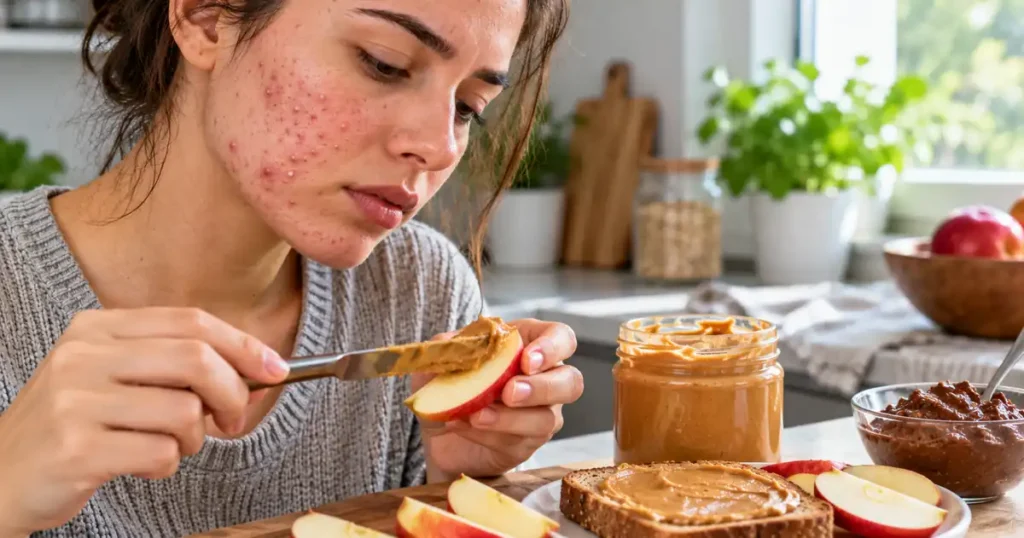
Peanut butter with apple slices or whole-grain toast creates a different nutritional context from a dessert-style peanut spread eaten with refined pastries and a sugary drink.
That distinction matters because the stronger evidence is about patterns such as glycemic load, not about demonizing a single ingredient.
If your goal is to improve the overall pattern instead of banning one food, our guide to building a more balanced skin-friendly diet focuses on practical meals, fiber-rich carbohydrates, protein, and realistic swaps.
Peanut Butter vs Better-Studied Diet and Acne Links
The easiest way to answer Does Peanut Butter Cause Acne responsibly is to compare the strength of the peanut-specific evidence with dietary factors that have been studied more directly.
| Dietary factor | Current acne evidence | Practical takeaway |
|---|---|---|
| Peanut butter | Direct evidence is very limited | No evidence-based reason for universal avoidance |
| High-glycemic dietary pattern | Better-supported association | Look at the overall diet rather than one food |
| Cow’s milk | Observational associations in some populations | Individual response may vary |
| Whey protein | Increasing attention in acne literature | Consider timing if acne began after supplementation |
| Omega-6/omega-3 balance | Emerging and indirect evidence | Does not prove peanut butter is causal |
The table also shows why simple “food X causes acne” claims can be misleading. Different diet-acne questions sit at very different levels of evidence.
Milk has been studied much more directly than peanut butter. If dairy or whey seems more closely connected to your breakouts, our guide to the evidence on dairy and acne explains what research supports, where it remains uncertain, and how to evaluate the pattern.
Does Peanut Butter Cause Acne for Some People? How to Test the Pattern
A personal food response is possible even when a universal effect has not been established. The goal is to test the idea without turning your diet into a long list of restrictions.
If you keep asking Does Peanut Butter Cause Acne because the same pattern seems to repeat, use a structured approach.
Do Not Judge One Meal
A pimple the morning after eating peanut butter is weak evidence. Acne lesions develop through a process that begins before the bump becomes visible, and several other factors can change at the same time.
Look for a repeated pattern over time rather than a single meal-and-breakout sequence.
Establish a Baseline
Before removing peanut butter, note what your skin is already doing. Track:
- New inflammatory pimples or clogged pores
- How often you eat peanut butter
- Dairy or whey intake
- New skin or hair products
- Medications or supplements
- Stress and sleep
- Menstrual-cycle timing when relevant
This gives you something to compare against. Otherwise, ordinary acne fluctuation can look like improvement or worsening.
Change One Variable
If you decide to test peanut butter, avoid removing several major food groups at once. Cutting peanuts, dairy, sugar, gluten, and oils together makes the result almost impossible to interpret.
Keep the rest of your routine reasonably stable. That is also less likely to create an unnecessarily restrictive diet.
Reassess Before Making the Restriction Permanent
If your acne seems consistently better without peanut butter, consider whether the pattern is reproducible.
Reintroduction can sometimes help clarify a suspected food relationship, but it should not be used if you have a known or suspected peanut allergy.
Acne and food allergy are different issues. Allergy symptoms require appropriate medical guidance and should not be tested through casual food challenges.
Should You Stop Eating Peanut Butter If You Have Acne?
For most people, there is no evidence-based reason to automatically stop eating peanut butter because of acne. The answer changes only when you have a repeatable personal pattern that makes a targeted test reasonable.
The question Does Peanut Butter Cause Acne should not turn into a rule that peanuts are “bad for skin.” Current research does not support that conclusion.
If you do remove peanut butter, keep the experiment focused. Do not assume that improvement proves a universal mechanism, and do not keep restricting more foods just because acne has not disappeared.
If dietary restriction starts affecting nutrition, food variety, or your relationship with eating, involve a qualified healthcare professional or registered dietitian.
When Diet Is Probably Not the Main Reason for Your Breakouts
Peanut butter becomes a less convincing explanation when breakouts continue regardless of whether you eat it.
Other possibilities deserve attention if:
- Acne follows a consistent hormonal pattern.
- You recently changed skin or hair products.
- Breakouts began after a medication or supplement change.
- Friction, sweating, or occlusive clothing affects the same area.
- Stress or sleep changed substantially.
- You have persistent nodules, cysts, or scarring.
- Removing peanut butter produces no meaningful change.
Acne is multifactorial. A food diary may identify a useful pattern, but it cannot replace evaluation of the other factors that drive acne.
Diet Changes Are Only One Part of Acne Care
Even if diet contributes to your acne, food changes should not replace evidence-based skin care or medication when those are needed.
Gentle cleansing, non-comedogenic products, avoiding picking, and using appropriate acne treatment remain important. Deep, painful, persistent, or scar-forming acne is a reason to seek professional care rather than relying on increasingly restrictive diets.
This is especially important when Does Peanut Butter Cause Acne becomes the main focus while active acne itself is going untreated. Identifying a food pattern can be useful, but controlling the acne process matters more for preventing ongoing inflammation and scars.
Frequently Asked Questions
Do peanuts cause hormonal acne?
There is no direct evidence showing that peanuts specifically cause hormonal acne. Hormonal acne is influenced by androgen signaling and other biological factors. Diet may affect acne pathways in some people, but current research does not establish peanuts as a specific hormonal trigger.
Is natural peanut butter better for acne?
Natural peanut butter may have a shorter ingredient list, which can make personal tracking simpler. However, there is no clinical evidence showing that natural peanut butter prevents acne while conventional peanut butter causes it.
Can added sugar in peanut butter make acne worse?
Added sugar contributes to the total glycemic pattern of your diet, and higher glycemic load has stronger acne evidence than peanut butter itself. That does not mean the sugar in one jar can be assumed to cause a breakout.
Does Peanut Butter Cause Acne if I eat it every day?
Does Peanut Butter Cause Acne simply because you eat it daily? Not based on current evidence. Frequency alone does not establish causation. Look for a repeatable relationship between intake and new breakouts while accounting for changes in diet, skin care, hormones, stress, and medication.
Is almond butter better than peanut butter for acne?
There is not enough direct comparative research to say almond butter is better for acne than peanut butter. If you switch products during a personal food test, treat the change as an observation rather than a proven acne treatment.
Conclusion
So, Does Peanut Butter Cause Acne? Current evidence does not show that peanut butter is a universal acne trigger. The better-supported dietary evidence concerns overall glycemic load, while milk, whey protein, and fatty-acid balance remain areas of ongoing research.
If peanut butter repeatedly seems linked with your breakouts, test that single variable methodically instead of banning multiple foods at once. If there is no repeatable relationship, there is little evidence-based reason to avoid it solely for acne.
Most importantly, do not let food testing replace treatment for persistent, painful, or scar-forming acne.
Medical and nutrition disclaimer: This article is educational and is not a diagnosis or a substitute for individualized medical or nutrition care. If you have a known or suspected peanut allergy, follow allergy-specific medical guidance rather than using reintroduction to test acne.
References:
- American Academy of Dermatology. Can the right diet get rid of acne?
- Dessinioti C, Dreno B. Diet and acne: Facts and controversies. Journal of the European Academy of Dermatology and Venereology. 2026.
- Meixiong J, Ricco C, Vasavda C, Ho BK. Diet and acne: A systematic review. JAAD International. 2022.
- Jung JY, Yoon MY, Min SU, et al. The influence of dietary patterns on acne vulgaris in Koreans. European Journal of Dermatology. 2010.