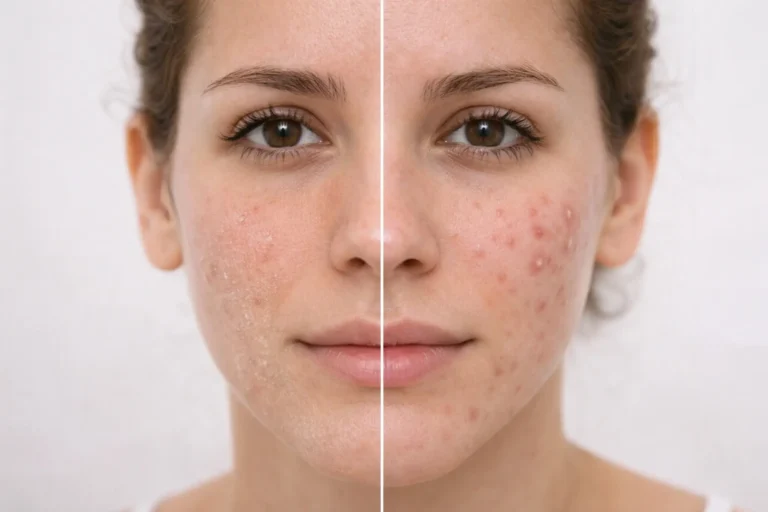
Will Peanut Butter Cause Acne? What the Evidence Really Shows
If you have noticed breakouts after eating peanut butter, you may be wondering Will Peanut Butter Cause Acne or whether peanuts should disappear from your diet completely.
The evidence does not support such a simple rule. Current research has not established peanut butter itself as a direct cause of acne. Broader dietary patterns—particularly high-glycemic eating and, in some populations, cow’s milk or whey protein—have stronger evidence behind them.
When asking Will Peanut Butter Cause Acne, it helps to separate direct evidence about peanuts from theories involving sugar, fats, or overall diet.
Quick answer: If your question is Will Peanut Butter Cause Acne, current evidence says there is no strong proof that ordinary peanut butter directly causes acne. If it repeatedly seems connected to your breakouts, you can track it as a possible individual trigger, but one breakout after one meal is weak evidence.
Table of Contents
Will Peanut Butter Cause Acne? What Current Research Actually Says
The most important fact is also the simplest: research directly testing peanut butter as an acne trigger is extremely limited.
Current evidence reviews focus much more heavily on glycemic load, dairy, whey protein, and broader dietary patterns. A 2026 review in the Journal of the European Academy of Dermatology and Venereology identified high-glycemic diets, skim or low-fat milk, whey protein supplements, and an imbalanced omega-6/omega-3 fatty-acid pattern as areas associated with acne research.
Peanut butter itself was not established as an acne-causing food.
That means Will Peanut Butter Cause Acne cannot currently be answered with a universal “yes.” The evidence simply is not strong enough to put ordinary peanut butter on a proven acne-trigger list.
A medically reviewed overview devoted specifically to peanut butter similarly notes that studies have not directly demonstrated that peanut butter causes acne.
That does not prove that no individual could ever notice a pattern after eating it. Population-level research and individual experience answer different questions.
What the Nut Studies Really Tell Us
One frequently discussed study examined dietary patterns among 783 Korean patients with acne and 502 controls.
The researchers found that reported nut intake was higher among the acne group than among controls. Nut consumption was also higher among people who reported that food aggravated their acne.
But this does not demonstrate that peanut butter caused their acne.
The study:
- Looked at nuts broadly rather than peanut butter specifically.
- Was observational rather than a randomized food intervention.
- Found several other dietary differences between groups.
- Could identify associations but not establish cause and effect.
So even when someone searches Will Peanut Butter Cause Acne and finds this study, the result should not be interpreted as direct peanut-butter evidence.
What Stronger Diet-Acne Evidence Points To
The better-supported diet question is not whether one specific nut butter causes pimples. It is whether certain overall dietary patterns may influence acne.
A systematic review published in JAAD International examined 34 studies and found that higher glycemic index and glycemic load were positively associated with acne development and severity. Dairy evidence was less consistent and varied by population and dietary habits.
The American Academy of Dermatology likewise says small studies suggest that a low-glycemic diet may reduce breakouts in some people and that cow’s milk has been associated with acne in several observational studies. More research is still needed.
Peanut butter is therefore only one small part of the diet-acne question. If you want the broader evidence, our guide to what current research says about foods that may worsen acne covers glycemic load, dairy, whey protein, processed foods, and ways to evaluate suspected triggers.
Will Peanut Butter Cause Acne Because of Omega-6 Fats?
Peanuts contain omega-6 fatty acids, and this fact is sometimes used online to argue that peanut butter is inherently inflammatory and therefore acne-causing.
The evidence is not that straightforward.
Omega-6 fatty acids are normal components of the diet. Current acne research is more interested in overall fatty-acid balance and dietary patterns than in proving that the omega-6 content of one food causes pimples.
So, Will Peanut Butter Cause Acne simply because peanuts contain omega-6? Current research does not support that conclusion.
The 2026 diet-and-acne review discusses an unbalanced omega-6/omega-3 ratio as a possible factor associated with acne, but it also stresses that controlled dietary studies remain limited and that restrictive diets should be avoided without good reason.
That evidence does not justify this chain of assumptions:
Peanut butter contains omega-6 → omega-6 is inflammatory → peanut butter causes acne.
There are too many unsupported steps between the nutrient and the claimed skin outcome.
What About Saturated Fat?
Peanut butter contains some saturated fat.
Older and newer diet research has investigated fat intake in relation to acne, but there is no good evidence showing that the amount of saturated fat in ordinary peanut butter directly causes breakouts.
The overall eating pattern matters more than isolating one nutrient from one food.
What About Peanut Lectins?
Another online theory focuses on peanut lectins, including peanut agglutinin, and claims they may affect the gut and then trigger acne.
There is currently no good clinical evidence showing that lectins in ordinary peanut butter cause acne.
For that reason, lectin theories do not provide a reliable answer to Will Peanut Butter Cause Acne, and there is no evidence-based reason to remove peanut butter solely because it contains lectins.
Will Peanut Butter Cause Acne If It Contains Added Sugar?
Some peanut butter products contain added sugar, but that still does not mean a sweetened peanut butter directly causes pimples.
The stronger acne evidence concerns the overall glycemic load of the diet.
High-glycemic foods raise blood glucose relatively quickly. A systematic review found a modest but significant association between higher glycemic index/load and acne.
AAD likewise reports that several small studies found fewer breakouts among participants following lower-glycemic diets, although not every study has found the same connection.
Therefore, when considering Will Peanut Butter Cause Acne, added sugar should be viewed as part of the total diet—not as proof that one jar of peanut butter is causing someone’s breakouts.
Read the Ingredient Label in Context
Peanut butter products can differ substantially.
You may see:
- Peanuts only
- Peanuts and salt
- Peanuts with added sugar
- Peanuts with added oils
- Sweetened chocolate or dessert-style peanut spreads
A shorter ingredient list may make it easier to test whether peanuts themselves seem related to your breakouts, but an unsweetened peanut butter is not automatically “acne-proof.”
Likewise, a product containing some added sugar is not automatically an acne trigger.
The Food You Pair With It Matters Too
Think beyond the spoonful of peanut butter.
Peanut butter eaten with whole fruit and higher-fiber toast exists in a very different dietary context from peanut butter inside a dessert made with refined flour, large amounts of added sugar, and a sweetened drink.
That does not mean one meal will determine your skin. It illustrates why nutrition research often studies overall dietary patterns instead of blaming one ingredient.
If your goal is to improve the overall pattern rather than ban one food, our guide to building a more balanced skin-friendly eating pattern focuses on practical food choices without unnecessary restriction.
Peanut Butter vs Better-Established Dietary Acne Factors
Another way to answer Will Peanut Butter Cause Acne is to compare the quality of peanut-specific evidence with dietary factors that have actually been studied more extensively.
| Dietary factor | Current acne evidence | Practical takeaway |
|---|---|---|
| Peanut butter | Direct evidence is very limited | No evidence-based need for universal avoidance |
| Higher-glycemic dietary pattern | Better-supported association | Worth assessing the overall diet |
| Cow’s milk | Observational associations in some populations | Individual response and population matter |
| Whey protein | Increasing concern in acne literature | Consider timing if acne began after supplementation |
| Omega-6/omega-3 imbalance | Emerging area of research | Does not prove peanut butter is causal |
The 2026 review particularly highlights high glycemic load, skim or low-fat milk, whey supplements, and fatty-acid balance as active areas of interest. It also cautions that the number of controlled dietary intervention studies remains relatively small.
Dairy has been studied far more directly than peanut butter. If milk or whey seems more suspicious in your routine, our guide to what research says about dairy and acne goes deeper into that evidence.
How to Tell Whether Peanut Butter Is a Personal Trigger
For an individual person, Will Peanut Butter Cause Acne may be better approached as a pattern-tracking question than as a universal food rule.
The absence of strong population-level evidence does not stop you from observing your own skin carefully.
The goal is to test the idea without turning your entire diet upside down.
Do Not Judge It From One Pimple
Acne lesions do not necessarily appear immediately after the event that contributed to them.
One spoonful of peanut butter at lunch followed by a pimple the next morning is therefore weak evidence of cause and effect.
Look for a repeated pattern instead.
Establish a Baseline
Before changing your diet, note what your acne has already been doing.
Useful factors to track include:
- Number and type of new lesions
- Peanut butter intake
- Other major dietary changes
- Dairy or whey supplements
- New skincare products
- Medication changes
- Menstrual cycle when relevant
- Stress
- Sleep
Without a baseline, normal acne fluctuations can easily look like a food reaction.
Change One Variable
If you want to test peanut butter, avoid simultaneously removing dairy, gluten, sugar, peanuts, oils, chocolate, and processed food.
If your acne improves, you will have no idea which change mattered.
AAD recommends paying attention to foods that seem repeatedly connected with breakouts and observing what happens when that food is removed.
Reassess Before Making It Permanent
If a consistent improvement appears after removing peanut butter, you can discuss whether reintroduction is appropriate to see whether the pattern returns.
Do not deliberately reintroduce peanuts as an experiment if you have a known or suspected peanut allergy. Acne and food allergy are completely different issues.
You also do not need to continue a restrictive diet indefinitely because of one uncertain observation.
Should You Switch to Natural Peanut Butter for Acne?
People asking Will Peanut Butter Cause Acne often also wonder whether “natural” peanut butter is safer for acne-prone skin.
There are no clinical trials showing that natural peanut butter prevents acne while conventional peanut butter causes it.
A product containing only peanuts, or peanuts and salt, can make dietary tracking simpler because fewer ingredients are involved. Choosing an unsweetened product also reduces added sugar intake.
But “natural” peanut butter is not a medical acne treatment, and it is not guaranteed to prevent breakouts.
The better question is whether the product fits your overall diet and whether you personally notice a reproducible skin response.
When Peanut Butter Probably Is Not the Main Cause
The question Will Peanut Butter Cause Acne can become misleading when other acne factors are much more obvious.
Acne is multifactorial. Hormones, genetics, follicular plugging, sebum production, inflammation, medications, cosmetics, and other factors can all matter.
Peanut butter becomes a less convincing explanation when:
- Your acne follows a clear hormonal pattern.
- Breakouts continue whether you eat peanut butter or not.
- You recently changed skincare products.
- Acne began after a new medication or supplement.
- You have persistent nodular or cystic acne.
- Removing peanut butter makes no meaningful difference.
- Several lifestyle factors changed at the same time.
One food is easy to blame because it is concrete and easy to remove. Acne biology is usually more complicated.
Diet Changes Should Not Replace Acne Treatment
Even if the answer to Will Peanut Butter Cause Acne seems personally relevant to you, removing one food should not replace evidence-based acne care.
AAD states that effective acne management generally still involves appropriate skincare and, when needed, acne medication.
Basic steps may include:
- Washing gently rather than scrubbing.
- Choosing non-comedogenic skincare products.
- Avoiding picking or squeezing lesions.
- Using evidence-supported over-the-counter acne treatment when appropriate.
- Following prescribed treatment consistently.
- Seeking dermatology care for deep, painful, persistent, or scar-forming acne.
Diet can be one piece of acne management without becoming the entire treatment plan.
Frequently Asked Questions
Does peanut butter cause hormonal acne?
There is no direct evidence showing that peanut butter specifically causes hormonal acne.
Hormonal acne is influenced by androgen activity and other biological factors. Diet may affect acne pathways in some people, but current research does not establish peanut butter as a specific hormonal-acne trigger.
Are peanuts bad for acne-prone skin?
There is no evidence-based rule requiring people with acne-prone skin to avoid peanuts.
One observational Korean study found higher reported nut intake among acne participants, but it did not isolate peanuts or peanut butter and could not establish causation.
Is almond butter better than peanut butter for acne?
There are no strong head-to-head clinical trials showing that almond butter is better for acne than peanut butter.
Switching may be useful during a personal food test, but it should not be presented as a proven acne treatment.
Should I stop eating peanut butter if I am breaking out?
Not automatically.
If you repeatedly ask Will Peanut Butter Cause Acne because breakouts seem to follow peanut butter intake, track the pattern before making permanent restrictions. Test one variable while keeping the rest of your routine relatively stable.
If removing peanut butter changes nothing, continued avoidance may not provide a skin benefit.
How long should I avoid peanut butter to see whether it affects acne?
There is no clinically validated peanut-butter elimination period for acne because peanut butter has not been established as a standard acne trigger.
Acne does not change reliably overnight, so track your skin consistently rather than judging the result after a day or two.
AAD suggests observing suspected foods over time and noting whether avoiding them actually changes breakouts.
Conclusion
So, Will Peanut Butter Cause Acne? Current evidence does not show that ordinary peanut butter directly causes acne in everyone.
The stronger diet-acne evidence concerns overall glycemic load and possible associations involving cow’s milk, whey protein, and broader dietary patterns. Research into omega-6 balance is evolving, but it does not establish peanut butter as a specific acne trigger.
If peanut butter consistently seems connected to your breakouts, test the pattern methodically instead of immediately eliminating multiple foods. Look at the full ingredient list, overall diet, skincare, medications, hormones, stress, and other changes occurring at the same time.
For most people, current evidence does not support avoiding peanut butter solely out of fear that it will cause acne.
If acne is persistent, painful, or causing scars, do not rely on dietary changes alone. Evidence-based acne treatment still matters.
Medical disclaimer: This article is for educational purposes only and is not a substitute for individualized medical or nutritional advice. Anyone with a known or suspected peanut allergy should follow allergy-specific medical guidance rather than using dietary reintroduction to test acne.
References:
- American Academy of Dermatology. Can the right diet get rid of acne?
- Dessinioti C, Dreno B. Diet and acne: Facts and controversies. Journal of the European Academy of Dermatology and Venereology. 2026.
- Meixiong J, Ricco C, Vasavda C, Ho BK. Diet and acne: A systematic review. JAAD International. 2022.
- Jung JY, et al. The influence of dietary patterns on acne vulgaris in Koreans. European Journal of Dermatology. 2010.
- Medical News Today. Does peanut butter cause acne? Everything to know