Skin Purging: Signs, Causes, Duration, and How to Tell It From a Breakout
Starting a new acne treatment and suddenly seeing more bumps can make you wonder whether your skin is getting worse or simply adjusting. Skin Purging is the term people often use for temporary acne worsening after certain treatments, but it is not a precise medical diagnosis. A breakout, irritation, contact reaction, or natural acne flare can look similar.
Quick answer: Skin Purging usually refers to an apparent temporary increase in acne after starting certain treatments, especially topical retinoids. Current tretinoin and adapalene labeling recognizes that acne can look worse during the early weeks before it improves. However, burning, marked redness, itching, peeling, or a rash may point more toward irritation than a useful “purge.”
Table of Contents
Skin Purging: What Does It Actually Mean?
In skincare, Skin Purging is commonly used to describe acne that appears to worsen after a new treatment is introduced and then settles as treatment continues. The phrase is useful shorthand, but it has limits. There is no single medical test for a “purge,” and direct research on the broader concept is limited.
That matters because online explanations often go too far. Skin does not need to “detox,” and worsening acne is not proof that impurities are being pushed out of your pores. A medically reviewed evidence summary notes that popular purging theories have not been directly proven and that research has not established how common the phenomenon is.
Topical retinoids provide a stronger, more concrete example of early treatment worsening. Current prescribing information for tretinoin gel states that inflammatory acne lesions may appear worse during the early weeks of treatment. Current OTC adapalene labeling also warns that acne may appear to worsen before it improves.
So the useful question is not simply, “Am I purging?” It is: What treatment did I start, what symptoms appeared, and are those symptoms more consistent with acne worsening or skin irritation?
What Causes Skin Purging — and Which Products Are Actually Relevant?
Not every new skincare product has the same chance of producing apparent early acne worsening. The active ingredient and its purpose matter.
Prescription and OTC Retinoids
Retinoids have the clearest documented connection with early worsening. Tretinoin and adapalene are established acne treatments that help prevent clogged pores. The American Academy of Dermatology includes topical retinoids among its strongly recommended acne therapies.
With tretinoin, official labeling specifically recognizes an apparent increase in inflammatory lesions during the first weeks. With adapalene 0.1%, current OTC labeling similarly says acne may appear worse during the early weeks and also warns that redness, itching, dryness, and burning can occur.
Those two effects can happen at the same time. You can have more visible acne lesions and also have irritated skin, but the irritation is not automatically part of a healthy purge.
If tretinoin is the treatment behind your current breakout, our guide to what to expect when starting tretinoin for acne covers its adjustment period, irritation, treatment timeline, and longer-term role in acne care in more detail. Tretinoin for Acne — Beyond Breakouts
Exfoliating Acids
Salicylic acid, glycolic acid, lactic acid, and other exfoliating acids are often discussed in connection with Skin Purging because they affect how surface skin cells are shed and, depending on the ingredient, can help with clogged pores. However, it is too simplistic to assume that everyone who starts an AHA or BHA should expect a purge.
These ingredients can also cause dryness, stinging, peeling, or irritation, especially when combined with retinoids, benzoyl peroxide, or additional exfoliants. The AAD warns that exfoliating while using products that already make skin sensitive or peel can worsen dryness and irritation.
Products That Should Not Automatically Be Blamed
A new moisturizer, hyaluronic acid serum, or niacinamide product does not automatically create a retinoid-like purge. A complete formula can still irritate the skin or contribute to breakouts in some people, but that is a different question.
If niacinamide is the product that made you start wondering about purging, read our guide to whether niacinamide really causes purging. It explains why new bumps after a niacinamide product may point instead to irritation, another ingredient in the formula, or an ordinary acne flare. Does Niacinamide Cause Purging? — Beyond Breakouts
Procedures are another separate issue. If bumps appeared after a treatment rather than a new cream or serum, see our dedicated guide to purging after microneedling, which explains why post-procedure bumps can have several possible causes. Purging After Microneedling — Beyond Breakouts
Skin Purging vs Breakout: How Can You Tell the Difference?
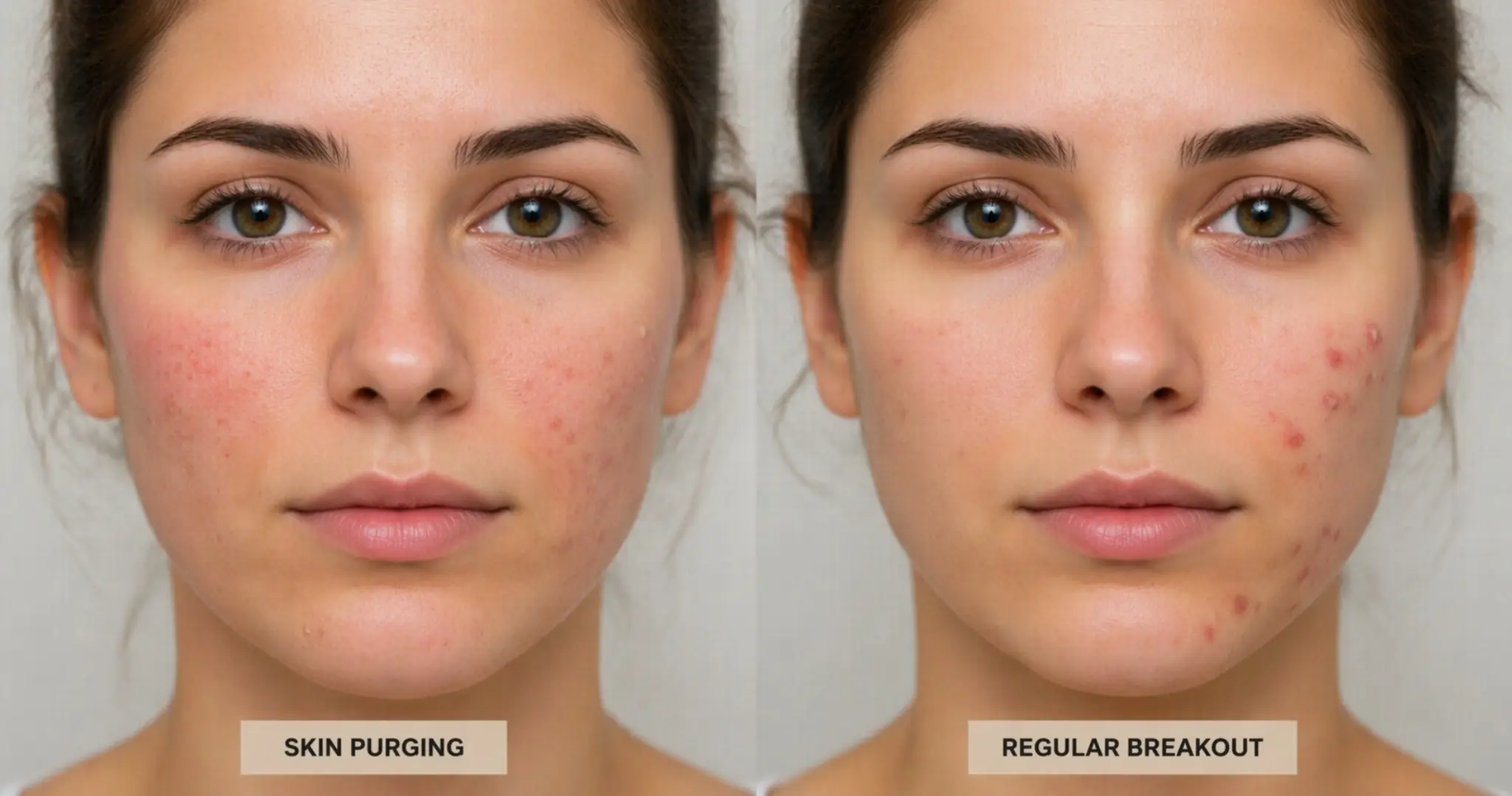
There is no perfect visual rule for separating Skin Purging from an ordinary breakout. Timing, the treatment you started, your usual acne pattern, and the direction the reaction is moving are more useful when considered together.
| Clue | Possible early treatment worsening | Ordinary breakout | Irritation or reaction |
|---|---|---|---|
| Recent treatment change | Often relevant | May or may not be relevant | Often relevant |
| Type of product | More plausible with certain acne treatments, especially retinoids | Any product or no product change | Any irritating or allergenic product |
| Acne lesions | Usually present | Present | Small acne-like bumps can occur |
| Burning or stinging | Not the defining feature | Usually not dominant | More concerning |
| Itching | Not a defining feature | Usually limited | More suggestive |
| Peeling or diffuse redness | May coexist because of treatment | Not typical of acne alone | Often prominent |
| Course | Should eventually settle if temporary | Can persist or recur | May continue with repeated exposure |
No single row in this table can diagnose your skin.
Location Is a Clue, Not Proof
You may read that Skin Purging always occurs exactly where you normally break out. Familiar acne-prone areas can be a useful clue, but they do not prove the cause. Ordinary acne also tends to recur in familiar locations.
Likewise, a breakout in a new area does not automatically prove that a product is clogging your pores. Friction, hair products, hormonal changes, medication, or an unrelated skin condition can alter where bumps appear.
The strongest clue remains the treatment itself. If you started adapalene or tretinoin and acne temporarily worsened during the early treatment period, that pattern is specifically recognized in current drug labeling.
Skin Purging vs Irritation: The Difference Matters
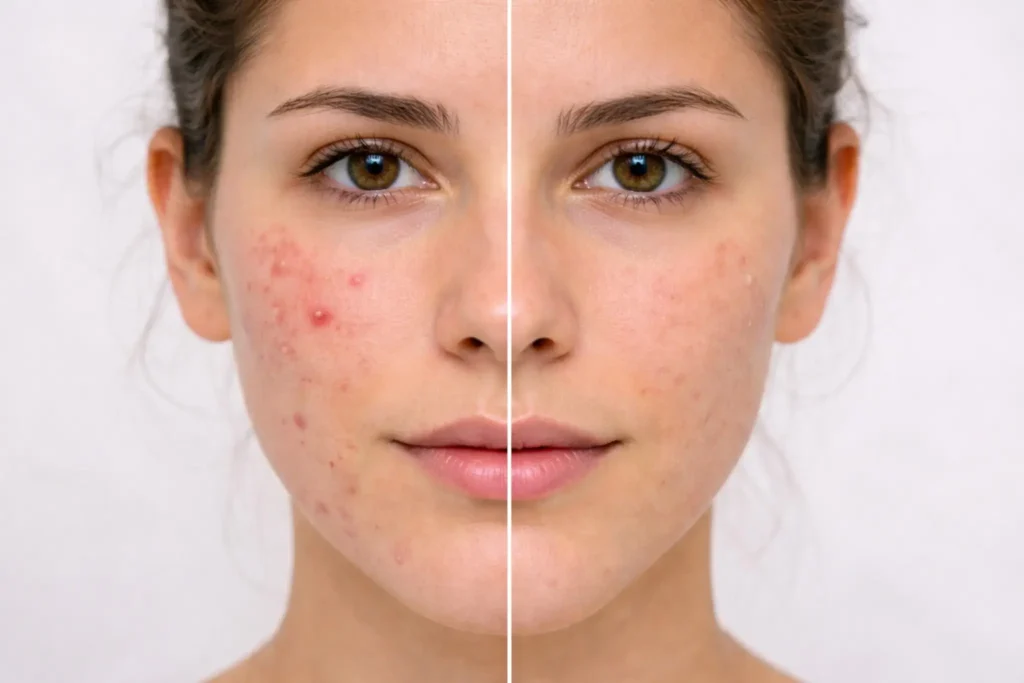
Skin Purging should not become a catch-all label for any unpleasant reaction to skincare.
Retinoids commonly cause local irritation. Current tretinoin labeling warns about local skin reactions, and current adapalene labels list redness, itching, dryness, and burning as more likely during the first weeks of use.
Signs that deserve more attention to irritation include:
- Persistent burning or stinging
- Diffuse or intense redness
- Significant itching
- Heavy peeling or scaling
- Cracking or raw-feeling skin
- Increasing tenderness
- Swelling
- Rash or hives
Dryness and mild peeling can occur with retinoids, but “it burns, therefore it is working” is not a safe rule.
The AAD advises people who develop retinoid irritation to work with their dermatologist. Depending on the situation, a dermatologist may adjust how much medication is used, how frequently it is applied, or how moisturizer is incorporated rather than having the patient simply force their way through severe irritation.
Moisturizer can also make acne treatment easier to tolerate. The AAD notes that adapalene, tretinoin, benzoyl peroxide, and salicylic acid can dry or irritate skin and that moisturizer can help reduce this problem.
Purging Is Not the Same as “Retinization”
People sometimes use several skincare terms interchangeably. Early dryness, peeling, and sensitivity from a retinoid describe treatment tolerance or adjustment. They do not necessarily mean that acne itself is purging.
That distinction helps you respond appropriately. More acne lesions and irritated skin can occur together, but redness, burning, and cracking still deserve attention as irritation.
How Long Does Skin Purging Last?
There is no evidence-based universal countdown for Skin Purging. The common “four to six weeks” rule is too rigid because different treatments have different formulations, strengths, directions, and response timelines.
For tretinoin, current labeling recognizes apparent worsening during the early weeks. Some labels also state that more than six weeks of treatment may be required before definite beneficial effects are seen.
For OTC adapalene 0.1%, a current 2026 label says acne may appear to worsen during the early weeks and that results can take up to three months of once-daily use. The label also advises asking a doctor if there is no improvement after three months.
These timelines should not be copied onto every cosmetic serum or exfoliating toner. A breakout after niacinamide, for example, does not get an automatic three-month “purge pass” simply because adapalene can take that long to show results.
Instead of watching a calendar alone, watch the direction of change. Is the acne gradually settling? Is the irritation manageable? Or is each week bringing more burning, swelling, rash-like bumps, or deeper lesions?
What to Do During Skin Purging Without Making Irritation Worse
If the treatment involved can reasonably cause early acne worsening and the reaction is mild, the goal is usually to keep the rest of the routine simple enough to judge what is happening.
Keep Cleansing Gentle
Use a mild cleanser and avoid scrubbing. Abrasive brushes, rough washcloths, and repeated exfoliation can add irritation without making acne clear faster.
Use a Moisturizer
Choose a moisturizer that suits acne-prone skin. The AAD recommends looking for terms such as non-comedogenic, oil-free, or won’t clog pores when selecting moisturizers for acne-prone skin.
Avoid Starting Several New Actives
If you begin adapalene, an exfoliating toner, benzoyl peroxide, and a new serum at the same time, a reaction becomes difficult to interpret.
Current adapalene labeling specifically notes that irritation is more likely when more than one topical acne medication is used at the same time.
Protect Skin From the Sun
Topical retinoids can increase sun sensitivity. Follow the medication label and use appropriate sun protection.
AAD acne guidance also recommends broad-spectrum, water-resistant SPF 30 or higher for acne-prone skin when outdoors.
Do Not Pick
Picking, popping, or squeezing can delay healing and increase the risk of acne scars and post-inflammatory dark marks.
Follow Prescription Instructions
If your Skin Purging question started after a prescription treatment, do not independently increase, decrease, stop, or rearrange the medication based only on an online purge schedule.
Contact the prescriber when irritation is difficult to tolerate or when the reaction is unclear.
When Skin Purging Deserves a Second Look
A temporary adjustment should not become a reason to ignore progressively worse symptoms.
Reassess the situation if you develop:
- Strong or persistent burning
- Marked itching
- Significant swelling
- Blistering or a spreading rash
- Cracked or raw skin
- Rapidly worsening acne
- Deep, painful nodules or cysts
- New scarring
- An eruption unlike your usual acne
- Symptoms that continue to intensify rather than settle
Severe allergic-type symptoms such as facial swelling or trouble breathing require urgent medical attention.
For adapalene, current OTC labeling specifically tells users to stop use and ask a doctor if severe irritation or symptoms of an allergic reaction develop.
If your acne is becoming deep, painful, or scar-forming, a dermatologist can also help determine whether the treatment needs adjustment or whether a different acne strategy is appropriate.
Should You Stop the Product or Keep Going?
There is no safe one-line answer because Skin Purging can describe very different situations.
If you are using a prescribed retinoid and acne looks somewhat worse but your skin remains tolerably comfortable: follow the prescription instructions and contact your prescriber if you are concerned. Current tretinoin labeling recognizes that early worsening alone is not necessarily a reason to discontinue treatment when the medication is otherwise tolerated.
If an OTC adapalene product is causing mild early acne worsening: follow its Drug Facts directions. Current labels say to continue as directed unless irritation becomes severe.
If a cosmetic product causes marked burning, itching, swelling, or a worsening rash: do not keep using it simply because someone called the reaction a purge. Remove the suspected trigger and seek medical advice when symptoms are significant or persistent.
If you started several products together: simplify. Fewer moving parts make it easier to identify what changed.
If you cannot tell what is happening: professional evaluation is more reliable than trying to diagnose acne, irritant dermatitis, allergic contact dermatitis, folliculitis, or another eruption from a checklist.
Frequently Asked Questions
Does Skin Purging mean a product is working?
No. Worsening skin by itself does not prove that a treatment is effective. Some retinoids have documented early acne worsening, but irritation, an ordinary acne flare, or another reaction can also appear after starting a product.
Judge the treatment by the active ingredient, expected response, tolerance, and eventual improvement—not by worsening alone.
Can Skin Purging happen with niacinamide?
Niacinamide alone is not generally expected to create the retinoid-like early acne worsening documented with tretinoin and adapalene.
If bumps appear after a niacinamide product, review the complete formula, other recent routine changes, and symptoms such as burning or itching before calling it purging. Beyond Breakouts has a dedicated guide examining this specific question.
Does Skin Purging always happen with retinol or tretinoin?
No. Early acne worsening can occur with retinoid treatment, but it is not guaranteed.
Some people primarily notice dryness or irritation, while others tolerate treatment with little difficulty. Tretinoin is also a prescription medication, so follow the directions given by the clinician managing your acne.
Can Skin Purging cause cystic acne?
Do not automatically label new deep, painful nodules or cyst-like lesions as healthy purging.
Severe inflammatory acne has a greater risk of leaving scars and deserves professional evaluation, especially when it is new, rapidly worsening, or significantly different from your usual acne pattern.
How do I know when Skin Purging has gone on too long?
There is no universal deadline. Use the timeline for the actual treatment rather than a generic social-media rule.
With adapalene, current labeling allows up to three months to see results, while some tretinoin labeling says more than six weeks may be needed for definite benefit. Persistent worsening, severe irritation, scarring, or symptoms outside the expected label guidance are reasons to seek professional advice.
Conclusion
Skin Purging is useful shorthand for apparent temporary acne worsening, but it should not become a diagnosis for every breakout after a new product.
Retinoids such as tretinoin and adapalene provide the clearest documented examples of early worsening, while burning, significant redness, itching, and heavy peeling deserve separate attention as possible irritation.
Focus on what you actually started, how your symptoms are changing, and whether the treatment is being tolerated. Keep the rest of the routine simple, follow prescription or Drug Facts directions, and get professional help when the reaction is severe, scarring, persistent, or difficult to identify.
Medical disclaimer: This article is for educational purposes only. It cannot diagnose Skin Purging, acne, irritant dermatitis, allergic contact dermatitis, or another skin condition and is not a substitute for individualized care from a qualified healthcare professional.
References:
- U.S. National Library of Medicine, DailyMed — Tretinoin Gel (Microsphere) Prescribing Information. DailyMed tretinoin prescribing information
- U.S. National Library of Medicine, DailyMed — Adapalene Gel 0.1% Drug Facts. Current 2026 labeling verifies early apparent worsening, irritation warnings, and treatment timeline. DailyMed adapalene label
- American Academy of Dermatology — Acne: Diagnosis and Treatment. AAD acne diagnosis and treatment guidance
- American Academy of Dermatology — Moisturizer: Why You May Need It If You Have Acne. AAD moisturizer guidance
- Medical News Today — What to Know About Skin Purging. Used specifically for the limitations of the broader purging concept rather than medication-label claims. Medical News Today skin purging evidence review