How to Eliminate Bacne: Best Products That Work
If you are trying to figure out how to eliminate bacne, start with the active ingredient rather than the strongest-looking bottle on the shelf. For mild to moderate back acne, benzoyl peroxide and salicylic acid are two of the most useful over-the-counter options, but they do different jobs and can irritate skin when used too aggressively.
Benzoyl peroxide is particularly useful for inflamed acne, while salicylic acid helps unclog pores and exfoliate dead skin. The right product also needs to be practical enough to use consistently across a large, sometimes hard-to-reach area like the back. Deep, painful, or scarring acne is different and deserves dermatologist care rather than an endless series of stronger body washes.
Table of Contents
How to Eliminate Bacne: Start With the Right Active Ingredient
For mild to moderate bacne, an acne wash containing benzoyl peroxide is one of the strongest evidence-based OTC starting points, particularly when you have red, inflamed pimples. Salicylic acid may be a better fit when clogged pores, blackheads, whiteheads, and numerous smaller bumps are the main problem. Neither ingredient needs to be used at maximum strength to be useful.
The FDA’s OTC acne monograph allows benzoyl peroxide concentrations from 2.5% to 10% and salicylic acid from 0.5% to 2% in qualifying acne medications.
That gives you plenty of options without automatically reaching for the harshest formula available.
How to Eliminate Bacne With Benzoyl Peroxide vs. Salicylic Acid
| Feature | Benzoyl Peroxide | Salicylic Acid |
|---|---|---|
| Often best suited to | Red, inflamed acne pimples | Clogged pores, blackheads, whiteheads, smaller bumps |
| OTC concentration range | 2.5%–10% | 0.5%–2% |
| Common body formats | Washes and cleansers | Washes and leave-on sprays |
| Common limitation | Dryness, peeling, fabric bleaching | Dryness, stinging, irritation |
| Useful practical detail | Contact time matters with a wash | Leave-on sprays can reach the middle of the back |
| Strongest concentration needed? | Not automatically | Not automatically |
The goal is not to pick a winner between the two ingredients. It is to match the product to the type of breakout you are dealing with.
Best Bacne Products by Concern
The following products were chosen by active ingredient, concentration, format, current manufacturer information, and usefulness for different bacne patterns—not by Amazon ratings, popularity, or commission.
PanOxyl Acne Creamy Wash 4% Benzoyl Peroxide: A Practical Starting Option
PanOxyl Acne Creamy Wash contains 4% benzoyl peroxide and is intended for acne-prone skin on the face and body. Its current formula is designed as a lower-strength alternative to the company’s 10% wash and includes humectants and emollients intended to reduce dryness.
Why it can make sense:
- 4% benzoyl peroxide is strong enough to be an OTC acne medication.
- A lower concentration may be easier to tolerate than immediately jumping to 10%.
- It can be used on the chest and back.
- A rinse-off format is convenient for larger areas.
The main limitation is still irritation. Benzoyl peroxide can cause dryness, peeling, or redness even in a creamier formula.
AAD guidance specifically notes that a mid-strength benzoyl-peroxide wash may be less irritating than a 10% option. Although its guidance cites a 5.3% wash rather than this exact PanOxyl formula, the principle is useful: stronger is not automatically better.
Check PanOxyl 4% Benzoyl Peroxide Creamy Wash on Amazon
PanOxyl Acne Foaming Wash 10%: Maximum OTC Strength
PanOxyl Acne Foaming Wash contains 10% benzoyl peroxide, which is the highest concentration allowed in an OTC benzoyl-peroxide acne medication under the current FDA monograph. PanOxyl directs users to wet the area, massage the cleanser into the skin for one to two minutes, rinse thoroughly, and begin with once-daily use before increasing if needed and tolerated.
This option may appeal to someone who:
- Has persistent inflammatory body acne.
- Has already tolerated benzoyl peroxide.
- Wants a face-and-body wash.
- Has not found a lower concentration adequate.
But maximum strength should not be treated as the automatic first choice.
A higher concentration can increase irritation, and AAD guidance specifically points out that lower-strength benzoyl-peroxide washes may cause less dryness and peeling.
Check PanOxyl 10% Acne Foaming Wash on Amazon

CeraVe Acne Foaming Cream Cleanser 4%: Benzoyl Peroxide With Barrier-Supporting Ingredients
CeraVe Acne Foaming Cream Cleanser contains 4% benzoyl peroxide. Its current formula also includes ceramides, niacinamide, glycerin, and sodium hyaluronate. CeraVe directs users to begin with once-daily treatment if needed because excessive dryness can occur.
This makes it worth considering when you want a benzoyl-peroxide cleanser but are also paying attention to skin-barrier comfort.
Its strengths include:
- 4% benzoyl peroxide.
- Cream-to-foam texture.
- Ceramides.
- Niacinamide.
- No need to use maximum-strength benzoyl peroxide.
The limitation is that the supportive ingredients do not remove the normal risks of benzoyl peroxide. It is still a medicated acne treatment and can still cause dryness, peeling, or sensitivity.
Check CeraVe Acne Foaming Cream Cleanser 4% on Amazon
Neutrogena Body Clear Body Wash: Salicylic Acid for Clogged Body Pores
If your back is covered mainly with smaller bumps, whiteheads, blackheads, or clogged-looking pores rather than larger inflamed pimples, a salicylic-acid body wash may make more sense.
Neutrogena Body Clear Body Wash currently contains 2% salicylic acid and is marketed for acne on the back, chest, and shoulders. The current formula is oil-free and contains glycerin.
Salicylic acid can exfoliate within clogged pores, making this type of wash especially relevant for comedonal body acne.
One limitation is fragrance. If you already know fragranced body products aggravate your skin, take that into account before purchasing.
Check Neutrogena Body Clear 2% Salicylic Acid Wash on Amazon
Differin Acne-Clearing Body Spray: For Hard-to-Reach Areas
Sometimes the problem is not the ingredient—it is reaching the middle of your back.
Differin Acne-Clearing Body Spray contains 2% salicylic acid in a 360-degree spray format designed for hard-to-reach body breakouts. The current formula also contains glycolic acid, alcohol denat., and witch hazel.
Its main advantage is practical: you can apply a leave-on acne treatment to areas that are difficult to cover evenly with a cream.
It may be useful for:
- Upper-back acne.
- Shoulder acne.
- Chest acne.
- Clogged pores and smaller body breakouts.
- Readers who cannot easily apply a lotion to the center of the back.
The formula is more than just salicylic acid, however. Because it also contains glycolic acid and alcohol, piling it on top of several other exfoliating products may increase dryness or irritation.
Check Differin Acne-Clearing Body Spray on Amazon
How to Use Benzoyl Peroxide Wash Correctly
Choosing a good product is only half of how to eliminate bacne. A wash that is rinsed away immediately may not perform the same way as one given appropriate contact time.
The AAD recommends allowing a benzoyl-peroxide wash to sit on the back for approximately two to five minutes before rinsing. The skin on the back is thicker than facial skin, and this contact time can help the medication work more effectively.
A practical shower routine is:
- Wet your back.
- Apply the benzoyl-peroxide cleanser according to its label.
- Spread it gently over the acne-prone area rather than scrubbing aggressively.
- When appropriate for the product and your skin, allow brief contact time.
- Rinse thoroughly.
- Pat the skin dry.
- Use a moisturizer if your skin becomes dry.
There is an important nuance: follow the directions on your specific product first. PanOxyl, for example, currently directs users to massage its washes for one to two minutes. AAD’s broader back-acne guidance describes two to five minutes. Product-specific directions should not be ignored simply to reach the longest possible contact time.
Benzoyl peroxide can bleach fabric
Benzoyl peroxide is well known for bleaching towels, shirts, sheets, and other fabrics.
Rinse thoroughly and consider using light-colored or white towels while you are figuring out your routine. The AAD specifically notes that rinsing benzoyl peroxide from the back helps reduce fabric bleaching.
Should You Start With 4% or 10% Benzoyl Peroxide?
For many people, starting with a lower concentration is reasonable.
A 10% wash is not necessarily twice as useful as a 5% wash simply because the number on the bottle is twice as large. What matters is whether the treatment controls your acne without causing enough irritation that you stop using it.
Consider 4% benzoyl peroxide when:
- You are new to benzoyl peroxide.
- Your skin dries easily.
- You want to start conservatively.
- Your bacne is mild to moderate.
A 10% wash may be worth considering when:
- You already know that you tolerate benzoyl peroxide.
- Lower-strength treatment has been inadequate.
- Your body acne is more persistent.
- You have discussed stronger OTC treatment with a dermatologist.
If a 4% wash is controlling your bacne, there is no prize for moving to 10%.
When Salicylic Acid Makes More Sense
Benzoyl peroxide gets a lot of attention in back-acne treatment, but salicylic acid has a different useful role.
Consider a salicylic-acid product when your back has:
- Blackheads.
- Whiteheads.
- Small clogged bumps.
- Rough pore congestion.
- Mild breakouts spread over a large body area.
The maximum OTC concentration under the FDA monograph is 2%, which is why products such as Neutrogena Body Clear and Differin Body Spray commonly use that strength.
If your main problem is large, red, inflamed pimples, benzoyl peroxide may be the more logical product to evaluate first.
Wash or Spray: Which Is Better for Back Acne?
Neither format wins for everyone.
A wash makes sense when:
- You want to treat a large area in the shower.
- You prefer a rinse-off treatment.
- Benzoyl peroxide is your chosen active.
- You can easily cover most of the affected skin.
A spray makes sense when:
- You cannot reach the center of your back.
- You want a leave-on salicylic-acid treatment.
- Your shoulders and upper back have numerous clogged pores.
- Applying cream evenly is impractical.
A spray also remains on the skin, which means irritation matters. Avoid assuming a leave-on product should be sprayed repeatedly throughout the day unless its current label says to do so.
How to Eliminate Bacne With a Simple Product Routine
You do not need five acne products to start.
In the shower
Choose one medicated cleanser based on your acne pattern.
For inflammatory acne, that might be a benzoyl-peroxide wash.
For predominantly clogged pores, a salicylic-acid body wash may be enough to start.
Do not scrub your back with a rough brush or abrasive loofah in an attempt to physically remove acne. Friction and irritation can make inflamed skin harder to manage.
After exercise
Change out of sweaty clothing and shower when practical.
Tight, sweaty clothing and repeated friction can contribute to back breakouts. For a deeper explanation of common triggers, see Beyond Breakouts’ guide to common triggers behind back breakouts:
Why Do I Have Back Acne? 13 Common Triggers Explained
After showering
If the wash alone is not enough and your skin tolerates it, a leave-on treatment may sometimes fit into the routine.
This does not mean that everyone using benzoyl peroxide should automatically add a 2% salicylic-acid spray.
Introduce products with a clear purpose. If your skin begins burning, peeling heavily, or becoming very irritated, simplifying the routine may make more sense than adding another active.
A plain, noncomedogenic moisturizer can also be helpful when medicated body products cause dryness.
What About Chest Acne?
Many acne on back products are also labeled for use on the chest and shoulders.
Neutrogena’s current Body Clear wash, for example, is marketed for back, chest, and shoulder acne, while PanOxyl’s current benzoyl-peroxide washes are intended for both face and body.
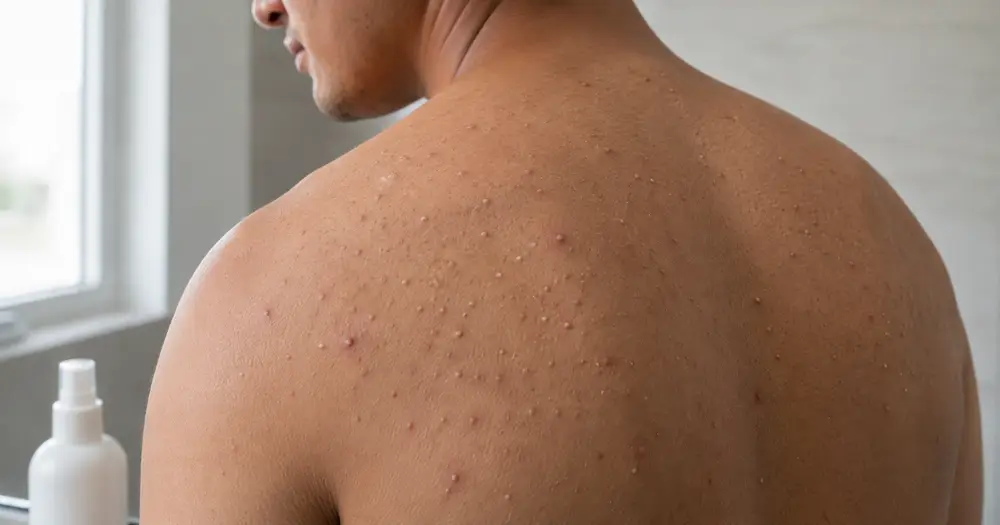
But not every cluster of bumps on the chest or back is necessarily acne.
If bumps are very itchy, unusually uniform, spreading despite appropriate acne treatment, or simply do not behave like acne, professional evaluation can help determine whether something else is going on.
Common Product Mistakes That Can Make Bacne Harder to Clear
Buying maximum strength first
A 10% benzoyl-peroxide wash can be appropriate, but more concentration also means more potential irritation.
Start with the product that fits your acne and tolerance—not the biggest percentage on the bottle.
Scrubbing harder
Acne is not caused by having a dirty back. Aggressive scrubbing does not clean acne out of your pores and can irritate inflamed skin.
Using several medicated washes together
A benzoyl-peroxide wash in the morning, salicylic-acid wash after exercise, exfoliating scrub at night, and leave-on acid spray may create more inflammation than improvement.
Forgetting that benzoyl peroxide bleaches fabric
Rinse thoroughly and plan accordingly with towels, bedding, and clothing.
Changing products every few days
Acne treatment takes time. Constantly switching products makes it difficult to tell whether a treatment is helping.
Picking back acne
Squeezing or scratching inflamed pimples increases trauma to the skin and can increase the chance of lasting marks or scars.
A Current Safety Note About Benzoyl Peroxide Storage
Benzoyl peroxide received additional attention after FDA testing announced in March 2025 found elevated benzene levels in a small number of tested acne products. According to the AAD, more than 90% of the 95 products tested by FDA had undetectable or extremely low benzene levels, while several products led to voluntary retail-level recalls.
AAD currently recommends:
- Store benzoyl-peroxide products according to package instructions, generally at room temperature or cooler.
- Replace them approximately every 10–12 weeks.
- Discard benzoyl-peroxide products exposed to temperatures above about 78°F.
- Speak with a dermatologist if you want to avoid benzoyl peroxide.
This guidance is worth remembering if you keep acne products in a hot bathroom, vehicle, gym bag, or other high-temperature location.
How Long Should Bacne Products Take to Work?
Bacne does not usually disappear in a few days.
AAD guidance tells people treating mild or moderate back acne at home to follow an acne-friendly treatment plan consistently and notes that if they do not see results after about six to eight weeks, dermatologist evaluation may be appropriate.
That does not mean every reader will be completely clear at eight weeks.
Instead, look for progress such as:
- Fewer new inflamed pimples.
- Less widespread clogging.
- Existing breakouts healing.
- Longer periods between flares.
- Treatment remaining tolerable enough to use consistently.
If nothing is changing despite correct and consistent use, reconsider the diagnosis or treatment strategy instead of simply buying a harsher cleanser.
How to Eliminate Bacne With a Simple Product Routine
OTC products are most appropriate for relatively mild or moderate acne.
See a board-certified dermatologist if you have:
- Deep, painful nodules or cysts.
- Acne that is leaving scars.
- Rapidly worsening inflammation.
- Large areas of persistent acne.
- Significant pain.
- No meaningful improvement after a consistent OTC routine.
- A rash or bumps you are not sure are acne.
- Bacne that is causing substantial emotional distress.
AAD guidance specifically states that deep, painful back acne needs dermatologist care.
For the broader treatment approach—including causes, prescription options, prevention, and longer-term routines—see our complete back acne treatment guide:
Back Acne Treatment: Learn the Causes, Symptoms, and Best Ways to Clear Breakouts
Frequently Asked Questions
What product is best for bacne?
The best product depends on the type of breakout. A benzoyl-peroxide wash is a strong starting option for inflamed red pimples, while a 2% salicylic-acid body wash or spray may make more sense for clogged pores, whiteheads, and smaller bumps. Choose according to the problem and your skin’s tolerance rather than brand popularity.
Is benzoyl peroxide or salicylic acid better for back acne?
Benzoyl peroxide is often the stronger choice for inflammatory back acne, while salicylic acid is particularly useful for unclogging pores and exfoliating. Some people eventually use both ingredients in a larger treatment plan, but you do not need to begin with several medicated products simultaneously.
Can I use a bacne product on chest acne?
Often, yes, when the product’s label allows body use. Several body-acne washes are specifically intended for the back, chest, and shoulders. However, if chest bumps are very itchy, unusually uniform, or do not improve with appropriate acne treatment, consider professional evaluation because not every body eruption is acne.
How long should benzoyl peroxide stay on my back?
AAD back-acne guidance recommends allowing a benzoyl-peroxide wash to remain on the skin for about two to five minutes before rinsing. However, always check your specific product directions because manufacturers may recommend a shorter contact time. For example, current PanOxyl wash directions specify massaging for one to two minutes before rinsing.
Why is my bacne not improving with acne body wash?
Possible reasons include using the wrong active ingredient, stopping too soon, inconsistent application, excessive irritation, deeper acne that needs prescription treatment, or having an acne-like condition rather than acne. If a consistent OTC routine is not helping after several weeks, or your acne is painful or scarring, a dermatologist can help determine the next step.
The Bottom Line
If you want to know how to eliminate bacne, resist the urge to build the strongest possible routine.
Start by matching the treatment to the breakout. Benzoyl peroxide is a strong choice for inflammatory back acne, and a 4% formulation may be enough for many people without immediately moving to maximum strength. Salicylic acid can be useful when clogged pores, whiteheads, or smaller bumps dominate. A spray can also make treatment easier when the problem is simply reaching the middle of your back.
Use one appropriate product consistently, follow the label, give it time to work, and pay attention to irritation. If your bacne is deep, painful, scarring, or not improving with appropriate OTC care, the next purchase should not necessarily be another stronger body wash—it may be time to see a dermatologist.
This article is for educational purposes only. It does not provide a diagnosis and is not a substitute for care from a qualified healthcare professional.
References:
- American Academy of Dermatology — Back acne: How to see clearer skin. Covers OTC benzoyl peroxide, contact time, concentration considerations, fabric bleaching, treatment expectations, and when dermatologist care is appropriate. AAD back acne guidance
- U.S. Food and Drug Administration — OTC Monograph M006: Topical Acne Drug Products for OTC Human Use. Lists permitted OTC concentrations of benzoyl peroxide and salicylic acid. FDA OTC acne monograph
- American Academy of Dermatology — FAQs: Benzene in acne products containing benzoyl peroxide. Current storage and replacement recommendations. AAD benzoyl peroxide safety guidance
- PanOxyl — Acne Creamy Wash Benzoyl Peroxide 4%. Current active concentration and manufacturer directions. PanOxyl 4% Creamy Wash
- PanOxyl — Acne Foaming Wash Benzoyl Peroxide 10%. Current active concentration and manufacturer directions. PanOxyl 10% Foaming Wash
- CeraVe — Acne Foaming Cream Cleanser. Current 4% benzoyl-peroxide formula, ingredients, directions, and warnings. CeraVe Acne Foaming Cream Cleanser
- Neutrogena — Body Clear Oil-Free Body Acne Wash with Salicylic Acid. Current 2% salicylic-acid formula and intended body areas. Neutrogena Body Clear Body Wash
- Differin — Acne-Clearing Body Spray. Current 2% salicylic-acid formula, spray format, and additional ingredients. Differin Acne-Clearing Body Spray