Can Biotin Cause Acne? What to Know About Supplement Breakouts
If your skin started breaking out after you added a hair, skin, and nails vitamin, you may be wondering: can biotin cause acne?
The connection is not as clear as many social-media posts make it sound. People commonly report acne after taking biotin supplements, but current research has not established that biotin directly causes acne. The popular theory involving vitamin B5 also has not been proven to explain breakouts in people.
That does not mean you should ignore the timing. If acne appeared soon after you started a supplement, it is reasonable to investigate. The most useful approach is to look at the dose, the complete supplement formula, other recent changes, and the type of breakout rather than automatically blaming biotin.
Table of Contents
Can Biotin Cause Acne? The Short Answer
There is currently no strong clinical evidence proving that biotin directly causes acne. Breakouts are frequently reported by people taking biotin, especially high-dose beauty supplements, but reports alone cannot establish cause and effect.
If acne started after you began taking biotin, review the entire supplement and your recent routine changes before assuming biotin is responsible.
What Is Biotin?
Biotin is a water-soluble B vitamin, also known as vitamin B7.
Your body uses it to help process carbohydrates, fats, and proteins. Biotin occurs naturally in many foods, including:
- Eggs.
- Fish.
- Meat.
- Nuts and seeds.
- Sweet potatoes.
- Spinach.
- Broccoli.
Most people get enough biotin through food.
Biotin deficiency can occur, but it is uncommon. Certain medical conditions and circumstances can increase the risk, which is different from taking large doses for cosmetic reasons.
Biotin is also widely sold in:
- Multivitamins.
- B-complex products.
- Standalone biotin capsules.
- Gummies.
- Hair, skin, and nail supplements.
These products can contain much more biotin than a normal diet provides.
Why Is Biotin Added to Hair, Skin, and Nail Supplements?
Biotin has become strongly associated with hair and nail growth in supplement marketing.
There are situations in which biotin deficiency can affect hair or skin health. However, evidence that high-dose biotin improves hair, skin, or nails in otherwise healthy people who already get enough biotin is limited.
This distinction matters if you are taking a large biotin dose simply because the front of the bottle promises stronger hair or clearer-looking skin.
A supplement can still have a purpose for a person with a confirmed medical need. But more biotin does not automatically mean more benefit.
Why Do People Think Biotin Causes Acne?
The concern comes mainly from two things:
- People notice breakouts after starting biotin.
- A biological theory suggests that high biotin intake could interfere with vitamin B5 availability.
Both are worth understanding, but neither proves biotin causes acne.
Breakouts after starting a supplement
The timeline can feel convincing.
You start a new supplement. A week or several weeks later, pimples appear. You stop the supplement, and eventually your skin seems better.
That pattern makes biotin a reasonable suspect.
But several things may have changed at the same time.
Someone beginning a hair or fitness supplement may also have:
- Started exercising more.
- Added a whey protein shake.
- Changed their diet.
- Changed shampoo or styling products.
- Started new skincare.
- Experienced hormonal changes.
- Been sleeping less.
- Had more stress.
Even if the timing is real, it does not tell us which change caused the breakout.
The vitamin B5 theory
One common explanation online is that biotin and pantothenic acid, or vitamin B5, may compete during absorption or transport.
From there, the claim often becomes:
Too much biotin lowers B5, increases oil production, and causes acne.
That last part is where the evidence becomes weak.
There is biological overlap in how some nutrients are transported, but there is not good clinical evidence showing that taking biotin causes a meaningful B5 deficiency that then produces acne in typical supplement users.
Treat the B5 explanation as a hypothesis, not an established acne mechanism.
What Does the Research Actually Show?
The strongest conclusion right now is that the biotin-acne connection remains uncertain.
What we know
Biotin is an essential nutrient.
Most people obtain adequate amounts from food.
True deficiency is uncommon.
Biotin supplements are widely used, often at amounts much higher than normal dietary intake.
People do report breakouts after taking them.
What we do not know
Research has not established:
- A dose of biotin that reliably causes acne.
- How frequently biotin users develop acne because of biotin itself.
- Whether high-dose biotin consistently affects vitamin B5 enough to trigger acne.
- A predictable timeframe for “biotin acne.”
- Whether taking extra B5 prevents these breakouts.
- How long acne should take to resolve after stopping biotin.
That uncertainty is important.
If a supplement company, influencer, or skincare page gives you an exact biotin dose above which acne supposedly occurs in everyone, that claim should be treated cautiously unless reliable human evidence supports it.
Dietary Biotin Is Not the Same as a High-Dose Supplement
It would be misleading to read about suspected supplement-related breakouts and then start avoiding normal biotin-containing foods.
Food provides biotin as part of an ordinary diet.
A concentrated supplement can provide a much larger amount in one dose.
| Source | What It Means for the Acne Question |
|---|---|
| Food | Normal dietary exposure; not established as an acne trigger |
| Multivitamin | Usually contains several nutrients, so check the full label |
| B-complex | Other B vitamins may be relevant |
| Hair, skin, and nails product | Often contains many ingredients, making one culprit difficult to identify |
| Standalone biotin | Easier to identify as a new exposure, but causation is still not proven |
| Medically recommended biotin | Do not change treatment without professional guidance |
You do not need to eliminate eggs, nuts, fish, vegetables, or other nutritious foods simply because they naturally contain biotin.
Check the Whole Supplement Before Blaming Biotin
One of the biggest mistakes is looking at the word “biotin” on the front of a supplement and ignoring everything else on the label.
Hair and beauty products often contain a long list of ingredients.
Check for:
- Biotin.
- Vitamin B12.
- Vitamin B6.
- Other B vitamins.
- Minerals.
- Herbal extracts.
- Amino acids.
- Protein ingredients.
- Other added compounds.
Also note the amount of each ingredient.
Then write down:
- The day you started the supplement.
- When the breakout began.
- Whether you changed the dose.
- Whether you added another supplement at the same time.
- Whether skincare, diet, exercise, medication, or hair products changed too.
This simple timeline can be much more useful than assuming the most recognizable ingredient caused the problem.
Can B12 Vitamins Cause Acne?
Vitamin B12 deserves separate attention because the evidence is different from the evidence for biotin.
Rare acneiform eruptions associated with vitamin B12 have been documented in medical case reports and case series.
An acneiform eruption can resemble acne but may appear more suddenly and uniformly than typical acne vulgaris. Some reported cases have involved inflammatory bumps on the face, chest, back, or other areas after oral or injected B12.
This does not mean vitamin B12 usually causes acne.
B12 is an essential nutrient, and people with a diagnosed deficiency may need supplementation.
The important distinction is:
- Biotin: often blamed for acne, but direct evidence remains weak.
- B12: rare acneiform eruptions have been documented medically.
If your supplement contains both, it is harder to know which ingredient—if either—is relevant.
Do not stop B12 prescribed for a diagnosed deficiency without discussing it with the healthcare professional managing your treatment.
Does Fish Oil Cause Pimples?
Fish oil is not established as a typical acne trigger.
In fact, some small clinical research has investigated omega-3 fatty acids as a possible supportive treatment for inflammatory acne.
That does not mean fish oil is a proven acne treatment, and it does not mean every supplement containing fish oil will suit every person.
A fish oil capsule may contain additional ingredients, and a breakout can happen for reasons unrelated to the supplement.
So if you are asking does fish oil cause pimples, the evidence does not support treating fish oil as a routine acne-causing supplement.
If Your Acne Started After Biotin, What Should You Check?
Rather than immediately adding another vitamin or completely changing your skincare routine, work through the timeline.
1. Check when you started biotin
Write down the approximate date.
Then compare that with when the breakout began.
A strong timing relationship makes the supplement worth investigating, but it still does not prove causation.
2. Read the entire label
Do not stop at “biotin.”
Look for B12, B6, protein ingredients, herbal blends, or other components.
3. Look at what else changed
Think about the previous few weeks.
Did you also change:
- Moisturizer?
- Sunscreen?
- Makeup?
- Hair products?
- Protein powder?
- Diet?
- Exercise habits?
- Medication?
- Birth control?
- Sleep?
Our guide to other common triggers behind chin acne can help you review factors beyond supplements.
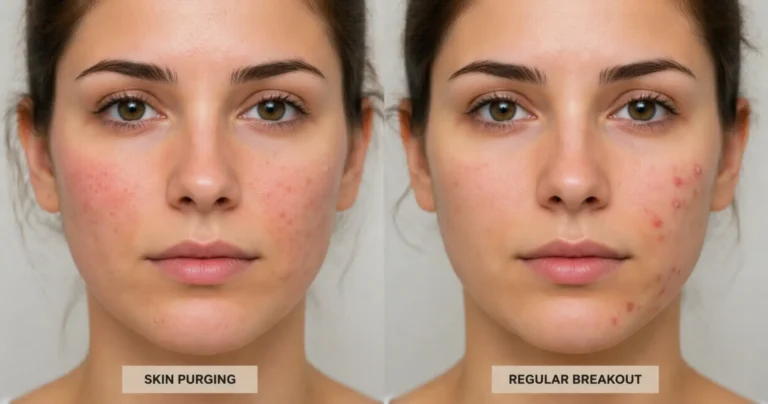
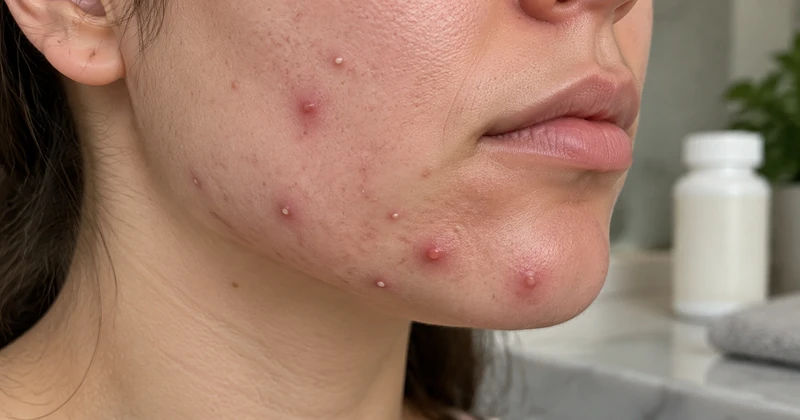
4. Look at the type of breakout
Typical acne can involve:
- Blackheads.
- Whiteheads.
- Red pimples.
- Pustules.
- Deeper nodules.
A sudden eruption of many similar-looking inflammatory bumps after a medication or supplement may deserve medical evaluation, especially if the pattern is unusual for you.
5. Avoid trying to “cancel out” biotin with another supplement
It can be tempting to add vitamin B5 because of the popular competition theory.
There is not enough evidence to recommend this as a proven prevention strategy.
Adding another supplement also makes it harder to identify what is affecting your skin.
Other Changes That Can Be Mistaken for “Biotin Acne”
Supplements rarely exist in isolation from the rest of your routine.
Protein and workout changes
Someone taking biotin may also have started a fitness program or added protein supplements.
Whey protein has been investigated as a possible acne trigger in some people, so it deserves consideration if it was introduced around the same time.
Read more about diet and supplement-related breakout triggers.
Hair products
Hair oils, conditioners, pomades, and styling products can transfer onto the forehead, temples, neck, and back.
That can create breakouts that appear at roughly the same time as a new hair supplement.
Hormonal changes
Hormonal fluctuations can cause acne regardless of supplement use.
This is especially relevant when breakouts cluster around the chin or jawline.
New skincare
Starting several new serums or strong acne treatments can produce irritation or a breakout that gets incorrectly blamed on the vitamin bottle sitting on your counter.
Creatine and other supplements
People often blame individual workout or beauty supplements when acne appears.
The same causation problem applies to other products as well. For example, our guide to creatine and acne explains why a temporal association does not automatically prove that one supplement caused the breakout.
Should You Stop Taking Biotin if You Break Out?
It depends on why you take it.
If you started a high-dose beauty supplement on your own and then developed a new breakout, it is reasonable to discuss whether the supplement is necessary with a healthcare professional or pharmacist.
That is different from biotin being used for a diagnosed deficiency or another medical reason.
Do not stop medically recommended supplementation without discussing it with the person managing your care.
There is also no reliable universal rule such as:
“Stop biotin for exactly four weeks and your acne will disappear.”
If your acne improves after the supplement is removed, that supports the possibility of a connection but still may not prove biotin itself was responsible, especially if the supplement contained several ingredients.
Do You Actually Need a Biotin Supplement?
For many people, the answer may be no.
Most healthy adults can obtain enough biotin through a varied diet, and true deficiency is uncommon.
High-dose beauty supplements are often marketed for:
- Hair growth.
- Stronger nails.
- Clearer-looking skin.
But evidence supporting these benefits in people who are not deficient is limited.
If your supplement provides a very large amount of biotin and you are taking it only because you assume more must be better, it may be worth reviewing whether there is a clear reason to continue.
This is especially important when you are already trying to troubleshoot a new skin problem.
Important: Biotin Can Interfere With Lab Tests
The strongest established safety concern with high-dose biotin is not acne.
It is laboratory-test interference.
Some lab tests use technology that can be affected by biotin in the blood. Depending on the specific assay, this interference can produce results that are falsely high or falsely low.
This can affect tests used in important medical decisions.
If you take biotin:
- Tell your doctor.
- Tell other healthcare professionals involved in your care.
- Tell the laboratory when appropriate.
- Include the dose or bring the supplement bottle if you know it.
Do not rely on a universal internet instruction telling you to stop biotin for a specific number of hours before every blood test.
Different tests and doses can require different considerations. Follow instructions from the healthcare professional or laboratory handling the test.
What Supplements Can Cause Breakouts?
The evidence varies widely between supplements.
A few useful distinctions:
- Vitamin B12: rare acneiform eruptions are medically documented.
- Biotin: suspected by many users, but direct causation is not established.
- Fish oil: not established as a routine acne trigger.
- Multi-ingredient beauty supplements: difficult to evaluate because several ingredients change simultaneously.
The broader question of what supplements can cause breakouts deserves a separate evidence-based comparison rather than one long blacklist.
For now, the safest rule is to avoid assuming that “natural” means incapable of affecting your skin—or that every supplement blamed online has been proven to cause acne.
How to Care for Your Skin While You Investigate the Trigger
Keep things simple.
A complicated new routine makes it harder to know whether the supplement change mattered.
Consider:
- A gentle cleanser.
- A non-comedogenic moisturizer.
- Broad-spectrum sunscreen.
- Avoiding harsh scrubs and picking.
- Keeping new skincare changes to a minimum.
- Using evidence-supported acne treatment when appropriate.
If your acne is mild, over-the-counter ingredients such as salicylic acid or benzoyl peroxide may be useful depending on the type of acne and your skin tolerance.
Avoid trying five new acne treatments at the same time just because you suspect biotin. Irritation can make the situation harder to interpret.
When to See a Dermatologist
Get professional help if the breakout is:
- Deep or painful.
- Nodular or cystic.
- Rapidly worsening.
- Leaving scars.
- Severe on the face, chest, or back.
- Very different from your usual acne.
- Not improving with appropriate care.
- Difficult to distinguish from another skin condition.
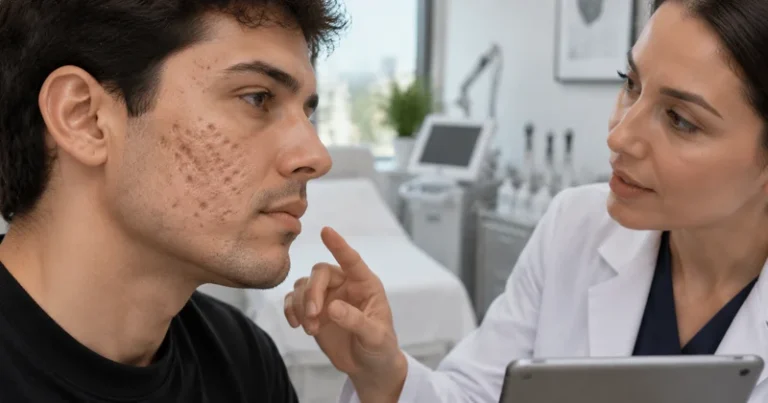
A sudden, unusual eruption after a medication or supplement also deserves evaluation because acneiform reactions can look different from ordinary acne.
Frequently Asked Questions
Can biotin cause acne even if I never had acne before?
It is possible for acne to begin after someone starts biotin, but that timing does not prove biotin caused it. Current evidence does not establish biotin as a direct acne trigger. Review the full supplement, other recent changes, and the appearance of the breakout before drawing a conclusion.
How long after starting biotin can breakouts appear?
There is no established timeline for biotin-related acne because a direct causal relationship has not been proven. Online reports describe very different timelines, but anecdotal experiences cannot establish when or whether biotin should cause a breakout.
Will my acne clear if I stop biotin?
It may improve if the supplement was genuinely contributing, but improvement is not guaranteed. Acne can have several causes, and multi-ingredient supplements make attribution difficult. If biotin was medically recommended, speak with your healthcare professional before discontinuing it.
Does vitamin B12 cause acne more often than biotin?
There is stronger medical documentation for rare B12-associated acneiform eruptions than for biotin directly causing acne. That does not mean B12 commonly causes acne. People who need B12 for a diagnosed deficiency should not stop treatment without medical advice.
Should I take vitamin B5 with biotin to prevent acne?
There is not enough reliable clinical evidence to recommend vitamin B5 as a proven way to prevent biotin-related breakouts. The idea is largely based on a proposed nutrient-competition theory that has not been shown to cause acne in controlled human studies.
The Bottom Line
So, can biotin cause acne? The current evidence does not prove that it does.
The timing of a breakout after starting biotin can still be worth investigating, especially with a high-dose supplement. But look at the complete formula, B12 and other ingredients, skincare changes, diet, protein supplements, hormones, and other possible triggers before blaming one vitamin.
Avoid adding extra supplements to “balance” biotin based on an unproven theory. And remember that biotin has a much better-established concern: interference with certain laboratory tests.
If your acne is deep, painful, unusual, rapidly worsening, or leaving scars, get help from a dermatologist rather than relying only on supplement troubleshooting.
This article is for educational purposes only and is not a diagnosis or a substitute for care from a qualified healthcare professional. Do not stop medically necessary supplements without discussing the change with the appropriate clinician.
References:
- National Institutes of Health Office of Dietary Supplements — Biotin Fact Sheet for Consumers
Covers biotin’s role, dietary sources, recommended intake, supplement availability, rarity of deficiency, limited evidence for hair/skin/nail benefits, and laboratory-test concerns. - U.S. Food and Drug Administration — Biotin Interference With Troponin Lab Tests and Assays
FDA guidance confirming that biotin can significantly interfere with some laboratory assays and produce incorrect results. - Veraldi S, et al. — Acneiform Eruptions Caused by Vitamin B12: A Report of Five Cases and Review of the Literature
Documents rare acneiform eruptions following oral or injected vitamin B12 and helps distinguish the B12 evidence from the much less established biotin-acne association. - Bahbouhi I, et al. — Vitamin B12 Induced Acneiform Eruption
A documented clinical case describing a sudden acneiform eruption after vitamin B12 treatment and characteristics that can differ from ordinary acne vulgaris. - Jung JY, et al. — Effect of Dietary Supplementation With Omega-3 Fatty Acid and Gamma-Linolenic Acid on Acne Vulgaris
Small randomized controlled trial investigating omega-3 supplementation as an adjunctive acne intervention rather than establishing fish oil as an acne trigger. - American Academy of Dermatology — What Can Clear Severe Acne?
Supports professional evaluation for severe acne and the importance of treatment in reducing future scarring.