Acne Scar Removal Near Me: Compare Treatments Before You Book
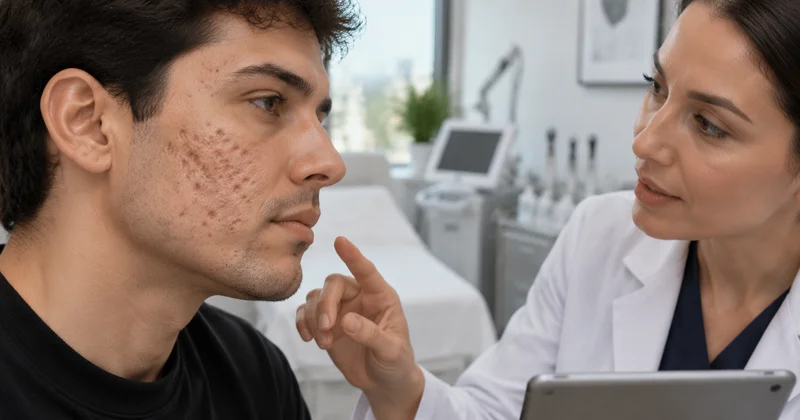
Searching for acne scar removal near me can bring up a long list of clinics offering laser resurfacing, microneedling, radiofrequency, fillers, peels, and scar procedures. The hard part is not finding a treatment name. It is figuring out which type of treatment makes sense for the scars you actually have.
“Scar removal” is also stronger wording than most treatments can realistically promise. True depressed or raised acne scars often become less noticeable with treatment rather than disappearing completely. The American Academy of Dermatology (AAD) recommends matching treatment to scar type, skin tone, active acne, goals, budget, downtime, and other individual factors.
Before booking the clinic advertising the newest device, compare what the major procedures are designed to do, where their limits are, and what questions you should bring to a consultation.
Table of Contents
Acne Scar Removal Near Me: Which Treatment Should You Compare First?
There is no single best professional acne-scar procedure for everyone. A useful first step is identifying whether your main concern is depressed scarring, raised scarring, or flat post-acne discoloration. From there, you can compare treatments such as microneedling, laser resurfacing, scar-release procedures, fillers, or chemical peels based on the specific problem they are intended to address.
A qualified clinician may also recommend more than one procedure when several scar patterns appear together.
Before Comparing Treatments, Identify the Problem You Want Treated
Professional procedures make more sense when the treatment is matched to the type of scar.
Depressed acne scars
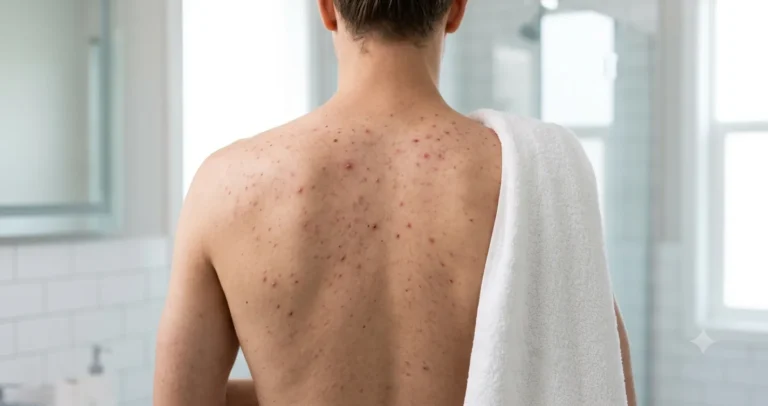
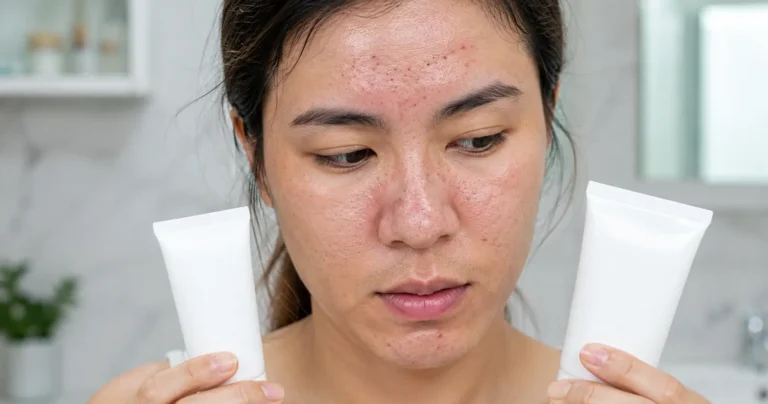
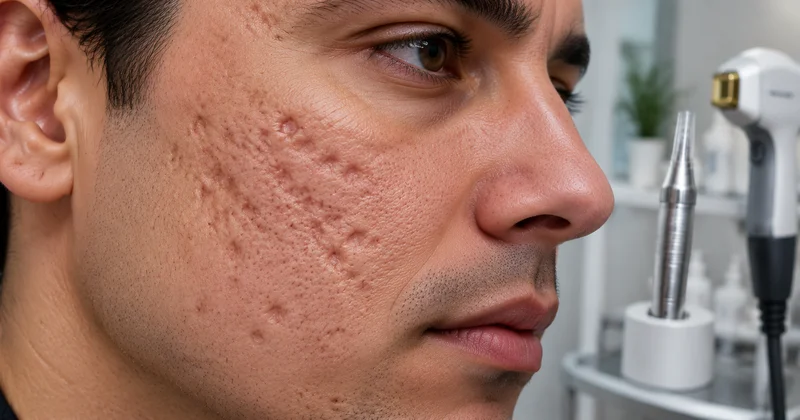
Depressed, or atrophic, scars form below the surrounding skin. AAD describes common patterns including:
- Ice-pick scars: narrow but deep pits.
- Boxcar scars: round or oval depressions with more defined edges.
- Rolling scars: wider, shallower depressions that can create a wavy surface.
One person can have more than one type, which is one reason a single procedure may not address every area equally well.
Raised acne scars
Raised scars develop when excess scar tissue forms. Hypertrophic scars and keloid-type scars need a different treatment approach from depressed scars. AAD lists options such as corticosteroid injections, laser treatment, prescription medications, freezing, or surgery depending on the raised scar type.
Flat red or dark marks
A flat red, pink, brown, or gray mark after acne is not necessarily a structural scar. AAD notes that flat pigmented spots can remain after acne clears and are generally not scars.
That distinction can save you from paying for an aggressive texture procedure when discoloration is actually your main concern.
For a deeper explanation of which treatments match different acne scar types, see Beyond Breakouts’ acne-scar treatment guide.
Professional Acne Scar Removal Treatments at a Glance
| Treatment | Common role | Main advantage | Important limitation |
|---|---|---|---|
| Microneedling | Selected depressed scars | Collagen remodeling; usable across skin tones | Usually gradual and may require a series |
| RF microneedling | Selected textural scars | Combines needling with radiofrequency | More complex and not automatically superior for every scar |
| Laser resurfacing | Selected depressed/textural scars | Resurfacing and collagen remodeling | Downtime and pigment-risk considerations vary |
| Scar release/surgery | Selected tethered depressed scars | Addresses tissue pulling a scar downward | Not appropriate for every scar |
| Fillers | Selected depressed scars | Adds volume beneath scars | Many filler results are temporary |
| Chemical peels | Selected superficial or depressed scar concerns | Different strengths allow customized resurfacing | Deep scars may require another procedure |
| Raised-scar treatments | Hypertrophic or keloid scars | Targets excess scar tissue | Requires a different plan from depressed scars |
This table is a starting point, not a treatment prescription.
Microneedling for Acne Scars
Microneedling creates controlled microscopic punctures that trigger a wound-healing response and new collagen formation. AAD includes it among treatments for depressed acne scars and states that microneedling is safe for all skin tones.
Its main appeal is that it can improve textural irregularity without relying on a resurfacing laser. Results develop gradually as collagen remodels rather than appearing immediately.
Microneedling often involves more than one treatment. AAD notes that a series may be needed, but the exact number should be individualized rather than assumed from a clinic package.
Main limitation: Microneedling is not a universal answer for every deep pit, tethered scar, or raised scar.
RF Microneedling: How Is It Different?
Radiofrequency microneedling combines tiny needles with radiofrequency energy.
AAD states that radiofrequency and RF microneedling can stimulate collagen and elastin, and both are considered usable across skin tones. It also notes that combining radiofrequency with microneedling can make acne scars less noticeable.
That does not mean RF microneedling automatically produces better results for every reader.
The extra technology may increase treatment cost and changes the procedure’s risk and recovery profile. Ask why RF is being recommended instead of standard microneedling and what specific scar characteristic the provider expects it to address.
Laser Resurfacing for Acne Scars
Laser treatment is one of the most heavily marketed options when people search for professional scar treatment.
AAD explains that dermatologists use lasers to resurface acne-scarred skin and stimulate collagen and elastin as the skin heals. Some lasers can also contour the skin surrounding a scar to make the depression less noticeable.
But “laser” is not one treatment. Different systems and treatment intensities can have very different recovery periods, risks, and treatment schedules.
ASDS lists possible laser-related risks including pain, swelling, discoloration, bleeding, infection, crusting, and additional scarring.
Provider expertise matters, especially when pigment changes are a concern.
For a closer look at what laser scar results can realistically look like, see Beyond Breakouts’ dedicated acne-scar laser results guide.
When Scar Release or Surgery May Be Discussed
Some depressed scars are held down by fibrous tissue beneath the skin. In selected cases, a dermatologist may surgically release the scar from underlying tissue so the surface can rise.
AAD describes acne-scar surgery as including procedures that remove a scar or surgically lift it from the tissue underneath. Another treatment, such as resurfacing or filler, may sometimes be used afterward.
You may hear clinics use terms such as subcision for scar-release techniques.
The important point is that these procedures solve a different mechanical problem from surface exfoliation. A peel or resurfacing treatment cannot necessarily correct a scar that remains deeply tethered.
This is also why a provider who understands scar structure matters more than simply picking the most aggressively marketed device.
Fillers for Depressed Acne Scars
Dermal fillers can raise selected depressed scars by restoring volume beneath them.
AAD notes that dermatologists use different fillers and that most fillers provide temporary results, although duration varies considerably by material. Touch-up treatment may also be necessary.
Fillers can sometimes be part of a combination plan, especially when a depressed scar has first been released from underlying tissue.
Main limitation: Filling a depression does not treat every scar pattern, and many filler results require maintenance.
Before booking, ask:
- What filler is being used?
- Why is it appropriate for this scar?
- How long is the expected effect?
- What maintenance may be needed?
- What are the material-specific risks?
Chemical Peels: Where Do They Fit?
Chemical peels intentionally remove controlled layers of skin to promote renewal and, depending on the peel, stimulate collagen remodeling.
AAD describes peels from mild to stronger depths and notes that mild and medium peels often require repeat sessions.
Peels may make sense for selected scar patterns or accompanying discoloration, but they should not automatically be treated as a substitute for procedures that address deep or tethered scars.
Peel depth also matters for risk. Skin tone, pigmentation history, sun exposure, and the specific chemical used should be discussed with the treating professional.
What About Raised Acne Scars?
Raised acne scars need a different treatment strategy because the problem involves excess scar tissue rather than a depression.
AAD says hypertrophic acne scars may be treated with approaches such as corticosteroid or other injections, prescription medication applied to the scar, and laser treatment. Keloids may require combinations that can include injections, laser, freezing, or surgery.
If you have a firm, thick, raised scar—especially one that has grown beyond the area of the original breakout—do not assume microneedling or resurfacing intended for depressed scars is the right category.
Have the scar properly evaluated first.
Why Combination Treatment Is Common
Mixed acne scarring is common, and one procedure may solve only part of the problem.
For example, one area may contain broad rolling depressions while another has narrow pits. A dermatologist may therefore use more than one technique to address different structural issues.
AAD specifically notes that individualized acne-scar plans may use multiple treatments and gives examples of combining scar surgery with fillers or combining microneedling with other procedures.
Combination care should still have a clear rationale.
More procedures do not automatically mean a better plan. Ask what each step is expected to improve.
Laser vs. Microneedling: Which Should You Ask About?
Neither treatment wins automatically.
| Factor | Microneedling | Laser |
|---|---|---|
| Main goal | Collagen remodeling for selected depressed scars | Resurfacing and remodeling for selected scars |
| Skin-tone use | AAD describes it as safe across skin tones | Suitability depends more heavily on device, settings, and expertise |
| Recovery | Depends on treatment intensity | Can vary widely by laser type and intensity |
| Repeat treatment | Often used as a series | Some laser approaches also require multiple sessions |
| Key question | Does collagen induction fit this scar? | Which laser is being used, and why? |
AAD and ASDS both emphasize that treatment planning should occur after evaluation rather than assuming one device fits all acne scars.
If a clinic recommends laser only because it owns a laser, ask whether other options were considered.
How Much Downtime Should You Expect?
There is no useful universal downtime number for acne-scar treatment.
A relatively mild microneedling session and a more aggressive resurfacing procedure are not comparable. Even within one treatment category, intensity can change recovery.
Before booking, ask specifically about:
- Redness and swelling.
- Peeling or crusting.
- When you can wear makeup.
- Sun-avoidance requirements.
- Exercise restrictions.
- Skin-care restrictions.
- When you can comfortably return to work or social activities.
ASDS notes that microneedling can cause several days of redness and swelling in some patients, while laser recovery varies according to the treatment used.
Your provider’s instructions for the exact procedure should take priority over a generic internet timeline.
How Many Sessions Will You Need?
There is no single session count that applies to every scar or procedure.
AAD notes that several acne-scar treatments require multiple sessions. The number can depend on scar type, depth, treatment intensity, healing response, and the level of improvement you are trying to achieve.
Ask a clinic:
- Why is this number of sessions being proposed?
- When will progress be reassessed?
- Could the treatment plan change based on response?
- Does the quote cover a single session or an expected series?
Be cautious when a package is sold before anyone has properly assessed your scars.
How to Compare Acne Scar Removal Costs Near You
Price is part of a transactional decision, but comparing only the cheapest session can be misleading.
The total treatment plan may depend on:
- Procedure type.
- Treatment area.
- Number of sessions.
- Provider experience.
- Geographic market.
- Numbing or anesthesia.
- Combination treatments.
- Follow-up appointments.
- Aftercare.
- Maintenance procedures.
A low per-session price can become expensive if many sessions are expected. A higher-priced procedure is not automatically better either.
Ask for the expected total plan cost and what is included.
If laser is the main treatment you are considering, Beyond Breakouts has a separate guide explaining what affects laser scar treatment cost.
What Should You Ask Before Booking a Procedure?
Bring the same core questions to every consultation:
- What scar types do I have?
- What exactly is this procedure supposed to improve?
- What probably will not improve?
- Why are you recommending this instead of another treatment?
- What risks matter for my skin tone?
- Who will perform the procedure?
- How many treatments are you proposing, and why?
- What downtime should I expect?
- Could another procedure be needed later?
- What is included in the quoted cost?
- What follow-up is provided?
- How are complications handled?
You should understand the reasoning before you sign up for a package.
Signs a Treatment Recommendation Deserves a Second Opinion
Consider another consultation when:
- Complete scar removal is guaranteed.
- A treatment is recommended before your scars are properly examined.
- The provider cannot explain your scar type.
- Skin-tone considerations are dismissed.
- The clinic markets one device as best for every scar.
- Alternatives are not discussed.
- You are pressured to buy a package immediately.
- Risks and downtime are minimized or avoided.
- The provider cannot explain who will actually perform the procedure.
AAD guidance is clear that safe, effective acne-scar treatment begins with evaluation and an individualized plan.
When Active Acne Should Be Treated First
If you are still developing inflammatory acne, treating the scars while new scars continue to form may work against your long-term goal.
AAD states that acne-scar treatment plans generally begin by controlling active acne when breakouts are still occurring. Preventing new breakouts can reduce the risk of additional scars.
That does not mean you cannot discuss scars during the same consultation. It means the clinician may recommend controlling active disease before beginning some cosmetic procedures.
Frequently Asked Questions
What is the best acne scar removal near me option for deep scars?
The best acne scar removal near me option depends on the type of deep scar. Narrow ice-pick scars, broad boxcar scars, and tethered rolling scars may require different approaches, and some people need combination treatment. A qualified clinician should identify the scar pattern before recommending laser, microneedling, scar-release procedures, filler, or another option.
Is laser better than microneedling for acne scars?
Not universally. Microneedling and laser resurfacing work differently, and the better choice depends on scar type, skin tone, treatment intensity, downtime tolerance, and provider expertise. AAD lists both as professional options rather than naming one as universally superior.
Can acne scars be removed completely?
True depressed acne scars usually cannot be guaranteed to disappear completely. AAD states that depressed acne scars may become less noticeable with treatment and rarely go away entirely on their own. Treatment goals should focus on realistic improvement rather than flawless skin.
How many sessions does acne scar removal take?
There is no universal number. Microneedling, laser, peels, fillers, and other treatments may involve more than one visit, but the appropriate series depends on your scar pattern, procedure, goals, and response. Ask why a clinic is recommending a particular number rather than assuming a pre-sold package is standard.
Should I compare treatment prices before booking?
Yes, but compare the expected total treatment plan rather than only a single-session advertisement. Ask about the likely number of treatments, consultation fees, anesthesia or numbing, combination procedures, aftercare, follow-up, and maintenance where relevant. Price should be considered alongside treatment suitability, provider qualifications, risks, and realistic outcomes.
The Bottom Line
When you search for acne scar removal near me, compare the treatment categories before you compare promotional packages.
Microneedling, RF microneedling, laser resurfacing, scar-release procedures, fillers, peels, and treatments for raised scars solve different problems. One may be appropriate for part of your scarring while another may address a different feature.
Start by identifying the scar pattern with a qualified professional. Then compare the proposed treatment’s purpose, limitations, skin-tone considerations, downtime, likely number of visits, total cost, and who will perform it.
The goal is not to find the procedure with the most impressive marketing. It is to understand why a specific treatment makes sense for the scars you want to improve.
This article is for educational purposes only. It does not diagnose acne scars or recommend a specific procedure for an individual reader. A qualified healthcare professional can examine your skin and discuss appropriate options.
References:
- American Academy of Dermatology — Acne scars: Consultation and treatment. AAD acne scar treatment guidance
- American Academy of Dermatology — Acne scars: Signs and symptoms. AAD acne scar types guidance
- American Academy of Dermatology — Scars: Will my scar go away? AAD scar expectations guidance
- American Academy of Dermatology — Microneedling can fade scars, uneven skin tone, and more. AAD microneedling guidance
- American Academy of Dermatology — Scars: Diagnosis and treatment. AAD raised-scar treatment guidance
- American Society for Dermatologic Surgery — Laser Therapy for Acne Scars. ASDS laser acne scar guidance
- American Society for Dermatologic Surgery — Microneedling. ASDS microneedling guidance