Body Acne Treatment: What Works for Back, Chest, and Shoulder Breakouts
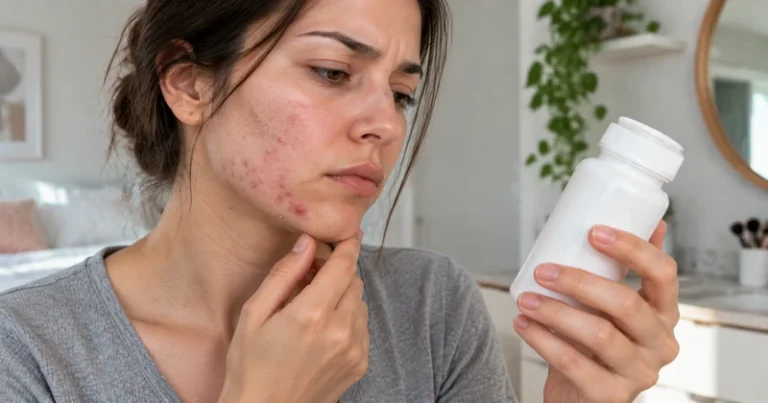
Body Acne Treatment can feel harder than facial acne care because breakouts may cover a large area, sit in hard-to-reach places, and be aggravated by sweat or friction. The first step is not buying the strongest wash you can find. It is figuring out whether the bumps behave like acne and then matching treatment to the pattern you actually see.
Quick answer: A practical Body Acne Treatment plan usually combines an evidence-supported active with gentle skin care and less friction. Benzoyl peroxide is especially useful for inflamed pimples, while salicylic acid and topical retinoids can help clogged pores. Deep, painful, widespread, or scar-forming acne deserves professional evaluation. Current AAD guidelines support benzoyl peroxide, topical retinoids, salicylic acid, and other treatments depending on acne severity.
Table of Contents
Body Acne Treatment Starts With Making Sure the Bumps Are Acne
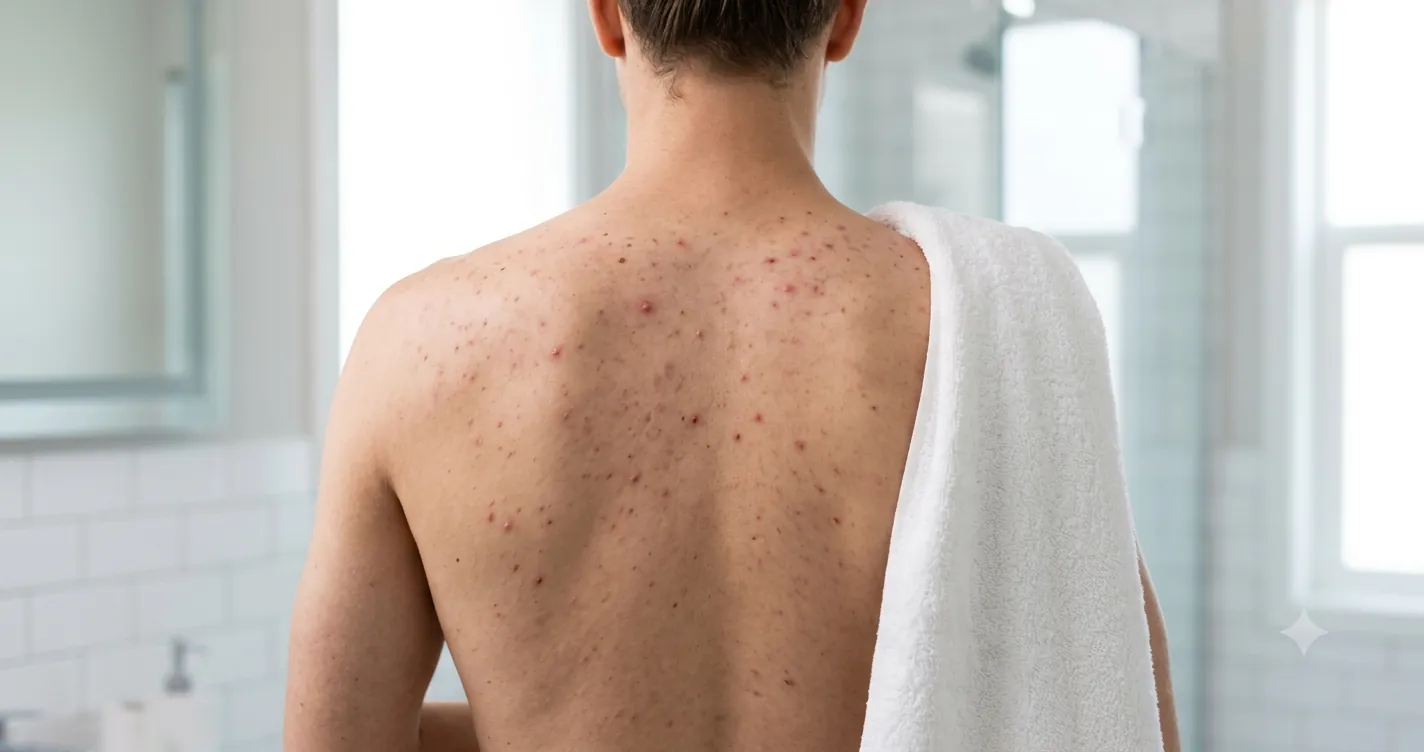
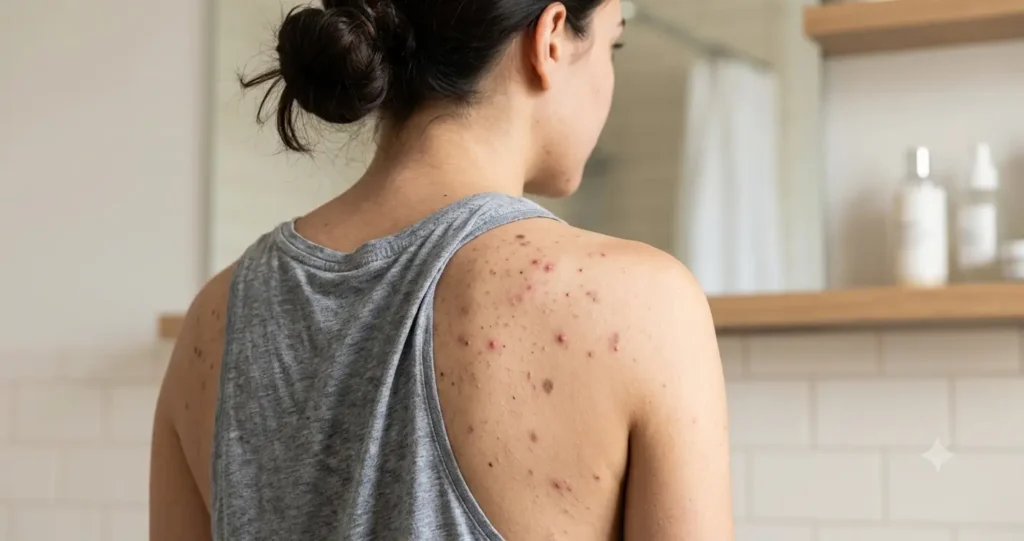
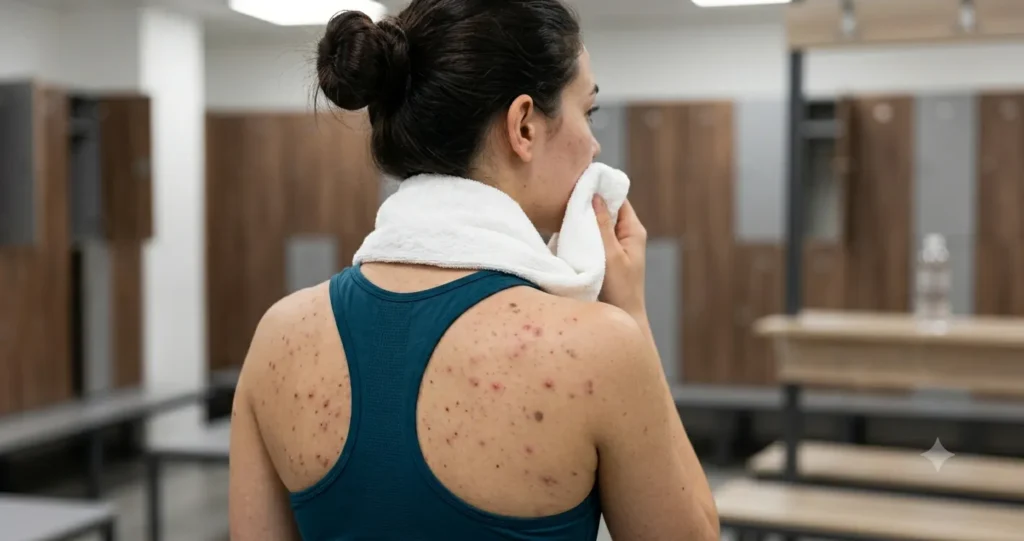
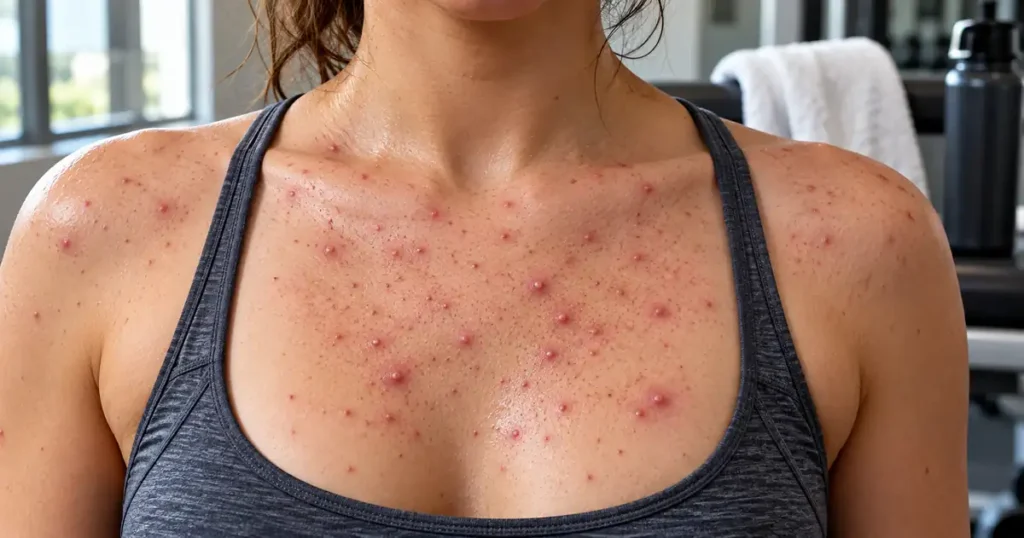
True acne vulgaris can appear on the upper back, shoulders, chest, and sometimes the upper arms. These areas contain many sebaceous glands, so they can develop the same basic lesion types seen on the face: blackheads, whiteheads, red papules, pustules, and deeper nodules.
That variety matters. A mix of clogged pores and inflamed pimples supports acne more strongly than a field of nearly identical itchy bumps. If every bump looks the same, seems centered on a hair follicle, or is intensely itchy, ordinary Body Acne Treatment may miss the real problem.
What True Body Acne Usually Looks Like
Body acne can include:
- Blackheads: Open clogged pores that look dark at the surface.
- Whiteheads: Closed clogged pores that appear as small skin-colored or pale bumps.
- Papules: Red, inflamed bumps without a visible pus-filled center.
- Pustules: Inflamed pimples with a visible white or yellow center.
- Nodules: Deeper, firmer, often painful lesions that have a higher risk of scarring.
The back and chest can develop several lesion types at once, which is one reason combination therapy is common in acne care. Current AAD guidance recommends using therapies with different mechanisms when combination treatment is appropriate.
When It May Be Folliculitis Instead
Not every body breakout is acne. Folliculitis involves inflammation around hair follicles and may look acne-like, but the pattern can differ.
| Pattern | Acne may be more likely | Folliculitis or another condition may be more likely |
|---|---|---|
| Lesions | Mixed blackheads, whiteheads, papules, and pustules | Many similar-looking hair-centered bumps |
| Itching | Possible, but usually not the main feature | Itching can be prominent |
| Location | Common on oily areas such as the chest and upper back | Can occur across many hair-bearing areas |
| Response | May improve with standard acne therapy | May not improve with ordinary acne products |
This table cannot diagnose a rash from appearance alone. If the pattern is unusual, very itchy, spreading, or not responding to acne care, a clinician can help determine what it is.
What About “Butt Acne”?
Bumps on the buttocks are often called acne, but many are actually folliculitis, keratosis pilaris, ingrown hairs, or other conditions.
Our guide to why butt bumps are not always acne explains common look-alikes and why their treatment can differ from classic acne vulgaris.
Body Acne Treatment With Benzoyl Peroxide, Salicylic Acid, or Adapalene
The best active depends on what dominates your breakout. Current American Academy of Dermatology guidance supports benzoyl peroxide, topical retinoids, and salicylic acid among evidence-based topical acne options.
A good Body Acne Treatment plan does not require using every active at once. Starting with the ingredient that best matches the lesion pattern can make the routine easier to tolerate and easier to evaluate.
Benzoyl Peroxide for Inflamed Body Acne
Benzoyl peroxide is especially useful when red, inflamed papules and pustules dominate. It helps reduce acne-associated bacteria and is a standard acne treatment.
For mild-to-moderate back acne, the AAD specifically discusses benzoyl peroxide wash as an OTC option. Its guidance also notes that allowing the wash to remain on the back briefly before rinsing can improve contact with the skin.
Benzoyl peroxide can cause dryness or irritation. It can also bleach towels, shirts, sheets, and other fabrics, which matters when you are treating large body areas.
Salicylic Acid for Clogged Pores
Salicylic acid is a reasonable option when blackheads, whiteheads, and clogged pores are more prominent. It helps clear material from pores and is included among the topical treatments recommended in current AAD acne guidance.
It may be convenient in body-wash or leave-on formats, but stronger or more frequent use is not automatically better. Irritation can make a routine harder to maintain.
If you are unsure which active better matches your breakout pattern, our guide to benzoyl peroxide vs salicylic acid compares how the two ingredients work, which acne patterns they tend to suit, and where irritation can become a problem.
Adapalene and Other Topical Retinoids
Topical retinoids help keep pores from becoming clogged and are strongly recommended in acne guidelines. Adapalene 0.1% is available over the counter in the United States and is labeled for acne treatment.
Retinoids can cause dryness, redness, burning, or peeling, particularly when first introduced. The current OTC adapalene label also directs people who are pregnant or breastfeeding to ask a doctor before use.
A large body area can amplify irritation, so a Body Acne Treatment routine should prioritize consistency and tolerability rather than immediately covering the torso with several aggressive products.
Do You Need More Than One Active?
Sometimes. Acne treatment often works better when different mechanisms are combined, and combination topical therapy is supported by current acne guidelines.
That does not mean every ingredient needs to start on the same day. If you begin a benzoyl peroxide wash, salicylic acid spray, exfoliating scrub, and retinoid together, irritation can make it difficult to know what is helping and what is causing trouble.
A simpler plan is usually easier to follow.
Recommended Body Acne Products
🏆 PanOxyl 4% Benzoyl Peroxide — Best for Inflamed Body Acne
A strong choice for red, inflamed pimples on the back, chest, and shoulders. It contains 4% benzoyl peroxide in a practical wash format.
Best for: Red pimples and pustules
Best verified price: About $10.19
💰 Neutrogena Body Clear 2% Salicylic Acid — Best Value for Clogged Pores
A good option for clogged pores, whiteheads, and smaller body breakouts. It contains 2% salicylic acid and is designed for acne-prone body areas.
Best for: Clogged pores and smaller bumps
Best verified price: About $9.97
Body Acne Treatment Routine for the Back, Chest, and Shoulders
A practical routine matters because even an effective ingredient cannot help if it rarely reaches the affected skin. For large or hard-to-reach areas, ease of use is part of treatment quality.
In the Shower
Use a gentle cleanser or an appropriate acne wash without aggressively scrubbing. Rough loofahs, stiff brushes, and abrasive scrubs can irritate inflamed skin rather than “cleaning out” acne.
If you use a medicated wash, follow the product directions. For benzoyl peroxide back washes specifically, AAD guidance notes that allowing the wash to remain on the skin for a short period before rinsing can help.
If conditioner or styling products run down your back, rinse them away thoroughly. Then cleanse the acne-prone area so residue is less likely to remain on the skin.
After the Shower
If your plan includes a leave-on treatment, apply it as directed to the acne-prone area rather than assuming that only visible pimples matter.
If treatment makes the skin dry, a non-comedogenic moisturizer can help make the routine easier to tolerate.
The middle of the back can also be difficult to reach. AAD specifically notes that a lotion applicator may make applying medication to the back easier.
If your breakouts are concentrated mainly across the upper back, our guide to how to treat back acne in more detail covers back-specific treatment options, common mistakes, and practical ways to manage an area that can be difficult to reach consistently.
On Workout Days
Sweating does not mean your skin is dirty, and sweat alone is not the sole cause of acne. However, heat, sweat, occlusion, and rubbing can aggravate acne-prone areas.
AAD guidance recommends changing sweaty clothing and showering after exercise when possible. It also recommends reducing friction on acne-prone skin.
Wash sports bras, compression tops, and shirts between uses rather than repeatedly putting sweaty fabric against the same areas.
Clothing, Backpacks, and Equipment
Friction and pressure can worsen breakouts where straps, sports equipment, uniforms, or tight clothing repeatedly rub the skin.
You do not need to eliminate exercise or stop using every backpack. The practical goal is to reduce avoidable rubbing on actively inflamed areas.
AAD specifically advises reducing friction from items such as backpacks when back acne is flaring.
If the same areas keep flaring, our guide to common triggers behind recurring back breakouts looks more closely at sweat, friction, clothing, hair products, and other patterns that may work against treatment.
Body Acne Treatment by Breakout Pattern
Matching the plan to the lesion type can make treatment more rational.
| What dominates | Reasonable treatment direction |
|---|---|
| Mostly blackheads and whiteheads | Salicylic acid or a retinoid-oriented approach may fit |
| Mostly red inflamed pimples | Benzoyl peroxide becomes especially relevant |
| Mixed clogged pores and inflamed pimples | More than one treatment mechanism may be useful |
| Deep, painful nodules | Professional evaluation is appropriate |
| Very itchy, uniform bumps | Reconsider whether the condition is actually acne |
AAD patient guidance similarly distinguishes treatment needs by lesion type and includes benzoyl peroxide, salicylic acid, and adapalene among commonly used approaches.
This table is a treatment-direction framework, not a personalized prescription. Skin sensitivity, pregnancy or breastfeeding, medications, and other health factors can change what is appropriate.
A good Body Acne Treatment strategy also considers the size of the area. An ingredient that works well on a few facial lesions may be too irritating, messy, or difficult to apply across the entire back.
How Long Does Body Acne Treatment Take to Work?
Body acne needs time. According to the AAD, if back-acne treatment is working, visible improvement may begin in approximately six to eight weeks, while more complete clearing can take three to four months.
That timeline matters because switching products every few days can create irritation without giving any treatment enough time to work.
For Body Acne Treatment, consistency often tells you more than intensity. If the routine is tolerable and the acne is gradually improving, repeatedly adding stronger products may not help.
If there is no meaningful improvement after a consistent trial, or if acne is worsening, the diagnosis or treatment plan may need reassessment.
Why Body Acne Treatment Sometimes Fails
Treatment failure does not always mean the active ingredient is weak. Several practical problems can undermine an otherwise reasonable plan.
Treating the Wrong Condition
If the bumps are folliculitis, keratosis pilaris, or another eruption, standard acne products may do little. Strong itching, very uniform lesions, or an unusual distribution are reasons to reconsider what you are treating.
Using Treatment Inconsistently
Large areas are easy to skip, especially the middle of the back. A routine with too many steps is also harder to maintain.
Scrubbing Too Hard
Acne is not simply a cleanliness problem. Aggressive scrubbing can irritate inflamed skin and make a routine less tolerable.
Staying in Tight, Sweaty Clothing
Occlusion and friction can repeatedly aggravate the same area, particularly during sports or hot weather.
Using Too Many Actives
Burning, peeling, and redness can force you to stop treatment altogether. Adding an ingredient because it serves a specific purpose is more useful than stacking products simply because they are all marketed for acne.
Stopping Too Early
If you expect clear skin in one week, even an effective Body Acne Treatment routine can look like a failure. AAD guidance makes clear that improvement usually takes weeks, not days.
When Body Acne Treatment Needs a Dermatologist
Over-the-counter care can be reasonable for mild body acne, but not every breakout should be managed alone.
Professional evaluation is especially useful when you have:
- Deep, painful nodules or cyst-like lesions
- Widespread chest or back involvement
- New or worsening scars
- Ongoing inflammatory acne with persistent dark marks
- No meaningful improvement after consistent OTC care
- Strong itching or a uniform rash-like pattern that may not be acne
- Breakouts causing significant distress or interfering with daily life
Prescription treatment may include stronger topical therapy, oral antibiotics, hormonal therapies for appropriate patients, or isotretinoin for severe acne. Current AAD guidelines recommend limiting systemic antibiotic use and pairing systemic antibiotics with benzoyl peroxide and other topical therapies when antibiotics are used.
Truncal acne also deserves attention because the research base is smaller than the one for facial acne. Expert consensus publications have specifically identified gaps in truncal-acne assessment and management.
That makes individualized evaluation especially useful for severe, scarring, or difficult-to-treat cases.
Frequently Asked Questions
What is the best Body Acne Treatment for back and chest acne?
There is no single best option for everyone. Inflamed pimples often make benzoyl peroxide particularly useful, while clogged pores may respond to salicylic acid or a topical retinoid. Mixed acne may benefit from more than one mechanism. Deep, painful, scarring, or widespread acne should be evaluated professionally.
Is benzoyl peroxide or salicylic acid better for body acne?
Benzoyl peroxide is particularly useful for inflammatory pimples and pustules. Salicylic acid can be a good fit when blackheads, whiteheads, and pore congestion dominate. The better choice depends on lesion type, skin tolerance, and the rest of your routine.
Can sweat cause body acne?
Sweat alone is not the sole cause of acne, but heat, sweat, tight clothing, and friction can aggravate acne-prone skin. Changing out of sweaty clothing and showering when practical may reduce that added friction and occlusion.
Why is my body acne itchy?
Acne can sometimes itch, especially when skin is irritated, but intense itching with many uniform bumps raises the possibility of folliculitis or another acne-like condition. If an itchy breakout is not responding to acne care, professional evaluation is more useful than simply applying stronger acne products.
How long should I try an OTC body acne routine before seeing a dermatologist?
For mild acne, improvement may begin after about six to eight weeks of consistent care, and clearing can take several months. You do not need to wait that long if acne is deep, painful, rapidly worsening, causing scars, or possibly not acne.
Conclusion
Effective Body Acne Treatment is less about finding the strongest product and more about matching treatment to the pattern. Make sure the bumps behave like acne, choose an active that fits the lesion type, reduce avoidable friction and post-workout occlusion, and give a tolerable routine enough time to work.
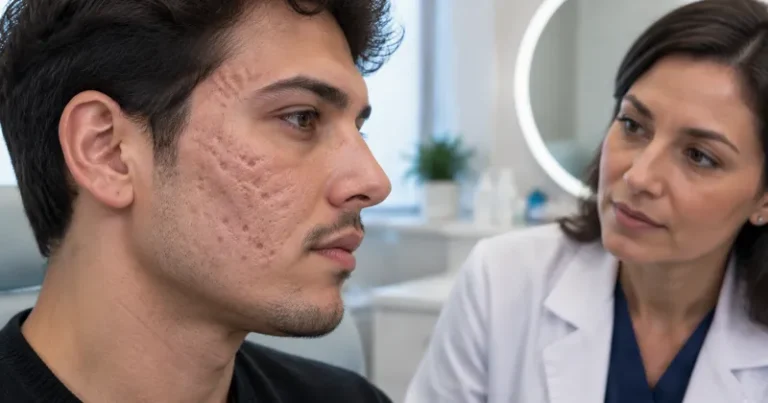
If your acne is deep, painful, widespread, scarring, or not improving with consistent care, a dermatologist can help confirm the diagnosis and choose stronger treatment when appropriate.
Medical disclaimer: This article is for educational purposes and is not a diagnosis or a substitute for care from a qualified healthcare professional.
References:
- American Academy of Dermatology. Acne Clinical Guideline
- American Academy of Dermatology. Back Acne: How to See Clearer Skin
- American Academy of Dermatology. How to Treat Different Types of Acne
- U.S. National Library of Medicine, DailyMed. Adapalene Gel 0.1% — OTC Drug Label
- Choi YS, et al. Gaps and Recommendations for Clinical Management of Truncal Acne From the Personalising Acne: Consensus of Experts Panel
- Ko JY, et al. Consensus Report on Truncal Acne: The Korean Acne and Rosacea Society Experts Panel