Can Niacinamide Cause Acne? Breakouts, Irritation and What to Check
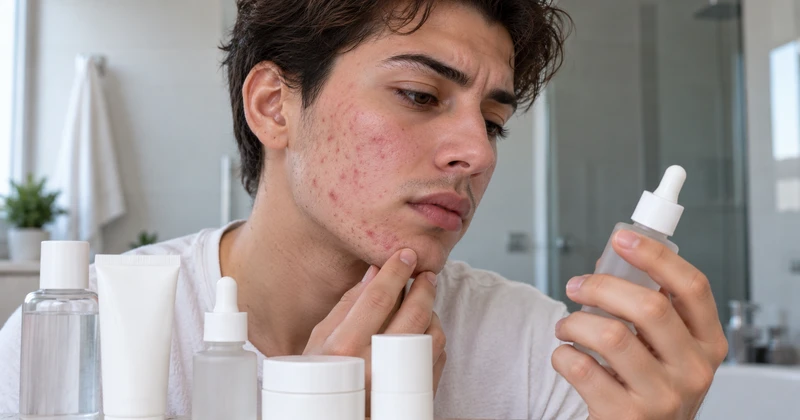
You add a niacinamide serum because it is supposed to work well for acne-prone skin. A few days or weeks later, you notice new bumps, redness, or pimples. Naturally, you start wondering: can niacinamide cause acne?
Niacinamide is not considered a typical direct acne-causing ingredient. In fact, topical niacinamide has been studied for acne and is commonly included in products designed for oily or blemish-prone skin.
That does not mean every niacinamide product will agree with your skin. Irritation, a stronger-than-necessary formula, another ingredient in the product, or using too many active products at once can all make your skin look worse.
The useful question is not only whether niacinamide is present. You need to look at the entire product and your entire routine.
Table of Contents
Can Niacinamide Cause Acne? The Short Answer
Niacinamide is not established as a common direct cause of acne. Clinical studies have actually evaluated topical niacinamide as a possible acne-supportive ingredient.
However, you can still develop bumps or breakouts after starting a niacinamide product. The cause may be irritation, another ingredient in the formula, excessive skincare layering, another active ingredient, or an unrelated acne trigger.
What Is Niacinamide?
Niacinamide, also called nicotinamide, is a form of vitamin B3 commonly used in topical skincare.
It is found in products such as:
- Serums.
- Moisturizers.
- Toners.
- Cleansers.
- Sunscreens.
- Acne-supportive treatments.
- Products for uneven skin tone.
Niacinamide has been studied for several effects that can be useful in skincare, including supporting the skin barrier and reducing inflammation.
It has also been investigated in people with acne.
Older clinical trials compared topical niacinamide formulations with topical antibiotics, while newer reviews continue to include niacinamide among cosmetic ingredients that may support acne-prone skin.
The evidence is not strong enough to treat niacinamide like a first-line acne medication, but it also does not support labeling niacinamide as a routine acne trigger.
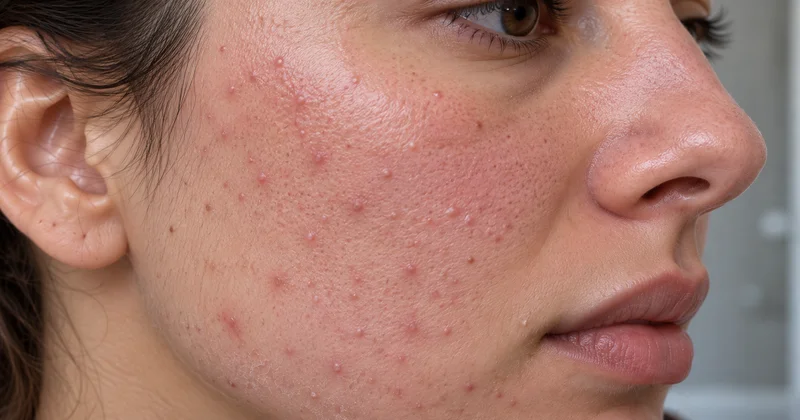
Why Is Niacinamide Used in Acne-Prone Skin?
Niacinamide has several properties that explain why formulators include it in acne-focused products.
It may help calm inflammation
Inflammation is an important part of red, swollen acne lesions.
Niacinamide has anti-inflammatory properties, which may help explain why some clinical acne studies have found improvement with topical formulations.
It may support the skin barrier
Acne-prone skin is often exposed to drying ingredients such as:
- Benzoyl peroxide.
- Salicylic acid.
- Retinoids.
When the skin barrier becomes irritated, people often respond by adding even more products or scrubbing harder, which can make the problem worse.
Niacinamide is frequently included in moisturizers and supportive skincare because of its role in barrier function.
It has been studied in oily and acne-prone skin
Some research has explored niacinamide’s effect on sebum and acne, but that does not mean it reduces oil enough to clear acne on its own.
The evidence is better interpreted as supportive, not as proof that every niacinamide serum treats acne.
If Niacinamide Is Used for Acne, Why Did I Break Out?
This is where the issue becomes more complicated.
A product can contain a generally well-tolerated ingredient and still cause problems for an individual user.
Possible explanations include:
- Skin irritation.
- Another ingredient in the formula.
- A concentration your skin does not tolerate well.
- Several products containing niacinamide.
- Too many strong actives in your routine.
- A rich formula that does not suit your skin.
- Starting several new products at once.
- Your existing acne worsening independently.
- Hormonal, stress-related, dietary, or other acne triggers.
Timing is helpful, but it does not prove causation.
If you introduce a new serum on Monday and your skin becomes irritated shortly afterward, the serum deserves attention. That still does not tell you with certainty that niacinamide itself is the ingredient responsible.
Niacinamide Irritation Can Look Like a Breakout
Not every cluster of bumps is ordinary acne.
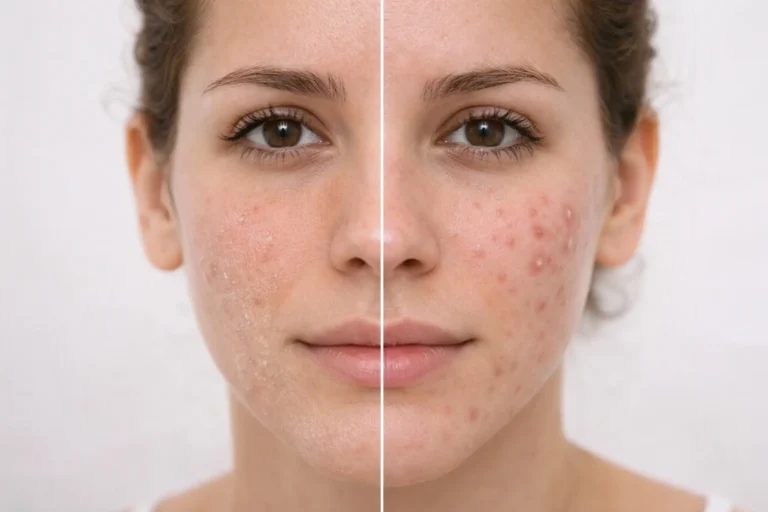
Irritated skin can become red, rough, itchy, or covered with small bumps that someone may describe as “new acne.”
| More Consistent With Irritation | More Consistent With Ordinary Acne |
|---|---|
| Burning or stinging | Blackheads |
| Diffuse redness | Whiteheads |
| Significant itching | Familiar inflamed pimples |
| Tight or uncomfortable skin | Recurrent clogged pores |
| Dryness or scaling | Lesions in your usual acne areas |
| Many tiny irritated bumps | Your typical acne pattern |
This table cannot diagnose your skin.
Acne and irritation can also occur together. For example, you may already have acne and then irritate the surrounding skin with an overly complicated routine.
Niacinamide Redness: Is It Normal?
Persistent redness should not automatically be dismissed as a normal adjustment period.
If a product causes noticeable:
- Burning.
- Stinging.
- Itching.
- Tightness.
- Scaling.
- Swelling.
- Persistent redness.
your skin may be irritated or reacting to something in the formula.
A brief sensation immediately after application does not necessarily mean you have an allergy, but a reaction that persists, becomes more uncomfortable, or worsens with continued use deserves attention.
Do not keep applying an irritating product simply because someone online says your skin needs to “get used to it.”
Can Too Much Niacinamide Cause Acne or Irritation?
There is no established universal amount of topical niacinamide that suddenly starts causing acne.
However, using more of an ingredient does not guarantee better results.
Many clinical studies involving acne have used niacinamide concentrations around 4% to 5%, while modern cosmetic serums may contain 10%, 15%, or even 20%.
That difference does not prove higher concentrations are harmful.
It does mean that a very strong serum is not automatically necessary simply because a lower concentration has benefits.
If your skin becomes irritated after switching to a stronger formula, a higher percentage may offer no practical advantage for you.
Niacinamide may be hiding throughout your routine
The percentage on your serum bottle is only part of the story.
Check whether niacinamide also appears in your:
- Cleanser.
- Toner.
- Essence.
- Acne treatment.
- Moisturizer.
- Sunscreen.
- Foundation.
You might think you are using one niacinamide product when the ingredient is actually present at several stages of your routine.
That does not mean combining niacinamide products is automatically dangerous. It simply gives you another factor to consider when your skin suddenly becomes uncomfortable.
Does 10% Niacinamide Cause Acne?
There is no good evidence establishing 10% niacinamide as a universal acne-causing threshold.
Some people tolerate 10% products without difficulty. Others may prefer lower-strength formulas, especially if their routine already contains multiple active ingredients.
What matters more than chasing a percentage is how the complete formula behaves on your skin.
If a 10% serum causes persistent burning, redness, itching, or bumps, you do not need to continue using it simply because another person’s skin tolerates the same concentration.
Likewise, moving from 5% to 10% or 20% does not guarantee twice or four times the benefit.
Could Another Ingredient in the Serum Be the Problem?
This is one of the most overlooked explanations.
A bottle marketed as a “niacinamide serum” may contain dozens of other ingredients.
Depending on the formula, these might include:
- Fragrance.
- Preservatives.
- Botanical extracts.
- Humectants.
- Emollients.
- Oils.
- Acids.
- Other active ingredients.
If your skin reacts, it is difficult to identify the responsible ingredient from the product name alone.
This is why judging the complete formula matters more than assuming the highlighted ingredient must be responsible.
The same principle applies to makeup. Our guide to how the complete formula matters for breakout-prone skin explains why one ingredient cannot reliably predict how an entire cosmetic will behave.
Niacinamide Allergy vs. Irritation
People often use “allergy” and “irritation” interchangeably, but they are not the same.
Irritation may cause
- Burning.
- Stinging.
- Redness.
- Dryness.
- Tightness.
- Flaking.
This can happen when your skin barrier does not tolerate the product or when the overall routine is too irritating.
An allergic contact reaction may involve
- Significant itching.
- Persistent redness.
- Swelling.
- Rash-like bumps.
- A reaction that returns with repeated exposure.
Importantly, even if a product triggers allergic contact dermatitis, niacinamide itself may not be the allergen.
Preservatives, fragrance, botanicals, and other components can also trigger allergic contact dermatitis.
A dermatologist may use formal patch testing in selected cases when an allergy is suspected.
Does Niacinamide Cause Purging?
Niacinamide is not generally expected to cause true skin purging.
Purging is more commonly discussed with ingredients that accelerate the turnover or shedding of skin cells, such as topical retinoids and some exfoliating acids.
Niacinamide does not work like these ingredients.
If you start niacinamide and develop unfamiliar bumps together with redness, burning, itching, or dryness, irritation or another product-related problem deserves consideration rather than automatically calling the reaction a purge.
The full difference between purging, irritation, and ordinary breakouts deserves its own explanation, so do not assume that continuing through worsening symptoms is always the correct choice.
What If You Use Niacinamide With Retinol or Exfoliating Acids?
Niacinamide is often used alongside other skincare ingredients.
That does not mean the combination is automatically irritating.
The bigger issue is the total routine.
Imagine using:
- An exfoliating acid cleanser.
- A niacinamide serum.
- A retinol product.
- An acne spot treatment.
- A strong exfoliating toner.
If your face becomes red and uncomfortable, blaming the niacinamide alone may miss the larger problem.
Retinoids, AHAs, BHAs, and benzoyl peroxide can all contribute to dryness or irritation, especially when several strong products are introduced at once.
Our guide to avoiding over-irritation with acne active ingredients explains why more treatment is not always better treatment.
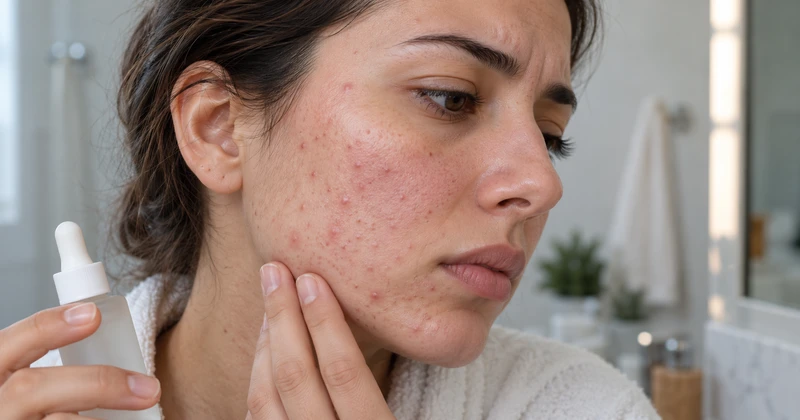
What to Do if Niacinamide Makes Your Skin Worse
Instead of immediately buying another corrective serum, simplify the investigation.
1. Check when the reaction started
Write down when you introduced the product and when your skin changed.
2. Identify everything else that changed
Did you also add:
- Retinol?
- Exfoliating acid?
- New sunscreen?
- Foundation?
- Moisturizer?
- Hair product?
- Acne medication?
If several products changed at once, identifying one culprit becomes much harder.
3. Look for niacinamide throughout your routine
Read the ingredient lists instead of relying only on the product names.
4. Pay attention to the symptoms
Ask whether you are seeing:
Acne-type signs:
- Whiteheads.
- Blackheads.
- Familiar pimples.
- Deeper inflammatory lesions.
Or more irritation-type signs:
- Burning.
- Itching.
- Scaling.
- Diffuse redness.
- Tightness.
5. Avoid adding another strong active immediately
Adding acids, retinoids, spot treatments, and harsh cleansers in an attempt to clear the reaction may create even more irritation.
6. Keep the routine simple
A gentle cleanser, moisturizer, and sunscreen may be enough while you work out what is happening.
If you already use a prescribed acne treatment, follow the instructions provided by the clinician who prescribed it rather than making major medication changes based on a cosmetic reaction.
Should You Stop Using a Niacinamide Product?
If a cosmetic product is causing significant burning, persistent redness, itching, swelling, or a rash-like reaction, you do not need to “push through” those symptoms to prove the product works.
For mild breakouts without obvious irritation, the situation may be less clear.
Consider:
- What else changed.
- Whether the breakout is your normal acne pattern.
- Whether another active could be responsible.
- Whether the product contains several potentially irritating ingredients.
If symptoms are severe, persistent, or difficult to identify, stop experimenting and get professional advice.
How to Test a New Niacinamide Product
Testing new skincare on a small area first can help identify some irritation or allergic reactions before you cover your entire face.
AAD recommends applying a product to a small test area repeatedly for several days before wider use.
If you develop:
- Redness.
- Itching.
- Swelling.
- Significant discomfort.
avoid using the product broadly until you understand the reaction.
Remember that this type of product testing is better at identifying irritation or contact reactions than predicting whether a product will eventually clog your pores.
A patch test cannot guarantee that you will never develop acne from the complete formula.
Other Reasons You May Suddenly Be Breaking Out
Niacinamide may be the newest thing in your bathroom, but acne can change for many other reasons.
Hormonal changes
Hormones can affect oil production and inflammatory acne, particularly around the lower face and jaw.
Stress and sleep changes
Stress does not explain every breakout, but it can affect existing acne in some people.
Hair products
Oily styling products can transfer onto acne-prone areas, especially the forehead and hairline.
Makeup and sunscreen
A new leave-on product may coincide with the breakout.
Friction and sweat
Helmets, masks, tight straps, workout equipment, and sweat can contribute to acne in susceptible areas.
Over-treating acne
Trying several new treatments in a short period can irritate skin and make breakouts appear worse.
For a wider look at possible triggers, see other common causes behind sudden chin breakouts.
How to Keep Your Routine Simple While Your Skin Calms Down
When your skin is irritated, adding more active ingredients is rarely the easiest way to identify the problem.
A basic routine may include:
Morning
- Gentle cleanser when needed.
- Simple moisturizer.
- Broad-spectrum sunscreen.
Evening
- Gentle cleanser.
- Necessary acne treatment if tolerated and already part of your routine.
- Moisturizer.
Avoid:
- Harsh scrubs.
- Picking bumps.
- Strong exfoliation on irritated skin.
- Introducing several new products at once.
- Trying to deliberately “dry out” your face.
Current dermatology guidance emphasizes that irritation itself can worsen the appearance of acne and make treatment harder to tolerate.
When to See a Dermatologist
Consider professional evaluation if you develop:
- Deep or painful acne.
- Nodules or cyst-like lesions.
- New scarring.
- Severe or rapidly worsening breakouts.
- Significant facial swelling.
- Widespread rash.
- Persistent burning or itching.
- Blistering or substantial peeling.
- A sudden eruption unlike your usual acne.
- Symptoms that continue despite removing the suspected cosmetic.
- A reaction you cannot confidently identify.
Acne-like bumps are not always acne. A dermatologist can help distinguish acne from irritation, contact dermatitis, rosacea, folliculitis, and other conditions that may require different treatment.
Frequently Asked Questions
Can niacinamide cause acne if I have sensitive skin?
Niacinamide is not established as a typical direct acne trigger, but sensitive skin can still react to a niacinamide-containing product. Irritation, concentration, the complete formula, or other active ingredients may cause redness or bumps. When asking can niacinamide cause acne, the whole product matters more than the highlighted ingredient alone.
Does niacinamide cause purging?
Niacinamide is not generally expected to cause true purging because it does not work like retinoids or exfoliating acids that accelerate skin-cell turnover. New bumps accompanied by burning, redness, itching, or dryness deserve consideration as irritation or another reaction instead.
Can too much niacinamide cause small bumps?
There is no established topical niacinamide amount that universally causes bumps. However, higher-strength products or using niacinamide across several products may be unnecessary for some people. If tiny bumps occur with redness or discomfort, review the entire routine rather than assuming more niacinamide will improve the problem.
Is niacinamide redness a sign of an allergy?
Not necessarily. Redness can result from ordinary irritation, especially when other strong skincare products are involved. A persistent itchy, swollen, or rash-like reaction may raise more concern for contact dermatitis, but another ingredient in the product could be responsible. A dermatologist can help when the cause is unclear.
Should I use niacinamide again after breaking out?
There is no universal answer. If the reaction involved significant burning, swelling, persistent itching, or rash, avoid immediately reapplying the same product without understanding what happened. If the problem was mild and the responsible ingredient remains uncertain, consider discussing reintroduction or an alternative formula with a dermatologist if needed.
The Bottom Line
So, can niacinamide cause acne? Current evidence does not establish niacinamide as a typical direct acne trigger.
Niacinamide has actually been studied as a supportive ingredient for acne-prone skin, although the evidence is not strong enough to treat it as a guaranteed acne treatment either.
If your skin gets worse after starting a niacinamide product, do not dismiss what you are seeing. Check the complete formula, concentration, other niacinamide products, strong actives, and recent routine changes.
Most importantly, do not automatically label redness, burning, itching, or unfamiliar bumps as “purging.”
Simplify your routine and let your symptoms guide the next step. If the reaction is persistent, severe, painful, swollen, scarring, or difficult to identify, get help from a dermatologist.
This article is for educational purposes only. It does not diagnose acne, irritation, allergic contact dermatitis, or another skin condition and is not a substitute for individualized care from a qualified healthcare professional.
References:
- Cochrane / PubMed — Topical Azelaic Acid, Salicylic Acid, Nicotinamide, Sulphur, Zinc and Fruit Acid for Acne
Systematic review finding low- or very-low-quality evidence for many topical treatments, including nicotinamide, and emphasizing limitations in the available trials. - Journal of Evidence-Based Medicine — Evidence-Based Topical Treatments for Acne: Abridged Cochrane Review
Summarizes comparative nicotinamide acne trials and the limited certainty of the evidence. - Clinical, Cosmetic and Investigational Dermatology — Cosmeceuticals in Acne Vulgaris: From Mechanism of Action to Clinical Application
Recent review covering topical niacinamide in acne, including 4–5% formulations and reported minor effects such as itching, burning, mild dermatitis, and greasy skin. - International Journal of Dermatology — Topical 4% Nicotinamide vs. 1% Clindamycin in Moderate Inflammatory Acne Vulgaris
Randomized double-blind study evaluating 4% topical nicotinamide in inflammatory acne. - International Journal of Cosmetic Science — Mechanistic Insights Into the Multiple Functions of Niacinamide
Reviews topical niacinamide tolerability, dermatologic applications, and formulation evidence. - American Academy of Dermatology — How to Test Skin Care Products
Provides dermatologist guidance for testing new skincare and identifying redness, itching, swelling, or allergic contact reactions. - American Academy of Dermatology — 10 Skin Care Habits That Can Worsen Acne
Supports keeping acne routines gentle and avoiding frequent product changes that can irritate skin and worsen breakouts. - American Academy of Dermatology — Acne Clinical Guideline
Current evidence-based guideline identifying established topical and systemic acne therapies. Niacinamide is not listed among the guideline’s recommended primary acne treatments.