Does Birth Control Cause Acne Breakouts? What Helps vs. Worsens Acne
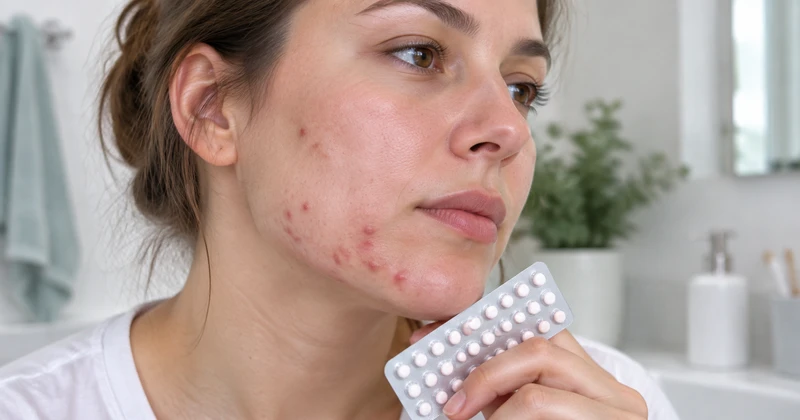
If you recently started, stopped, or switched contraception and your skin changed, you may be wondering: does birth control cause acne breakouts?
The answer depends on the type of birth control.
Some hormonal methods—especially certain combined birth control pills containing both estrogen and progestin—can actually improve acne. Other methods, particularly some progestin-only contraceptives, may be associated with new or worsening breakouts in some users.
There is another possibility that is easy to miss: if you switch away from a combined pill that had been keeping your acne under control, your breakouts may return even if the new contraceptive is not directly causing them.
That is why the timing of the breakout and the type of contraception both matter.
Table of Contents
Does Birth Control Cause Acne Breakouts? The Short Answer
Yes, birth control can affect acne, but it does not affect everyone in the same direction.
Combined oral contraceptives can improve acne and are an evidence-supported acne treatment for appropriate patients. Acne may occur or worsen with some progestin-only methods, including hormonal IUDs and implants, but individual response varies.
Starting, stopping, or switching birth control can also change your hormonal environment enough to affect your skin.
Do not stop contraception on your own solely because you develop acne. If the breakouts are significant, discuss both your skin and contraceptive goals with the clinician who prescribes or manages your birth control.
Why Birth Control Can Change Your Skin
Hormones influence several processes involved in acne.
Androgens—a group of hormones that includes testosterone—can stimulate the sebaceous glands to produce more oil. More oil does not automatically mean acne, but it can contribute to clogged pores and inflammation when combined with dead skin cells and other acne-related factors.
This helps explain why hormonal changes can show up on the skin.
Why estrogen-containing birth control may help acne
Combined hormonal contraception contains both an estrogen and a progestin.
Combined oral contraceptives can reduce the effects of androgens involved in oil production. For some users, this means:
- Less oily skin.
- Fewer clogged pores.
- Fewer inflamed pimples.
- Improvement in deeper hormonal breakouts.
The effect is gradual rather than immediate.
Hormonal acne often appears around the lower face, chin, and jawline, although acne location alone cannot prove that hormones are the cause.
If this pattern sounds familiar, you can also read about common hormonal and everyday causes of chin acne.
Birth Control and Acne: Quick Comparison
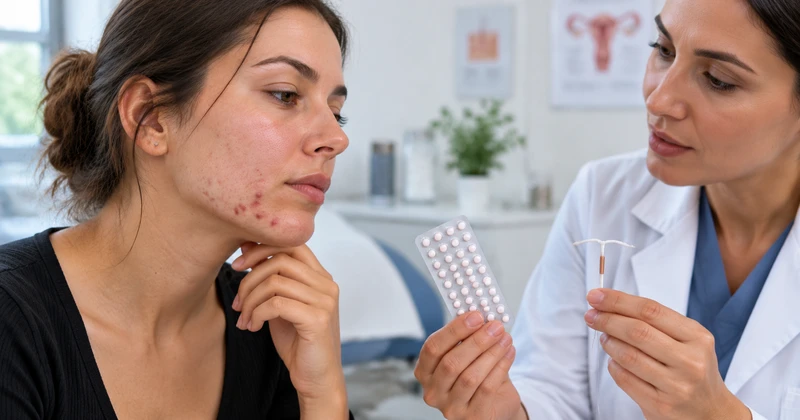
Different contraceptive categories should not be treated as if they have the same acne effect.
| Birth Control Method | Possible Acne Effect | Important Context |
|---|---|---|
| Combined birth control pill | May improve acne | Some formulations are specifically approved for acne treatment |
| Combined patch or vaginal ring | May improve acne for some users | Contains estrogen and progestin, but should not automatically be treated as equivalent to an acne-approved pill |
| Progestin-only pill | Acne response can vary | Does not provide the same estrogen-related acne benefit as combined pills |
| Hormonal IUD | Acne can occur or worsen in some users | Many users do not develop acne; individual risk varies |
| Etonogestrel implant | Acne is a reported adverse effect | Response varies between users |
| Birth control injection | Acne can occur in some users | Not everyone develops worsening acne |
| Copper IUD | Does not contain hormones | Acne after switching may reflect loss of the previous pill’s acne benefit |
This table describes general patterns, not a prediction of what will happen to an individual person.
Does Birth Control Help Acne?
Yes. Certain birth control pills can be an effective acne treatment.
Dermatologists use combined oral contraceptives for people who are appropriate candidates and want or need hormonal contraception.
These pills can improve several types of acne, including:
- Blackheads.
- Whiteheads.
- Inflamed pimples.
- Some deeper hormonal breakouts.
They can be especially useful when acne follows a hormonal pattern, such as breakouts that repeatedly worsen around menstrual cycles or affect the lower face and jawline.
Birth control pills are sometimes used alongside another acne treatment rather than as the only treatment.
For example, topical treatments may still be useful for clogged pores or inflammatory acne while the hormonal treatment takes time to work.
Which Birth Control Pills Are Used for Acne?
Some combined oral contraceptives have received FDA approval specifically for acne treatment.
Approved formulations have included combinations using hormones such as:
- Norgestimate with ethinyl estradiol.
- Drospirenone with ethinyl estradiol.
- Norethindrone acetate with ethinyl estradiol.
Brand availability and formulations can change, so this should not be treated as a permanent shopping list.
More importantly, an FDA acne indication does not mean a pill is automatically the best contraceptive for you.
A healthcare professional needs to consider whether estrogen-containing contraception is medically appropriate based on factors such as your health history, blood pressure, smoking status, migraine history, clotting risk, medications, and contraceptive needs.
The goal is not to find the pill with the strongest acne reputation.
It is to find a contraceptive that is medically appropriate and also fits your priorities.
How Long Does Birth Control Take to Help Acne?
Birth control does not usually clear acne within days or a couple of weeks.
With oral contraceptive hormonal therapy, acne improvement often becomes noticeable after roughly 2 to 3 months, although the timeline varies.
Some people improve gradually beyond that point.
This delay matters because stopping or switching too quickly can make it difficult to tell whether the treatment would have helped.
A dermatologist may use another acne medication alongside hormonal therapy so that acne is treated from more than one angle.
If clogged pores are part of your acne pattern, our guide to salicylic acid and acne treatment explains one common over-the-counter option.
Can Birth Control Make Acne Worse at First?
Skin changes can occur after starting a hormonal contraceptive, but every early breakout should not automatically be called “purging.”
Purging is a term more commonly associated with treatments that increase skin-cell turnover.
A hormonal change can instead alter oil production and the environment inside the pore.
If your acne clearly worsens after starting contraception, pay attention to:
- When the breakout began.
- Whether it is getting better or worse over time.
- Whether the acne is mild or severe.
- Whether painful nodules are developing.
- Whether you are beginning to scar.
- Whether other medications or skincare products changed at the same time.
A temporary change does not always mean the method needs to be stopped, but persistent or severe worsening deserves a conversation with your healthcare professional.
Hormonal IUDs and Acne
Hormonal IUDs release a progestin called levonorgestrel.
Acne is reported among some users, and current research supports an association between levonorgestrel IUD use and acne in a portion of users.
However, that does not mean a hormonal IUD will cause acne for everyone.
A 2026 systematic review and meta-analysis found that acne occurred among users of levonorgestrel-releasing IUDs, with rates varying between device doses and age groups. The studies were also quite different from one another, which makes it difficult to predict an individual’s risk from a single number.
A large earlier U.S. study also found somewhat more acne-related medical visits among levonorgestrel IUD users than among combined oral contraceptive users.
The key detail is that the absolute differences were small.
That is much more accurate than saying:
“Hormonal IUDs cause acne.”
A better statement is:
Hormonal IUDs may be associated with acne in some users, but many people use them without developing significant acne.
Does the Birth Control Implant Cause Acne?
The contraceptive implant contains the progestin etonogestrel.
Acne is listed among common adverse reactions in the current U.S. prescribing information for the etonogestrel implant.
That means acne occurred often enough in clinical studies to be recognized as a possible side effect.
It does not mean every person with an implant will develop acne or that every breakout during implant use was caused by the implant.
If you already have acne and are considering an implant, bring that concern into the contraceptive discussion.
If you develop severe acne after receiving the implant, your clinician can help you decide whether it makes more sense to treat the acne separately or consider another contraceptive method.
What About the Birth Control Shot?
The contraceptive injection is another progestin-only method.
Acne has been reported among users, but the skin response is not predictable enough to say that everyone who uses the shot will break out.
This is another situation where contraception should not be chosen by acne risk alone.
The injection has its own benefits, limitations, side effects, and medical considerations that should be discussed separately from skin concerns.
If your acne changes after starting the shot, document the timing and severity and discuss it with your healthcare professional instead of assuming the shot must immediately be discontinued.
Does a Copper IUD Cause Acne?
A copper IUD contains no hormones.
Because of that, it does not directly create the same hormonal environment as a levonorgestrel IUD or progestin implant.
So why do some people report acne after switching to a copper IUD?
One possible explanation is what they stopped.
Imagine that you were taking a combined birth control pill that had been suppressing hormonal acne. You stop the pill and switch to a copper IUD.
A few months later, acne returns.
It can feel as though the copper IUD caused the breakout, when the bigger change may actually be the loss of the pill’s acne-controlling effect.
Research comparing contraceptive methods has found somewhat more acne-related visits among copper IUD users than combined-pill users, but this comparison does not prove that copper itself caused the acne.
The previous contraception matters.
Acne After Stopping Birth Control
Stopping birth control pills can be just as relevant to acne as starting them.
If a combined pill was lowering androgen activity and helping keep your skin clear, stopping it removes that benefit.
Your natural hormonal pattern then becomes more visible again.
For some people, that means:
- Oilier skin.
- More clogged pores.
- Jawline breakouts.
- Cyclical acne.
- Return of acne they had before starting the pill.
The American Academy of Dermatology recognizes starting or discontinuing birth control pills as a hormonal change that can be associated with adult acne.
This does not mean everyone develops “post-pill acne.”
It means that when acne appears after a contraceptive switch, you should look at both the new method and the method that was stopped.
Is There a Best Birth Control for Acne?
There is no universal best birth control for acne.
If acne improvement is an important goal and you are medically eligible for combined hormonal contraception, certain combined oral contraceptives may be worth discussing with your clinician.
But acne should be only one part of the decision.
A birth control method also needs to fit your:
- Pregnancy-prevention goals.
- Medical history.
- Blood pressure.
- Migraine history.
- Smoking status.
- Clotting and cardiovascular risks.
- Menstrual preferences.
- Convenience needs.
- Comfort with daily pills versus longer-acting methods.
- Other side effects and benefits.
- Personal preferences.
Combined hormonal birth control is not appropriate for everyone.
For example, current U.S. medical eligibility guidance places important restrictions on combined hormonal contraception for certain people with conditions such as severe hypertension, migraine with aura, or significant cardiovascular or clotting risks.
That is why an internet ranking titled “best acne birth control” cannot replace individualized medical screening.
When Acne Should Not Be the Main Factor in Choosing Birth Control
Clearer skin can be a meaningful benefit.
But contraception has a much bigger job than treating acne.
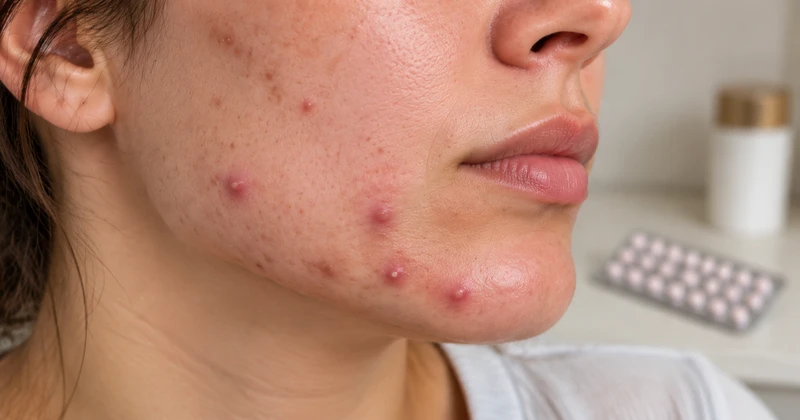
If one method provides excellent pregnancy prevention, fits your lifestyle, and is medically appropriate but causes manageable acne, treating the acne separately may sometimes make more sense than changing contraception.
In another situation, severe painful or scarring acne may make a contraceptive change worth discussing.
There is no one correct answer.
The decision should consider:
How well is the contraceptive working for you overall, and how significant is the skin problem?
This is where shared decision-making with a healthcare professional becomes useful.
Should You Switch Birth Control Because of Acne?
Do not stop or switch your contraception on your own solely because of acne.
Instead, look at the complete picture.
Ask:
- Did the acne begin after starting this method?
- Did you also stop a combined pill?
- How severe are the breakouts?
- Are you developing painful nodules?
- Are scars starting to form?
- How long have you been using the method?
- Is the contraception otherwise working well for you?
- Have standard acne treatments been tried?
- Are there other medically appropriate contraceptive options?
Sometimes acne can be treated effectively while the contraceptive stays the same.
Other times, switching may be a reasonable part of the plan.
If acne is becoming severe or scarring, involving a dermatologist as well as the clinician managing your contraception can be useful.
Birth Control Rash vs. Birth Control Acne
A birth control rash is not the same thing as birth control acne.
Acne commonly appears as:
- Blackheads.
- Whiteheads.
- Red pimples.
- Pus-filled pimples.
- Deeper nodules or cyst-like lesions.
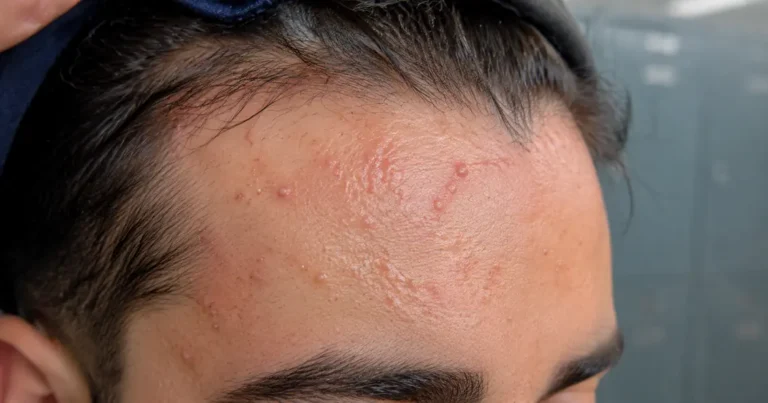
A rash is more likely to involve features such as:
- Itching.
- Diffuse redness.
- Hives or welts.
- Burning.
- Scaling.
- Swelling.
- Irritation in the exact shape or location of a contraceptive patch.
Do not assume an itchy or rapidly spreading eruption is acne.
If you develop facial or throat swelling, breathing difficulty, or other signs of a severe allergic reaction, seek urgent medical care.
The causes and warning signs of contraceptive-related rashes need a separate discussion from acne.
When to See a Dermatologist or Prescribing Clinician
Consider getting medical advice if:
- Acne became severe after starting or switching birth control.
- You develop painful nodules or cyst-like lesions.
- Breakouts are leaving scars.
- Acne continues to worsen rather than stabilize.
- Standard acne care is not helping.
- You are considering changing contraception because of your skin.
- You cannot tell whether the eruption is acne or a rash.
- You develop significant itching, swelling, or another possible medication reaction.
You do not have to wait until acne becomes severe before bringing it up.
If skin effects matter to you when choosing contraception, tell your healthcare professional during the decision process.
Frequently Asked Questions
Does birth control cause acne breakouts when you first start it?
It can, depending on the contraceptive method and your individual hormonal response. Some progestin-only methods are associated with acne in some users, while combined oral contraceptives can improve acne. A breakout after switching methods may also happen because you stopped a previous pill that had been keeping acne under control.
Does birth control help acne?
Yes. Combined oral contraceptives are an evidence-supported hormonal treatment for acne in appropriate patients. Several formulations have received FDA approval for acne treatment. Improvement usually takes time, and birth control may be combined with other acne treatments.
Which birth control is best for acne?
There is no universal best method. Certain combined oral contraceptives have the strongest established acne-treatment role, but whether they are appropriate depends on your health history and contraceptive needs. Acne should be considered alongside safety, effectiveness, convenience, bleeding preferences, and other personal priorities.
Can an IUD cause acne?
Hormonal levonorgestrel IUDs are associated with acne in some users, but many people do not develop significant breakouts. Copper IUDs contain no hormones. If acne appears after switching from a combined pill to a copper IUD, loss of the pill’s acne benefit may be part of the explanation.
Will acne go away if I stop birth control?
Not necessarily. If your birth control is contributing to acne, changing methods may help, but stopping a combined pill that was improving your skin can actually cause acne to return. Do not discontinue contraception solely for acne without discussing the change with your healthcare professional.
The Bottom Line
So, does birth control cause acne breakouts? Sometimes—but that is only part of the story.
Certain combined birth control pills can improve acne and are used as legitimate acne treatments. Hormonal IUDs, implants, injections, and other progestin-only methods may be associated with acne in some users, but the response varies widely.
And if acne develops after switching methods, do not forget to consider what you stopped. Losing the acne-suppressing effect of a combined pill can make a new method look responsible for a breakout even when the situation is more complicated.
The best contraceptive is not simply the one most likely to clear your skin. It is the method that fits your health, pregnancy-prevention goals, preferences, and acceptable side effects.
If acne becomes painful, persistent, or scarring, discuss both the contraception and the acne with your prescribing clinician or dermatologist rather than making the change alone.
This article is for educational purposes only and does not replace individualized medical or contraceptive advice. Do not start, stop, or switch prescription birth control without discussing it with an appropriate healthcare professional.
References
- American Academy of Dermatology — Stubborn Acne? Hormonal Therapy May Help
Explains the role of oral contraceptive pills in acne treatment and notes that improvement commonly takes about two to three months. - American Academy of Dermatology — Acne: Diagnosis and Treatment
Identifies combined oral contraceptives as an effective acne treatment and discusses FDA-approved acne indications for certain formulations. - American Academy of Dermatology — Adult Acne
Lists starting or discontinuing birth control pills among hormonal changes associated with adult acne. - American College of Obstetricians and Gynecologists — Combined Hormonal Birth Control: Pill, Patch, and Ring
Explains that combined hormonal birth control contains estrogen and progestin and may improve acne. - American College of Obstetricians and Gynecologists — Facts Are Important: Hormonal Birth Control
Emphasizes shared decision-making and that no single birth control method is right for every individual. - CDC — U.S. Medical Eligibility Criteria for Contraceptive Use, 2024
Provides U.S. guidance for determining whether contraceptive methods are appropriate with specific medical conditions and risk factors. - Barbieri JS, et al. — Influence of Contraception Class on Incidence and Severity of Acne Vulgaris
Large retrospective cohort comparing acne outcomes across contraceptive classes; differences relative to combined oral contraceptives were small in absolute terms. - Oliveira ECF, et al. — Incidence of Acne in Women Using the Levonorgestrel-Releasing Intrauterine Device: A Systematic Review and Meta-Analysis
2026 systematic review evaluating acne incidence with levonorgestrel IUDs and showing variation across studies, doses, and populations. - FDA — NEXPLANON (etonogestrel implant) Prescribing Information, 2026
Current prescribing information lists acne among common adverse reactions reported in clinical trials. - FDA — Depo-SubQ Provera 104 / Medroxyprogesterone Prescribing Information, 2025
Current prescribing information includes acne among reported adverse effects.