Products for Acne Scars: Best Options for Marks and Texture
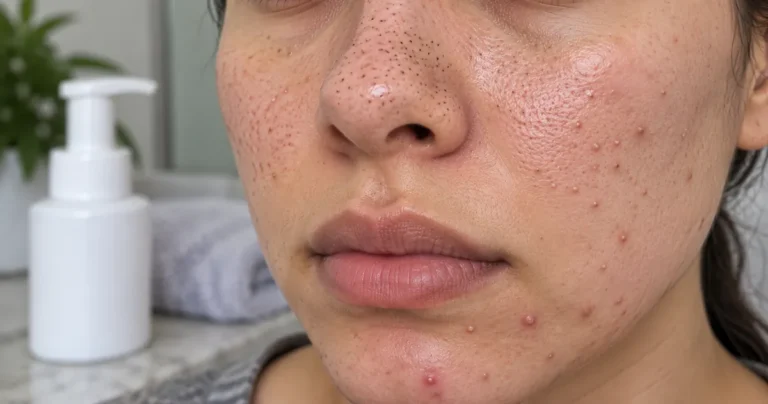
Shopping for products for acne scars can be confusing because “acne scar” is often used for several different things. A flat brown mark, a shallow uneven patch, a deep ice-pick scar, and a raised keloid do not respond to the same type of product.
The most useful approach is to identify what acne left behind before buying anything. Topical products can help some post-acne marks and mild surface changes, while deeper or raised structural scars often need a different strategy.
This guide matches the main product categories to the concerns they can realistically address—and points out when another serum is unlikely to be the best use of your money.
Table of Contents
Products for Acne Scars: Quick Picks by Concern
Products for acne scars work best when the product category matches the problem you can actually see. Flat discoloration may respond to a retinoid-based routine plus sun protection, mild surface unevenness may improve with selected topical ingredients, and raised scars may benefit from scar-specific care. Deep pitted scars usually need dermatologist-directed treatment rather than another over-the-counter cream.
| What you see | Product category to consider | What it may help | Main limitation |
|---|---|---|---|
| Flat brown, gray, red, or pink post-acne marks | Retinol/retinoid plus daily sunscreen | Uneven tone and mild texture | Flat marks are not true structural scars |
| Mild uneven surface texture | Retinoid or carefully chosen exfoliant | Mild surface irregularity | Limited effect on deep pits |
| Raised, healed scar | Silicone scar gel or sheet | Raised-scar management | Not designed to fill depressed scars |
| Ice-pick, boxcar, or rolling scars | Dermatologist evaluation | Structural scar treatment | OTC products cannot reliably rebuild lost tissue |
The key buying rule is simple: do not judge products for acne scars by how dramatic the package sounds. Judge them by whether the ingredient or product type fits your scar or mark.
Before Buying Products for Acne Scars, Identify What You Have
A large part of wasted spending comes from treating a mark as though it were a scar—or treating a deep scar as though it were a dark spot.
Flat post-acne marks
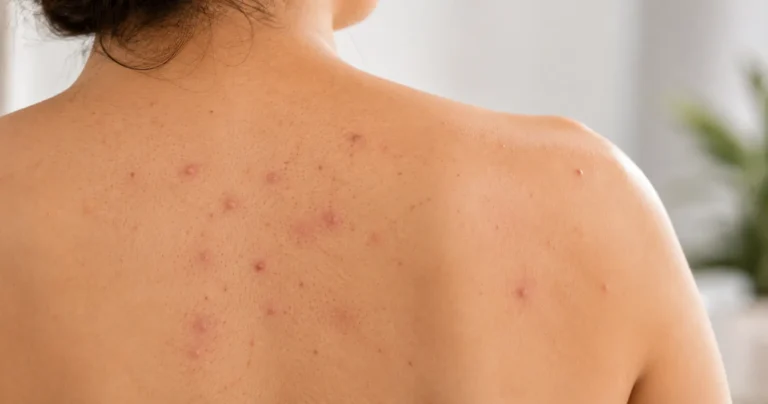
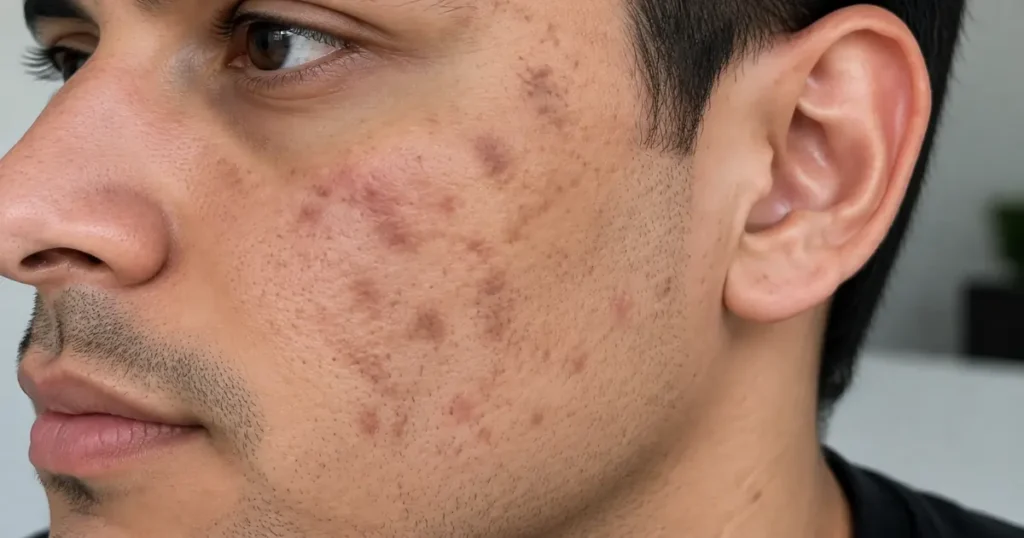
A flat spot that remains after a pimple heals may be post-inflammatory hyperpigmentation (PIH), which can look brown, gray, or black, or a lingering red or pink mark.
These spots can last for months, but they are not the same as a permanent depressed or raised scar.
That distinction matters because topical skincare products are generally more useful for color changes than for deep structural scars.
Depressed acne scars
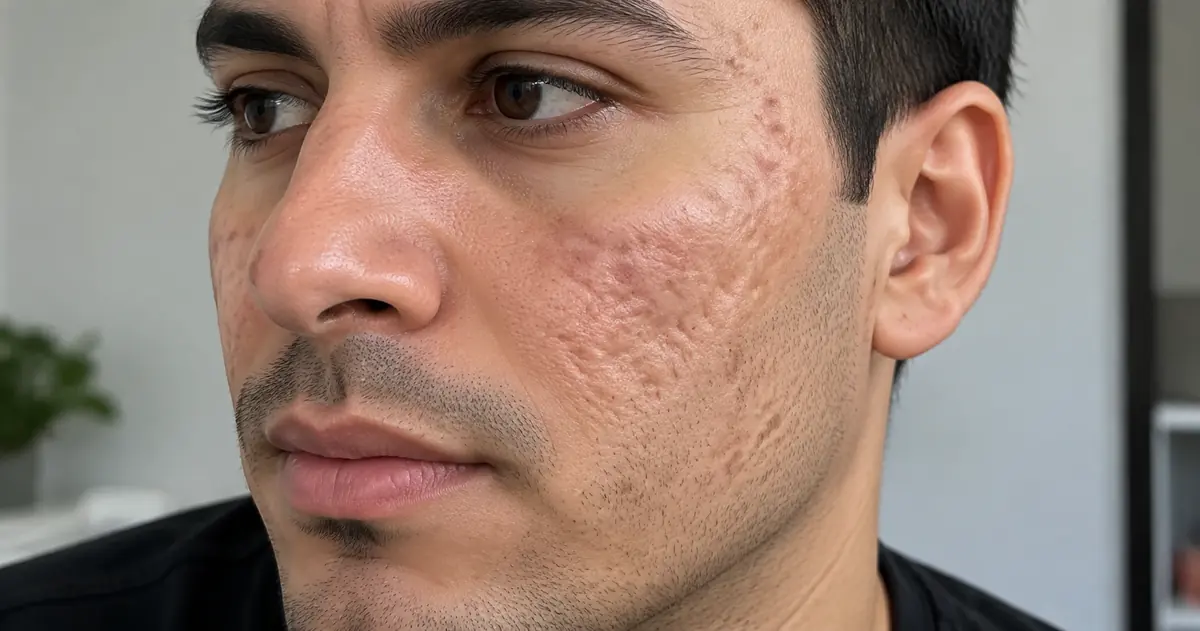
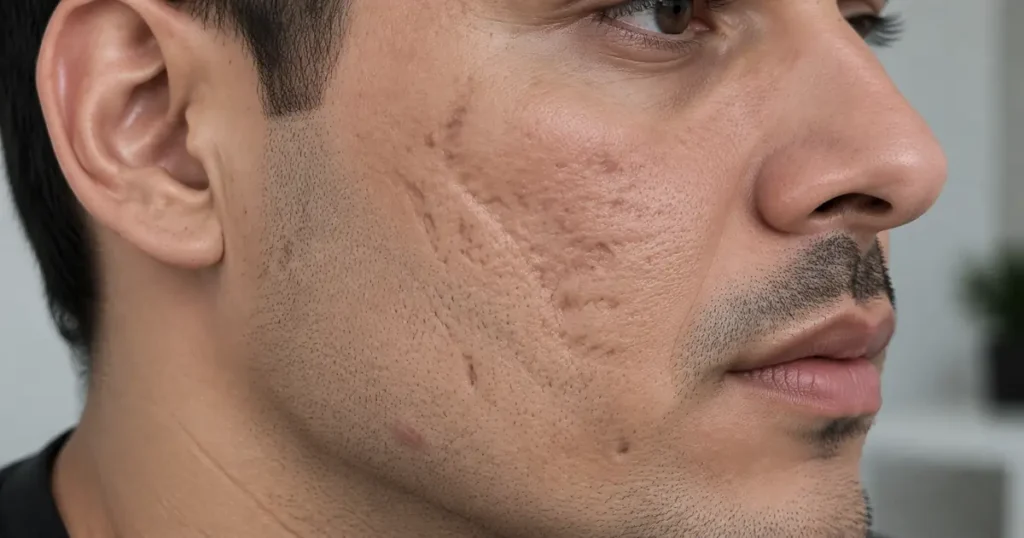
Depressed scars sit below the surrounding skin. Common types include:
- Ice-pick scars: narrow, deeper pits.
- Boxcar scars: broader depressions with more defined edges.
- Rolling scars: shallow depressions that create a wavy surface.
These form when the skin does not rebuild enough collagen during healing.
A topical product may make mild texture look smoother, but it cannot physically replace a substantial amount of lost tissue.
Raised acne scars
Raised scars form when the healing response produces excess collagen.
Hypertrophic scars generally stay within the original damaged area, while keloids can extend beyond it.
This category matters because products used for raised scars are not interchangeable with products intended for pigmentation or depressed scars.
Active acne plus old marks
If you are still getting inflamed pimples, nodules, or cysts, preventing new lesions deserves priority.
Continuing acne can create new discoloration and new scars while you are trying to fade older ones.
Products for Acne Scars for Dark Marks and Uneven Tone
For flat post-acne discoloration, useful products for acne scars are really products for post-acne marks.
The goal is not to “fill” missing tissue. It is to support a more even-looking tone, mild surface improvement, and protection from UV exposure that can make discoloration more noticeable.
Retinol and retinoid products
Over-the-counter retinol belongs to the retinoid family.
Retinoids can improve mild pigmentation irregularities and surface texture over time. They can also cause:
- Dryness.
- Peeling.
- Stinging.
- Redness.
- Irritation.
These effects are more likely when you begin too aggressively or combine several irritating actives.
A practical product example is CeraVe Resurfacing Retinol Serum.
Its current official formula is designed for post-acne skin and includes:
- Encapsulated retinol.
- Niacinamide.
- Ceramides.
That makes it a reasonable example for someone shopping for help with flat post-acne marks and mild texture.
It should not be presented as a serum that fills ice-pick, rolling, or boxcar scars.
If you choose a retinol product:
- Introduce it cautiously if your skin is sensitive.
- Keep the rest of your routine relatively simple.
- Use sunscreen during the day.
- Avoid immediately combining it with several strong exfoliants.
Dealing with flat post-acne marks and mild uneven texture? ✨
CeraVe Resurfacing Retinol Serum is designed for post-acne skin and combines encapsulated retinol with niacinamide and ceramides.
✅ Targets the appearance of post-acne marks
✅ Helps improve mild uneven skin texture
✅ Includes ceramides to support the skin barrier
Retinol can cause dryness or irritation, especially when introduced too quickly. It should not be expected to fill deep pitted scars, and retinoids should be avoided during pregnancy.
👉 Check CeraVe Resurfacing Retinol Serum on Amazon
Retinoids and retinol should be avoided during pregnancy. If you are pregnant, trying to become pregnant, or unsure whether an ingredient is appropriate, discuss your routine with your obstetrician or dermatologist.
Sunscreen belongs in a post-acne mark routine
Daily broad-spectrum sunscreen does not erase an acne scar.
What it can do is protect skin from UV exposure that can make post-inflammatory dark spots more noticeable and interfere with an even-looking complexion.
For acne-prone skin, look for:
- Broad-spectrum protection.
- SPF 30 or higher.
- A texture you will use consistently.
- A noncomedogenic formula when appropriate.
If hyperpigmentation is a major concern, a suitable tinted sunscreen containing iron oxide can also provide protection against visible light, which can contribute to persistent dark spots.
Think of sunscreen as protection for your progress—not as a product that rebuilds scar tissue.
Products for Acne Scars for Mild Surface Texture
Some products for acne scars may make mild texture less noticeable, but expectations matter.
A topical ingredient can influence the appearance of the skin surface. It is much less likely to make a deep depression disappear.
Want a product aimed specifically at post-acne surface texture? 🧴
Differin Resurfacing Scar Gel is formulated to support smoother-looking post-acne skin and soften the appearance of surface imperfections.
✅ Designed for post-acne marks and uneven-looking texture
✅ Contains bakuchiol and peptides
✅ Fragrance-free and noncomedogenic
Keep expectations realistic: this type of topical product may improve the appearance of mild surface irregularities, but it should not be expected to rebuild the tissue lost in deep ice-pick or boxcar scars.
👉 Check Differin Resurfacing Scar Gel on Amazon
Retinoids
Retinoids are one of the more useful topical categories when the problem is mild texture combined with uneven tone.
They influence skin turnover and longer-term remodeling processes, but their usefulness decreases as scar depth increases.
If your skin is already irritated, adding a retinoid simply because it is marketed for texture may make the routine harder to tolerate.
Salicylic acid
Salicylic acid makes the most sense when clogged pores or active acne are still part of the picture.
Dermatology guidance also recognizes that salicylic acid may make mild acne scarring less noticeable.
That does not mean it replaces missing dermal tissue or removes deep pitted scars.
If salicylic acid is the ingredient you are considering, read our guide on whether salicylic acid can help acne scars and marks before adding another exfoliant.
More exfoliation is not automatically better.
Using salicylic acid, a strong AHA, a retinol product, and a scrub together can turn a reasonable scar routine into an irritation problem.
Products for Acne Scars for Raised Scars
Raised scars require a different buying strategy.
Among products for acne scars, silicone scar gels and sheets are commonly used for hypertrophic and keloid-type scars. Research suggests potential benefit for raised-scar management, although the quality and certainty of evidence vary across studies.
Is your acne scar raised rather than indented? 🎯
Kelo-Cote Advanced Formula Scar Gel uses a silicone-based formula intended for raised hypertrophic and keloid-type scars.
✅ Silicone-based scar management
✅ Designed to help soften and flatten raised scars
✅ Transparent, water-resistant gel format
Use it only on healed, intact skin as directed. Silicone gel is intended for raised scars—it will not fill ice-pick, rolling, or boxcar depressions.
👉 Check Kelo-Cote Advanced Formula Scar Gel on Amazon
One current example is ScarAway Silicone Scar Gel.
According to its current official information, the product contains:
- Polysiloxanes.
- Silicon dioxide.
It is intended for healed scars on intact skin.
Its instructions specifically warn against applying it to:
- Active acne breakouts.
- Open wounds.
- Oozing skin.
- Crusted skin.
That limitation matters.
A silicone scar gel is not an acne spot treatment for an active cyst.
It is also not the correct product category for an ice-pick scar. Putting silicone gel over a depressed scar does not replace the missing tissue underneath it.
If a raised scar is growing, very itchy, painful, or may be a keloid, dermatologist evaluation is more useful than repeatedly changing over-the-counter products.
Why Products for Acne Scars Cannot Fix Every Pitted Scar
Products for acne scars have an important physical limitation: a cream or serum cannot reliably rebuild a substantial amount of tissue that has been lost below the skin surface.
Deep ice-pick, rolling, and boxcar scars are structural changes.
Depending on the scar type, a dermatologist may consider options such as:
- Microneedling.
- Chemical peels.
- Laser treatment.
- Fillers.
- Scar surgery.
- Other scar-specific procedures.
The appropriate option depends on the type and depth of the scars, skin tone, active acne, medical history, and treatment goals.
That does not make topical skincare useless.
A consistent routine can still:
- Help control active acne.
- Support the surrounding skin.
- Improve some discoloration.
- Make mild texture less noticeable.
It simply should not be marketed as the equivalent of structural scar treatment.
If depressed scars are your main concern, read which treatments work for different acne scar types before spending more money on another “scar-removing” serum.
How to Compare Products for Acne Scars by Ingredient
Instead of shopping according to marketing terms, match each category to a specific job.
| Product type | Best fit | What it cannot realistically do | Main caution |
|---|---|---|---|
| Retinol/retinoid | Flat marks, mild pigmentation irregularity, mild texture | Reliably fill deep pits | Dryness and irritation; avoid during pregnancy |
| Salicylic acid | Clogged pores, active acne, mild surface irregularity | Rebuild missing dermal tissue | Dryness and irritation, especially with other actives |
| Silicone scar gel/sheet | Healed raised scars | Treat active acne or depressed scars | Use only as directed on intact skin |
| Broad-spectrum sunscreen | Protecting acne-prone skin and limiting worsening of visible dark marks | Fill or flatten structural scars | Requires adequate application and reapplication |
You may need only one treatment category plus sunscreen.
A routine does not become more effective simply because it contains more active ingredients.
How to Choose Products for Acne Scars Without Wasting Money
Before buying products for acne scars, work through a few practical questions.
1. Identify the concern
Is it:
- Flat discoloration?
- Mild texture?
- A depressed scar?
- A raised scar?
If you cannot tell, a dermatologist can prevent months of treating the wrong problem.
2. Control active acne
New breakouts can lead to new marks and scars.
If acne is still active, preventing new inflammatory lesions may provide more long-term value than focusing only on old scars.
3. Pick one main goal
Trying to fade marks, unclog pores, smooth texture, flatten a raised scar, and stop new acne with one serum usually leads to unrealistic expectations.
4. Read the active ingredients
The phrase “scar serum” on the front of the package tells you less than the active ingredients and what those ingredients can realistically do.
5. Consider irritation
An effective-looking routine that leaves your skin persistently red, peeling, or uncomfortable is difficult to maintain.
Irritation can also make discoloration more troublesome in some skin tones.
6. Avoid duplicate actives
You usually do not need:
- A retinol serum.
- A strong AHA peel.
- A salicylic acid toner.
- A physical scrub.
all working on the same area at once.
7. Know when another purchase will not solve the problem
If your main concern is a deep rolling, boxcar, or ice-pick scar, a professional consultation may be a better investment than another topical product.
A Simple Routine Using Products for Acne Scars
A routine using products for acne scars does not need to contain five different treatment serums.
Morning
- Gentle cleanser, if needed.
- Moisturizer if your skin needs it.
- Broad-spectrum SPF 30 or higher.
If you have persistent post-inflammatory hyperpigmentation, an appropriate tinted sunscreen with iron oxide can be worth considering.
Evening
- Gentle cleanser.
- One selected treatment, such as retinol if it is appropriate for you.
- Moisturizer as needed.
If active acne is still causing new marks, controlling the acne itself may deserve priority over adding another dedicated scar product.
For a broader routine, see what acne-scar care can realistically do at home.
Consistency generally makes more sense than rotating through multiple aggressive actives.
Products for Acne Scars to Avoid or Approach Carefully
Not everything marketed as one of the best products for acne scars deserves a place in your routine.
Be cautious with:
Harsh physical scrubs: They can irritate skin without rebuilding scar tissue.
Strong DIY acid peels: Uncontrolled strength and exposure can increase the risk of irritation or skin injury.
Several exfoliants layered together: More irritation does not equal faster scar improvement.
Products promising to erase scars: Structural scars rarely disappear because of one over-the-counter topical.
At-home needling devices marketed as substitutes for professional microneedling: Home needling is not equivalent to dermatologist-performed treatment and can introduce injury, infection, or pigment problems when used incorrectly.
Silicone gel on active or broken skin: Follow the specific product instructions and use it only on appropriate healed skin.
A useful buying guide should help you rule out unnecessary products, not simply give you a longer shopping list.
How Long Should Products for Acne Scars Be Given to Work?
There is no universal timeline for products for acne scars because the goals are different.
Post-acne pigmentation, mild surface texture, and raised scars do not change at the same rate, and different formulas have different directions.
For retinol or other tone-focused skincare, expect gradual change rather than an overnight result. Follow the product instructions, and do not keep increasing frequency if your skin becomes difficult to tolerate.
Silicone scar products have their own treatment schedules, so follow the current label for the exact product you choose.
Most importantly, do not turn “give it time” into endless spending.
If the problem is a deep structural scar that a topical product cannot realistically address, using the same category for several additional months does not remove that limitation.
When a Dermatologist Is Better Than More Products for Acne Scars
There are situations where buying more products for acne scars is unlikely to be the most useful next step.
Consider seeing a dermatologist if you have:
- Deep ice-pick, rolling, or boxcar scars.
- Several different scar types.
- Raised scars or possible keloids.
- Active nodular or cystic acne creating new scars.
- Scars that are continuing to worsen.
- Persistent discoloration that is difficult to identify.
- Significant irritation from repeated OTC treatments.
- Scarring that affects your confidence or quality of life.
A dermatologist can identify scar types and combine treatments when necessary instead of expecting one product to solve every concern.
Frequently Asked Questions
Do products for acne scars actually work?
Yes, but the result depends on what you are treating. Products for acne scars may help mild texture, post-acne discoloration, or certain raised healed scars. Retinoids and selected exfoliating ingredients can improve some surface concerns, while silicone is used for raised scars. Deep pitted scars generally have limited response to OTC topicals alone.
Can a serum remove ice-pick or boxcar scars?
A serum cannot reliably replace the tissue loss that creates a deep ice-pick or boxcar scar. It may improve the surrounding tone or mild surface texture, but structural depressions often need dermatologist-directed treatment selected according to the specific scar.
Is retinol or salicylic acid better for post-acne texture?
It depends on what accompanies the texture. Retinol may make more sense for mild uneven tone and surface texture, while salicylic acid is particularly useful when clogged pores or active acne remain. Using both too aggressively can increase irritation.
Can I use scar products while I still have active acne?
Sometimes, but the product matters. Controlling active acne is important because new inflammatory lesions can create additional marks and scars. Silicone scar gel should not be applied to active acne or broken skin when its instructions warn against doing so.
What can I use for acne marks during pregnancy?
Retinoids, including over-the-counter retinol, should be avoided during pregnancy. Pregnancy changes which acne and pigmentation treatments are appropriate, so discuss your specific routine with your obstetrician or dermatologist rather than replacing retinol with another strong active without guidance.
The Bottom Line
The best products for acne scars depend on whether you are treating a flat post-acne mark, mild surface change, raised scar, or true depressed scar.
Retinol-based products may suit post-acne marks and mild texture. Silicone products can have a role for appropriate healed raised scars. Daily sunscreen helps protect against worsening visible discoloration.
Deep pitted scars are different: a topical product cannot reliably rebuild the missing tissue.
Choose one product category that matches your actual concern, keep active acne under control, and consider professional treatment when the scar is structural rather than continuing to buy products that cannot reach the problem.
This article is for educational purposes only. It does not diagnose your scar type and is not a substitute for individualized care from a dermatologist or another qualified healthcare professional.
References:
- American Academy of Dermatology — Acne scars: Consultation and treatment — Used to verify scar-type-specific treatment, the limited role of topical retinoids and salicylic acid for mild scarring, and the role of procedures for depressed scars.
- American Academy of Dermatology — Acne: Signs and symptoms — Used to distinguish flat post-inflammatory hyperpigmentation from true raised or depressed acne scars.
- American Academy of Dermatology — How do I know if I’m using the right sunscreen? — Used for broad-spectrum sunscreen selection, acne-prone skin considerations, and dark-spot protection.
- American Academy of Dermatology — Dermatologist-approved pregnancy skin care — Used to verify avoidance of prescription retinoids and OTC retinol during pregnancy.
- CeraVe — Resurfacing Retinol Serum — Used to verify the current post-acne positioning, encapsulated retinol, niacinamide, ceramides, directions, and formula information.
- ScarAway — Silicone Scar Gel — Used to verify current ingredients, directions, healed-scar use, and the warning not to apply the product to active acne, open wounds, or oozing/crusted skin.
- PubMed — Fluid silicone gels in the prevention and treatment of hypertrophic scars: a systematic review and meta-analysis of randomised controlled trials — Used to verify the current evidence base for fluid silicone gels while keeping claims appropriately cautious.