Skincare Routine for Pimple Scars: Morning & Night Guide
Your pimples may be gone, but the spots or uneven texture they left behind can make choosing skin care confusing. A skincare routine for pimple scars should begin with one question: are you trying to fade flat marks, prevent new breakouts, or improve dents and raised areas? These concerns do not respond to the same products.
Quick answer: Keep your routine simple: gently cleanse, moisturize, and use broad-spectrum SPF 30 or higher every morning. Add a suitable treatment only when it matches your main concern and your skin tolerates it. Some post-acne dark marks can fade with consistent care; deeper or raised scars generally need evaluation and scar-specific treatment.
The steps below explain what to use, when to use it, and how to avoid making irritated skin look worse.
Table of Contents
Skincare Routine for Pimple Scars: What Can It Actually Improve?
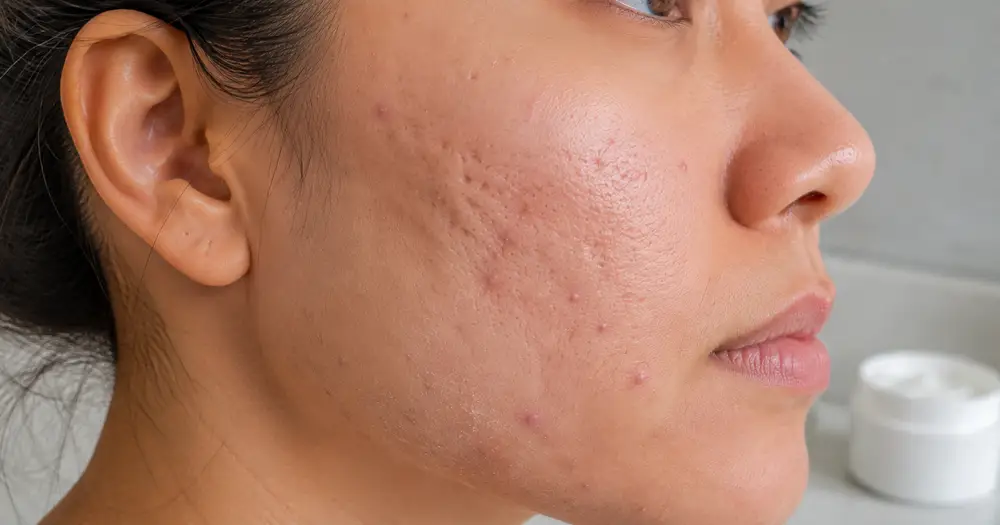
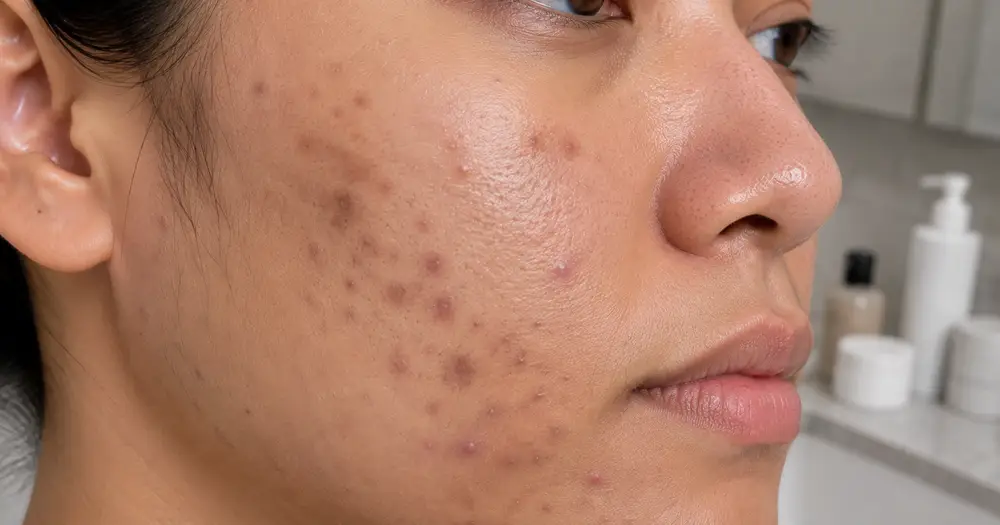
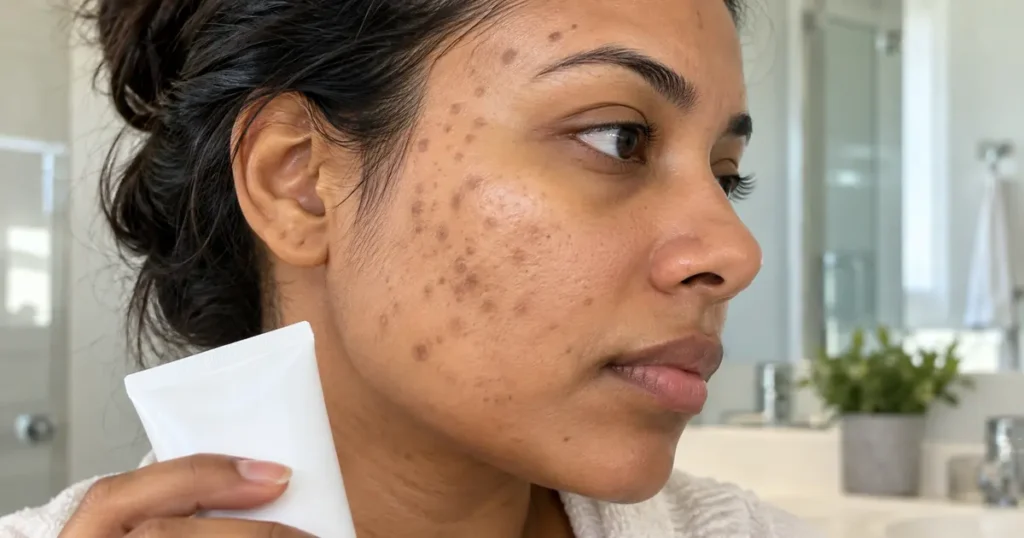
The phrase “pimple scars” often describes several different changes after acne. Before choosing an active ingredient, look for differences in color and skin texture. Appearance alone cannot confirm a diagnosis, but it can help you decide which questions to ask.
| What you notice | What it might be | What daily skin care may accomplish |
|---|---|---|
| Flat brown, tan, or blue-gray marks | Post-inflammatory hyperpigmentation (PIH) | Support gradual fading and reduce additional darkening |
| Flat pink, red, or purplish areas | Post-acne redness, sometimes called post-inflammatory erythema (PIE); the cause can vary | Protect the skin and avoid irritation, though redness may need a different assessment |
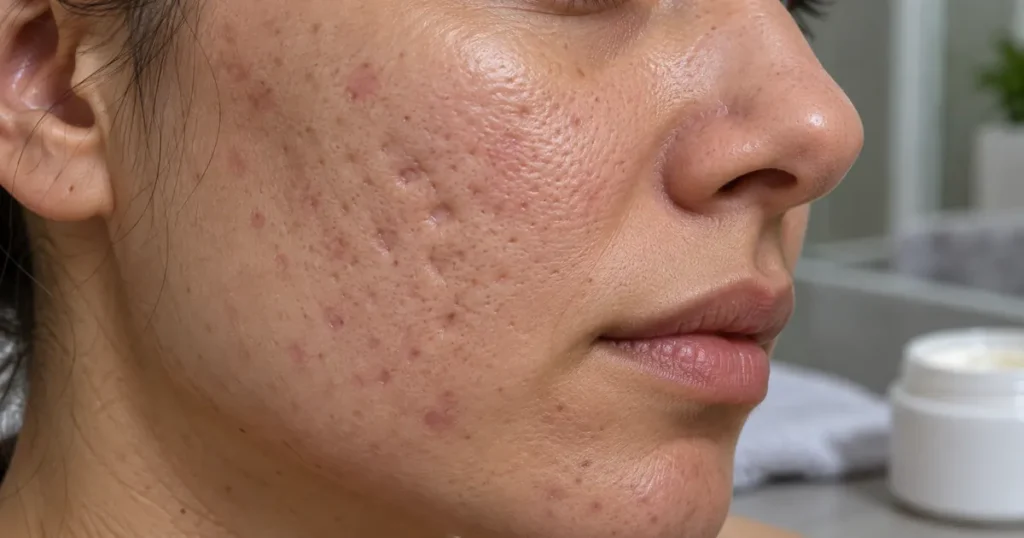
| Visible pits or depressions | Atrophic scars, such as ice-pick, boxcar, or rolling scars | Help the surrounding skin and active acne; limited ability to correct the depression |
| Firm, raised areas | Hypertrophic or keloid-type scars | Basic care cannot reliably flatten established scar tissue |
PIH involves excess pigment after inflammation. It can affect any skin tone and often persists longer in deeper skin tones. Flat redness can have a different cause, and not every pink mark should be assumed to be a vascular scar. Structural scars, in contrast, involve changes in the skin’s collagen and shape.
This distinction keeps a skincare routine for pimple scars realistic. A cream that gradually evens tone is not automatically capable of lifting a deep indentation. If you are unsure what you have, a dermatologist can help classify it before you spend money on treatments.
Morning Skincare Routine for Pimple Scars: Step-by-Step
The morning goal is to keep skin comfortable and protect healing marks from ultraviolet light. Here is a practical skincare routine for pimple scars that does not require a shelf full of serums.
Step 1: Cleanse Gently
Wash with a mild, non-abrasive cleanser and lukewarm water. Use your fingertips rather than a scrub brush or rough cloth. If your skin is very dry or sensitive, a water rinse in the morning may be enough; use a cleanser when needed to remove oil or residue.
A squeaky-clean sensation is not evidence that a cleanser is working better. Tightness, burning, or flaking are reasons to reconsider the formula.
Step 2: Consider One Targeted Treatment
If flat brown marks are the main issue, azelaic acid is one ingredient worth considering. It may help uneven pigmentation, and some formulations also treat acne. Vitamin C or a suitable retinoid may be options in other routines, but there is no reason to start all of them together.
A treatment is optional. If you already use a prescription acne medication, follow that plan and ask your prescriber before layering on another active. For a skincare routine for pimple scars, consistency with a manageable regimen usually matters more than the number of products.
Step 3: Apply Moisturizer
Choose a moisturizer suited to your skin’s needs. If you break out easily, labels such as “non-comedogenic,” “oil-free,” or “won’t clog pores” can be useful starting points. Dry skin may need a richer cream; oilier skin may prefer a lighter lotion.
Moisturizer will not erase pits, but it helps limit dryness and irritation, especially if you use acne medications. Apply it after cleansing and any compatible treatment, unless the product’s instructions say otherwise.
Step 4: Finish With Sunscreen
Daily sunscreen is a foundational part of a skincare routine for pimple scars, especially when discoloration is the main concern. Choose broad-spectrum SPF 30 or higher. For regular outdoor exposure, a water-resistant formula is preferable; reapply about every two hours outdoors and after swimming or sweating according to the label.
Visible light can contribute to persistent pigmentation, particularly in darker skin tones. If dark marks are your main concern, a tinted broad-spectrum sunscreen containing iron oxides may provide useful visible-light protection.
As an Amazon Associate, we earn from qualifying purchases.
☀️ Need daily protection while dealing with post-acne marks?
EltaMD UV Clear Tinted Broad-Spectrum SPF 46
✅ Provides broad-spectrum SPF 46 protection.
✅ Contains iron oxides in the tint.
✅ Has a lightweight formula marketed for acne-prone skin.
The tint may not match every complexion. This product is not water-resistant; choose a water-resistant sunscreen for swimming or heavy sweating. It does not remove structural scars.
👉 Check EltaMD UV Clear Tinted SPF 46 on Amazon
Night Skincare Routine for Pimple Scars: Step-by-Step
Nighttime is a convenient time to remove sunscreen and use treatment products that fit your acne plan. The best skincare routine for pimple scars is not necessarily the strongest one: the goal is a sequence you can follow without repeated irritation.
Step 1: Remove Sunscreen and Cleanse
Cleanse thoroughly but gently, especially if you have worn sunscreen or makeup. A mild cleanser is often enough. If you use a separate makeup remover, follow it with a gentle wash when needed rather than scrubbing away residue.
Pat your face dry. If a treatment needs to go on completely dry skin, follow its specific directions.
Step 2: Choose One Appropriate Evening Active
If you continue to develop acne, an appropriate topical retinoid may help prevent clogged pores and future lesions. Over-the-counter adapalene and prescription tretinoin are different medications with different instructions; they are not interchangeable scar erasers. Some topical retinoids may make mild scarring less noticeable, but deep pits are unlikely to disappear from cream alone.
Retinoids can cause dryness or irritation. Follow the exact product label or your prescription rather than increasing application to speed results. Avoid topical retinoids during pregnancy and consult your obstetrician or clinician about treatment choices if pregnant or planning pregnancy.
For details on where prescription treatment reaches its limit, see what tretinoin can and cannot improve.
Step 3: Moisturize and Support the Skin Barrier
Apply a comfortable moisturizer. If your medication causes dryness, ask your clinician whether moisturizer should go before or after it; follow your particular prescription instructions. Resist adding fragranced masks or exfoliating toners simply because it is nighttime.
Step 4: Keep Recovery Nights Simple
A night without an exfoliating or brightening active is not wasted. Gentle cleansing and moisturizer may be the better choice when your skin feels irritated. Do not independently skip or alter prescribed medication schedules; discuss recurring irritation with your prescriber.
How to Adjust Your Skincare Routine for Pimple Scars by Concern
The basic steps stay similar, but your treatment priorities change depending on what acne left behind. Use the following as a starting framework, not a self-diagnosis.
If You Mainly Have Brown or Gray Marks
Prioritize consistent sunscreen and control of the acne or irritation that produced the spots. For flat PIH, azelaic acid may help improve uneven pigmentation. Stronger exfoliation is not necessarily faster: irritation itself can trigger new dark marks.
An azelaic acid product may be a reasonable option for uneven tone, but its usefulness depends on the formulation, tolerance, and whether the concern is pigmentation rather than a true scar.
✨ Want one optional product for uneven-looking post-acne skin?
The Ordinary Azelaic Acid Suspension 10%
✅ Contains 10% azelaic acid.
✅ Is formulated for the appearance of uneven skin tone.
✅ Offers a single-treatment option instead of a multi-serum routine.
Use on unbroken skin and patch-test as directed. The brand recommends avoiding this particular product alongside retinoids and strong acids; choose a compatible routine rather than automatically combining it with a nighttime retinoid. Stop use if significant irritation occurs. It will not fill pitted scars.
👉 Check The Ordinary Azelaic Acid Suspension 10% on Amazon
If Your Marks Are Mostly Red or Pink
Flat red marks may reflect lingering blood-vessel changes, inflammation, or other forms of discoloration. Ingredients aimed at excess brown pigment may not provide the same benefit. Keep your routine gentle, protect against sunlight, and avoid chasing persistent redness with repeated acid treatments.
If redness is persistent, spreading, painful, or accompanied by flushing or a rash, seek an assessment instead of assuming that it is simply a pimple scar.
If You Still Have Active Pimples
In a skincare routine for pimple scars, treating ongoing acne matters because each inflammatory breakout is another opportunity for lasting discoloration or scarring. Choose an evidence-based acne treatment appropriate to your situation and use it consistently as directed. Picking or squeezing pimples increases the chance of injury.
If salicylic acid is already part of your acne routine, review how to use salicylic acid for acne marks safely before introducing another exfoliating step. More exfoliation is not automatically more effective.
If You Have Pitted or Raised Scars
An ice-pick depression, broad boxcar pit, rolling indentation, or thick raised scar is a structural change. Creams and sunscreen help protect the surrounding skin, but they generally cannot reverse established scar architecture. A dermatologist may discuss treatments such as microneedling, lasers, scar surgery, or other options after assessing scar type and skin tone.
A skincare routine for pimple scars remains useful for preventing additional breakouts, but buying stronger serums is not a substitute for a scar-specific evaluation. If you need help distinguishing product categories, see our guide to choosing products for different acne-scar concerns.
How to Start Without Overloading Your Skin
When you first build a skincare routine for pimple scars, establish the basic steps before introducing optional treatments. This makes it easier to tell which product caused irritation and whether the routine is realistic for your day.
| Stage | Morning | Evening |
|---|---|---|
| Basic foundation | Gentle cleanse as needed, moisturizer, SPF 30+ | Gentle cleanse, moisturizer |
| Add one treatment | One suitable product only if needed and compatible | Follow prescribed treatment or choose an appropriate single OTC option |
| Adjust for tolerance | Keep sun protection consistent | Do not pile on exfoliants to make up for missed days |
For a new nonprescription product, patch-test according to its instructions and consider easing into use if the directions allow. There is no universal starting frequency: leave-on acids, cosmetic serums, and prescription medications have different labels and tolerability considerations.
If you want both azelaic acid and a retinoid, do not assume all branded formulas are compatible. The Ordinary specifically advises against combining its Azelaic Acid Suspension 10% with retinoids. Ask a clinician or pharmacist about a regimen that involves multiple actives, especially when prescription medications are involved.
Common Routine Mistakes That Make Marks Harder to Manage
A skincare routine for pimple scars can lose its usefulness when it becomes an aggressive attempt to remove marks as quickly as possible. Watch for these avoidable mistakes:
- Skipping sun protection: Existing dark spots may remain more visible when exposed to ultraviolet and visible light.
- Scrubbing or using several acids together: Irritation can worsen uneven tone, particularly in pigment-prone skin.
- Switching products every few days: It becomes difficult to evaluate tolerance or gradual progress.
- Picking at active breakouts: Additional skin injury can create more marks and increase scar risk.
- Assuming every mark is a scar: Treating a depressed scar as a dark spot—or a flat mark as a dent—sets unrealistic expectations.
Choose the simplest adjustment that addresses the problem. For example, if your skin stings after an exfoliating serum, focus on restoring comfort rather than adding another “repair” active immediately.
When to Expect Results—and When to Seek Help
In a skincare routine for pimple scars, the clock is different for acne, pigmentation, and structural scars. With suitable acne medication, fewer breakouts may become noticeable after about four to eight weeks, although fuller clearing can take longer. That timeline should not be presented as a prediction for scar removal.
Flat PIH often fades gradually after the cause is controlled. The American Academy of Dermatology notes that marks only a few shades darker than your natural skin may take six to twelve months to fade without a fixed guarantee; deeper pigmentation may last substantially longer. Treatment may help, but outcomes vary.
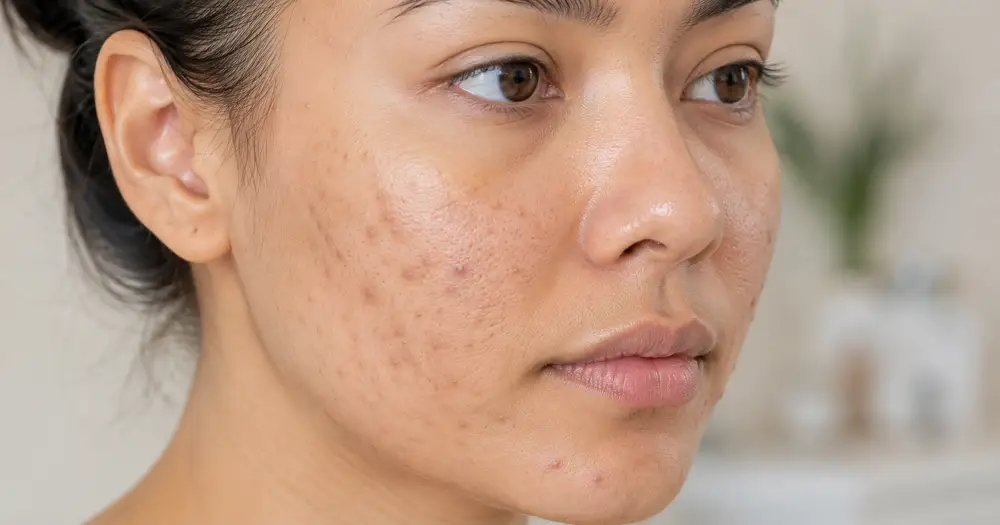
For your skincare routine for pimple scars, compare photographs about once a month using the same lighting and camera angle rather than checking individual spots each day. Photographs can help you notice trends, but they cannot replace a professional skin assessment.
See a dermatologist if you have deep or painful acne, new or worsening scars, raised or itchy scars, persistent discoloration that is not improving, or uncertainty about what the marks represent. Early acne management is especially valuable when breakouts are leaving new scars.
Frequently Asked Questions
1. Can I follow a pimple-scar routine without a treatment serum?
Yes. A skincare routine for pimple scars can start with gentle cleansing, moisturizer, and daily sunscreen. This foundation helps protect skin and avoid unnecessary irritation. If you have persistent active acne or dark spots, a targeted treatment may add value, but a serum is not mandatory for everyone.
2. Do I need niacinamide if I already use azelaic acid?
No. Niacinamide is optional, not a required companion to azelaic acid. Some moisturizers and sunscreens already contain it, so an additional serum may only add complexity. Choose based on tolerance and the products you already use rather than collecting ingredients for their own sake.
3. What should I do if a product makes my skin peel or sting?
Stop an irritating nonprescription cosmetic, return to gentle cleansing and moisturizer, and seek advice if symptoms persist or worsen. For a prescribed acne treatment, contact the prescriber for instructions instead of changing the regimen on your own. Severe swelling, blistering, or a serious allergic reaction warrants prompt medical attention.
4. Can I use this routine alongside prescribed acne medication?
Often, basic cleansing, moisturizing, and sunscreen can accompany prescription care. Extra acids, retinoids, or pigment serums may not be appropriate alongside your medication. Bring the full product list to your prescriber or pharmacist and ask which products should be kept, separated, or avoided.
5. How can I track progress without checking my skin every day?
Take an optional photo about monthly under similar lighting, distance, and angle, and note changes in breakouts, dark marks, and skin comfort separately. A spot that looks different under harsh bathroom lighting is not necessarily worsening. If comparisons increase anxiety, skip photographs and assess the routine with your clinician instead.
Conclusion
A skincare routine for pimple scars works best when it addresses what is actually left after acne. Protect and gently treat flat marks, prevent fresh breakouts, and recognize that deeper or raised scars often need professional options. Start with the morning and night basics, choose at most one appropriate new treatment at a time, and judge improvement over a realistic period—not from one day to the next.
Medical disclaimer: This article is educational and does not diagnose skin conditions or replace advice from a qualified health professional. Seek individualized guidance for prescription treatments, pregnancy-related skin care, significant scarring, or persistent symptoms.
References:
- American Academy of Dermatology — Acne Scars: Signs and Symptoms.
 American Academy of Dermatology
- American Academy of Dermatology — How to Fade Dark Spots in Darker Skin Tones. American Academy of Dermatology
- American Academy of Dermatology — Acne Scars: Consultation and Treatment. American Academy of Dermatology
- American Academy of Dermatology — Moisturizer: Why You May Need It if You Have Acne. American Academy of Dermatology
- American Academy of Dermatology — Adult Acne Treatment Dermatologists Recommend. American Academy of Dermatology
- American Academy of Dermatology — Practice Safe Sun. American Academy of Dermatology
- American College of Obstetricians and Gynecologists — Skin Conditions During Pregnancy. ACOG
- EltaMD — UV Clear Tinted Broad-Spectrum SPF 46. EltaMD®
- The Ordinary — Azelaic Acid Suspension 10%.