La Roche Posay Effaclar Duo M Review: Ingredients, Benefits, and Who It Suits
La Roche Posay Effaclar Duo M is easy to misunderstand if you shop across different countries or have seen older Effaclar Duo products. In the current U.S. lineup, the product reviewed here is Effaclar Duo+M Multi-Target Acne Treatment with 0.5% salicylic acid. It is not the same as La Roche-Posay’s separate Effaclar BPO treatment with 5.5% benzoyl peroxide.
This is an evidence- and label-based review, not a claim of first-hand product testing.
Quick answer: The current U.S. La Roche Posay Effaclar Duo M is a leave-on OTC acne treatment built around 0.5% salicylic acid. It makes the most sense for acne-prone skin with clogged pores, blackheads, whiteheads, and mild blemishes. The formula also contains niacinamide, LHA, zinc PCA, moisturizing ingredients, and fragrance. More severe, nodular, or scarring acne may need a different treatment strategy.
Table of Contents
La Roche Posay Effaclar Duo M: What Product Are We Reviewing?
The name matters because “Effaclar Duo” has not always meant the same thing in every market. On the current U.S. La Roche-Posay site, the product is sold as Effaclar Multi-Target Acne Treatment with Salicylic Acid and identified as Effaclar Duo+M. Its Drug Facts active ingredient is salicylic acid 0.5%.
That is different from Effaclar BPO Multi-Target Acne Treatment, a separate U.S. product that contains 5.5% benzoyl peroxide. If you find an older review saying “Effaclar Duo” contains benzoyl peroxide, check the date, country, and packaging before assuming it describes the product sold now.
| Product/version | Main acne active or positioning | Key distinction |
|---|---|---|
| Current U.S. Effaclar Duo+M | 0.5% salicylic acid | Product reviewed here |
| Current U.S. Effaclar BPO | 5.5% benzoyl peroxide | Different acne medication |
| International Duo+M versions | Regional anti-imperfection/acne-prone-skin positioning | Labeling and ingredient presentation can differ |
The safest approach is to read the ingredient list and Drug Facts on your own package. Formula and labeling can change, and regional versions may not be identical.
La Roche Posay Effaclar Duo M Ingredients: What Actually Treats Acne?
The ingredient list is long, but not every ingredient has the same role or level of evidence. In the current U.S. formula, salicylic acid 0.5% is the labeled OTC acne active. The rest of the formula supports texture, feel, hydration, oil control, exfoliation, or manufacturer-specific claims.
0.5% Salicylic Acid
Salicylic acid is the clearest evidence-based acne ingredient in the product. The FDA OTC acne monograph allows salicylic acid at concentrations from 0.5% to 2% in topical OTC acne drugs. The American Academy of Dermatology’s updated acne guideline conditionally recommends topical salicylic acid to help unclog pores and exfoliate the skin.
That makes La Roche Posay Effaclar Duo M especially logical for acne dominated by clogged pores, blackheads, and whiteheads. It may also help some mild inflammatory blemishes, but salicylic acid should not automatically be treated as interchangeable with benzoyl peroxide or a prescription acne regimen.
If you want more detail about the active itself, our guide to how salicylic acid works for acne explains its role in clogged pores, common strengths, irritation risks, and the difference between cleansers and leave-on products.
LHA
The formula also contains capryloyl salicylic acid, commonly called LHA. La Roche-Posay describes LHA as a salicylic-acid derivative with exfoliating and skin-surface-renewing properties.
It is reasonable to view LHA as a supporting exfoliating ingredient, but it should not be presented as a second independently labeled acne medication. The Drug Facts active remains salicylic acid 0.5%.
Niacinamide
Niacinamide appears relatively high in the ingredient list. It is commonly used in skin-care formulas for barrier support, tone, and soothing benefits, and La Roche-Posay links it with the appearance of dark marks.
However, niacinamide is not the labeled U.S. acne active in this product. It should be treated as a supportive ingredient rather than the main reason the formula qualifies as an OTC acne treatment.
Because this formula contains niacinamide alongside many other ingredients, a breakout after starting it does not automatically identify niacinamide as the cause. Our guide to whether niacinamide itself commonly causes breakouts explains why irritation, the complete formula, and the rest of your routine matter.
Zinc PCA, Glycerin, and Dimethicone
The formula also includes zinc PCA, glycerin, and dimethicone. Zinc PCA is often used in formulas aimed at oily skin. Glycerin is a humectant, while dimethicone helps improve slip and reduce moisture loss. These are supporting cosmetic ingredients rather than the labeled acne active.
Those ingredients matter because a leave-on acne product needs to be tolerable enough for repeated use. They do not cancel the drying potential of salicylic acid, but they help explain why the formula is more than a simple acid solution.
Phylobioma and Procerad
La Roche-Posay highlights Phylobioma for soothing and oil-control support and Procerad as a proprietary anti-mark ceramide. These are manufacturer-positioned ingredients or technologies, not independently established first-line acne treatments on the same evidence level as salicylic acid.
That distinction is important. Marketing names can be useful for understanding what a brand intends a formula to do, but they should not carry more weight than the labeled acne active or independent acne guidelines.
Fragrance
The current U.S. ingredient list includes fragrance. That does not mean the product will irritate everyone, and La Roche-Posay also markets the product as suitable for sensitive skin. Still, fragrance is a legitimate consideration if your skin is reactive or you already know fragranced leave-on products bother you.
Does La Roche Posay Effaclar Duo M Work for Different Types of Acne?
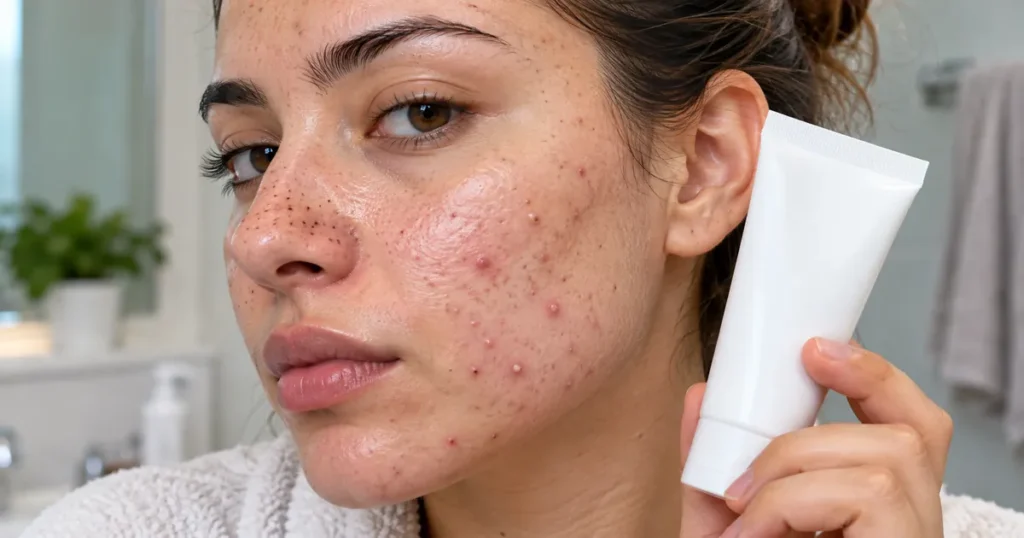
The product is easiest to evaluate when you match its main active to the acne pattern rather than asking whether it “works” in general.
Blackheads and Whiteheads
This is the clearest fit. Salicylic acid helps unclog and exfoliate pores, so a leave-on 0.5% formula can make sense when blackheads, whiteheads, and rough congestion are the main concerns. AAD’s current guideline conditionally recommends topical salicylic acid for acne.
The manufacturer also reports reductions in blackheads over four weeks, but those percentages come from La Roche-Posay’s own clinical grading rather than an independent head-to-head trial.
Oily, Congested Skin
The product is also positioned for oily, acne-prone skin. The combination of salicylic acid, LHA, silica, zinc PCA, and other supporting ingredients is consistent with that goal.
Still, oily skin does not automatically require an aggressive routine. If you combine this product with multiple acid cleansers, exfoliating toners, scrubs, and retinoids, irritation can become a bigger problem than oil.
Red, Inflamed Pimples
The official U.S. page lists acne blemishes and stubborn acne among the product’s intended concerns. Salicylic acid can still be useful in mixed acne, but a 0.5% salicylic-acid leave-on should not be assumed to perform the same job as benzoyl peroxide.
If most of your breakouts are red and inflamed rather than clogged, our comparison of benzoyl peroxide vs salicylic acid explains why the two ingredients are not interchangeable and which acne patterns each tends to match better.
Deep Nodules or Cyst-Like Acne
Deep, painful nodules are not a strong reason to rely on this product as a stand-alone solution. Severe or treatment-resistant acne can require prescription treatment; current AAD guidance includes isotretinoin for severe acne or acne that has failed standard topical or oral therapy.
If lesions are painful, deep, rapidly worsening, or leaving scars, professional evaluation is more important than continuing to cycle through OTC products.
Post-Acne Marks
La Roche-Posay markets the product for post-acne marks and highlights niacinamide and Procerad in that context. That claim should be interpreted carefully.
Flat dark or red marks left after acne are different from true indented or raised scars. A product may improve the appearance of post-acne discoloration without remodeling an ice-pick, boxcar, rolling, or raised scar.
La Roche Posay Effaclar Duo M Clinical Claims: What Do They Mean?
La Roche-Posay reports several product-specific results, including a 44% reduction in blemishes and a 66% reduction in blackheads after four weeks in clinical grading on 45 subjects using the product once daily in the morning. The company also promotes visible changes at eight hours based on a consumer study.
Those numbers are useful context, but they are manufacturer-reported results, not guarantees of what every user will experience.
| Manufacturer-reported claim | How to interpret it |
|---|---|
| 44% fewer blemishes at 4 weeks | Clinical grading reported by the manufacturer |
| 66% fewer blackheads at 4 weeks | Supports the product’s clogged-pore positioning, but does not guarantee an individual result |
| Visible changes at 8 hours | Consumer-perception/appearance claim, not proof that acne clears in 8 hours |
| Chest and back improvement | Manufacturer study supports body use, but results depend on the study protocol |
The official page also reports chest and back results after twice-daily use for 42 days. A separate product-page data point describes results from a routine using both an Effaclar cleanser and Duo+M. When multiple products are used together, the full result should not automatically be attributed to Duo+M alone.
How to Use La Roche Posay Effaclar Duo M Without Overdoing It
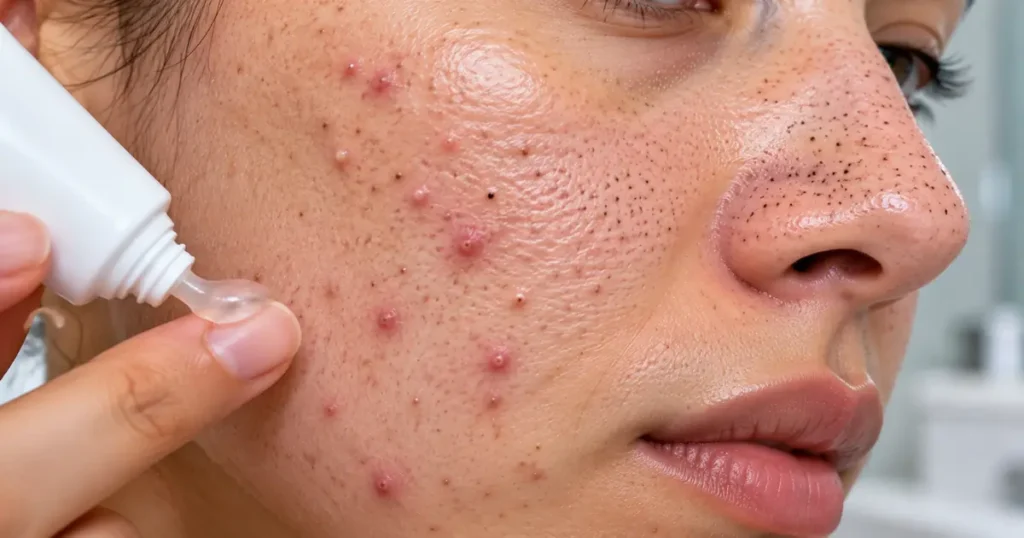
The current U.S. directions say to cleanse the skin, apply a thin layer over the affected area, and allow use from one to three times daily. Importantly, the label also advises starting with one application daily because excessive dryness can occur, then increasing only if needed and tolerated. If dryness or peeling becomes bothersome, frequency should be reduced.
That makes tolerability part of proper use. More applications are not automatically better.
La Roche Posay Effaclar Duo M is labeled for the face, chest, and back. Avoid the eye area and follow the Drug Facts on your own package, especially if the formula or directions have changed since this article was updated.
What If You Already Use Other Acne Actives?
Be cautious about stacking several exfoliating or irritating treatments simply because each one is sold for acne. A routine that already contains a retinoid, benzoyl peroxide, another salicylic-acid product, or a strong acid exfoliant may become much more irritating when another leave-on acid is added.
That does not mean these ingredients can never appear in the same overall acne plan. It means the combination should have a purpose and should be tolerable.
Is Worsening Skin “Purging”?
Do not assume that burning, itching, persistent redness, or heavy peeling means the product is “purging” the skin and therefore working.
Salicylic acid can cause dryness and irritation, and the official label specifically warns about excessive drying and peeling.
If your skin looks worse after introducing the product, our guide to how to tell purging from irritation or a regular breakout explains why discomfort should not automatically be interpreted as progress.
La Roche Posay Effaclar Duo M Side Effects and Limitations
The most practical limitation is irritation. Potential problems include:
- Dryness
- Peeling
- Stinging
- Redness
- Increased sensitivity when combined with other exfoliants
- Fragrance sensitivity in some users
La Roche-Posay describes the product as non-comedogenic, allergy tested, and suitable for sensitive skin, but those manufacturer descriptors do not guarantee that every sensitive-skinned person will tolerate it.
Another limitation is scope. A 0.5% salicylic-acid product may be useful for mild clogged-pore acne, but it is not a complete answer for every acne type. Deep nodules, widespread inflammatory acne, significant scarring, or acne that does not improve with appropriate OTC care may need medical evaluation.
Is La Roche Posay Effaclar Duo M Worth It?
Whether the product deserves a place in your routine depends more on fit than on brand reputation.
It may make sense if:
- Blackheads or whiteheads are a major concern.
- Your skin is oily or frequently congested.
- You want a leave-on 0.5% salicylic-acid treatment.
- You prefer a multi-ingredient formula with niacinamide and moisturizing support.
- You do not have a known problem with fragrance.
- You are not already overloading your routine with acids.
It may be less compelling if:
- Deep, painful nodules are your main problem.
- Most of your acne is strongly inflammatory and another acne mechanism makes more sense.
- Your skin reacts poorly to fragranced leave-on products.
- You already use enough salicylic acid or exfoliating products.
- You want the simplest possible formula.
- Persistent acne is scarring or has not responded to reasonable OTC care.
As of October 2, 2026, the official U.S. La Roche-Posay site listed the 40 mL product at $24.99. Prices and availability can change, so that figure should not be treated as permanent.
The practical question is not whether La Roche Posay Effaclar Duo M is universally “good” or “bad.” It is whether its 0.5% salicylic-acid base and supporting formula match the type of acne and skin sensitivity you are trying to manage.
Recommended Options
🏆 La Roche-Posay Effaclar Duo+M — Best Match for This Review
A multi-target acne treatment with 0.5% salicylic acid, designed for clogged pores, blackheads, whiteheads, and acne-prone skin.
Best for: Oily, congested, acne-prone skin
Current official price: About $24.99
💰 The Ordinary Salicylic Acid 2% Solution — Best Budget Alternative
A simple 2% salicylic acid treatment for acne, clogged pores, and uneven texture at a much lower price.
Best for: Readers who mainly want salicylic acid without the more complex Effaclar formula
Current official price: About $6.70
Frequently Asked Questions
Is La Roche Posay Effaclar Duo M a moisturizer or acne treatment?
In the current U.S. market, La Roche Posay Effaclar Duo M is sold as an OTC acne treatment with 0.5% salicylic acid. International versions may be presented more like corrective anti-imperfection care or a moisturizer for acne-prone skin, which is why regional packaging should always be checked.
Does La Roche Posay Effaclar Duo M contain benzoyl peroxide?
The current U.S. Duo+M reviewed here does not use benzoyl peroxide as its active ingredient. It contains 0.5% salicylic acid. La Roche-Posay separately sells Effaclar BPO Multi-Target Acne Treatment with 5.5% benzoyl peroxide, so the two products should not be confused.
Can La Roche Posay Effaclar Duo M help blackheads?
It may be a reasonable option for blackheads because salicylic acid helps unclog and exfoliate pores, and the AAD conditionally recommends topical salicylic acid for acne. The manufacturer also reports blackhead improvement in its own four-week clinical grading, but individual results can differ.
Can La Roche Posay Effaclar Duo M cause purging?
It can cause dryness or irritation, and new breakouts do not automatically mean “purging.” If you develop burning, persistent redness, marked peeling, itching, or a rash-like reaction, do not assume the reaction proves the product is working.
Can you use La Roche Posay Effaclar Duo M every day?
The current U.S. directions advise starting once daily because excessive dryness can occur. They allow gradual increases if needed and tolerated, with reduced frequency if peeling or bothersome dryness develops. Follow the label on your own package and seek professional advice if you are unsure how it fits with other acne medications.
Conclusion
La Roche Posay Effaclar Duo M is best understood as a current U.S. 0.5% salicylic-acid acne treatment supported by a broader cosmetic formula containing niacinamide, LHA, zinc PCA, moisturizing ingredients, and fragrance. Its clearest conceptual fit is clogged, oily acne-prone skin with blackheads and whiteheads.
The product’s branded ingredients and manufacturer clinical percentages can add context, but they should not be treated as stronger evidence than the labeled salicylic-acid active or independent acne guidelines. Fragrance, dryness, and irritation are also meaningful limitations.
If your acne is deep, painful, widespread, scarring, or not improving with appropriate OTC care, a product review is not a substitute for professional evaluation.
Medical disclaimer: This article is educational and is not a diagnosis or a substitute for individualized care from a qualified healthcare professional.
References:
- La Roche-Posay USA. Effaclar Duo+M Multi-Target Acne Treatment With 0.5% Salicylic Acid
- La Roche-Posay USA. Effaclar BPO Multi-Target Acne Treatment with 5.5% Benzoyl Peroxide
- American Academy of Dermatology. American Academy of Dermatology Issues Updated Guidelines for the Management of Acne
- U.S. Food and Drug Administration. OTC Monograph M006 — Topical Acne Drug Products for OTC Human Use