What Does Fungal Acne Look Like? Signs, Locations, and Look-Alikes
If you are asking What Does Fungal Acne Look Like, the most useful clue is not one isolated pimple. The pattern matters. “Fungal acne” usually refers to Malassezia folliculitis, an inflammation of hair follicles associated with Malassezia yeast. It is not the same condition as acne vulgaris, even though the bumps can look similar.
Quick answer: Fungal acne usually appears as clusters of small, very similar-looking follicular bumps. They may be red, skin-colored, or pustular and are often itchy. Common sites include the forehead or hairline, chest, shoulders, upper back, and upper arms. Unlike ordinary acne, classic blackheads and closed comedones are usually absent. Appearance can suggest the condition, but it cannot confirm the diagnosis by itself.
Table of Contents
What Does Fungal Acne Look Like Up Close?
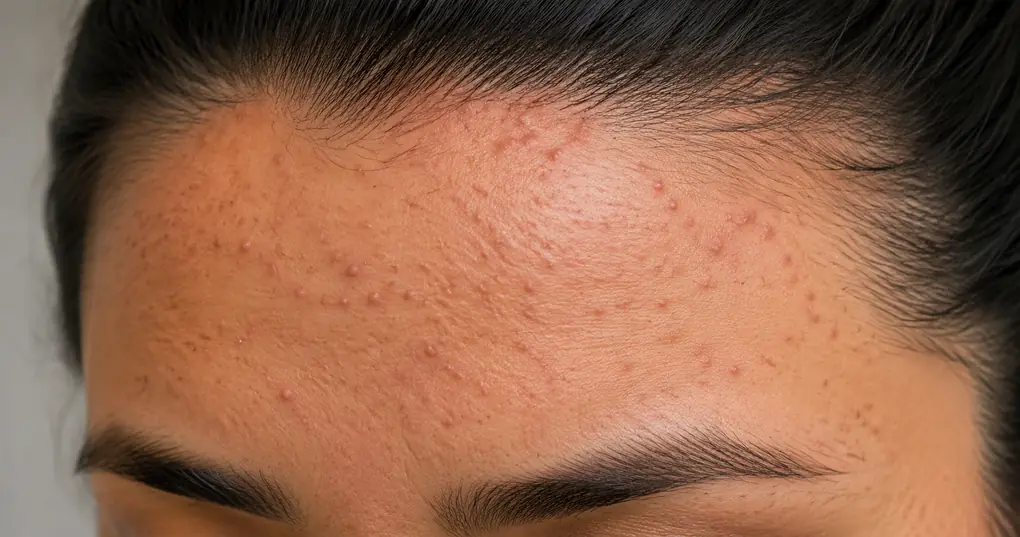
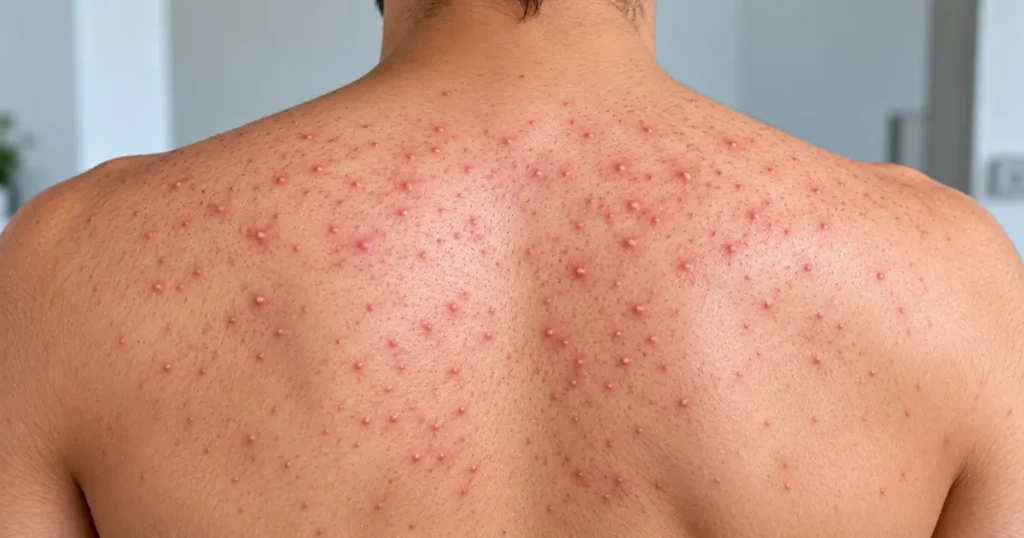
When dermatology sources describe Malassezia folliculitis as monomorphic, they mean the bumps tend to look unusually similar to one another. You may see many lesions that are close to the same size, shape, and stage of inflammation rather than a mixture of tiny clogged pores, larger red pimples, blackheads, pustules, and deep nodules.
That uniformity is one of the most helpful answers to What Does Fungal Acne Look Like. A cluster can resemble a rash of acne-like bumps rather than the varied collection of lesions typical of acne vulgaris.
Small Papules and Tiny Pustules
The bumps are often small follicular papules. Some develop a white or yellowish pustular center. A pale center does not automatically make the lesion a “whitehead.”
A true whitehead is a closed comedone caused by a plugged pore. A pustule contains inflammatory material. Malassezia folliculitis can produce pustules even though classic comedones are generally absent.
A Follicular, Clustered Pattern
The bumps arise around hair follicles. On close inspection, they may appear centered on follicles and grouped across a patch of skin.
The condition may involve dozens of small bumps at once, especially on oilier, sweat-prone areas of the upper body. A single isolated pimple does not strongly answer What Does Fungal Acne Look Like because many unrelated skin conditions can produce one bump.
Itching Can Be an Important Clue
Itching is common in Malassezia folliculitis. Some people also report burning or tenderness.
Still, itching is not a diagnostic test. Irritated acne, contact reactions, heat rash, and other forms of folliculitis can itch too. The clue becomes more useful when itch occurs together with uniform follicular bumps in a typical location.
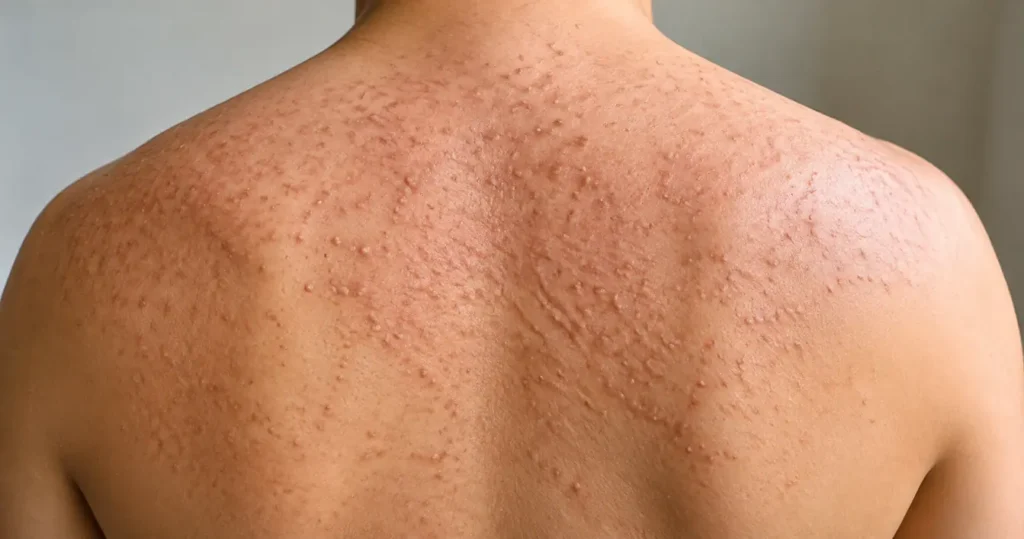
What Does Fungal Acne Look Like on the Forehead, Chest, and Back?
Location can make the visual pattern more informative. Malassezia folliculitis often involves the forehead or hairline and oilier areas of the upper trunk, including the chest, shoulders, and upper back.
Forehead and Hairline
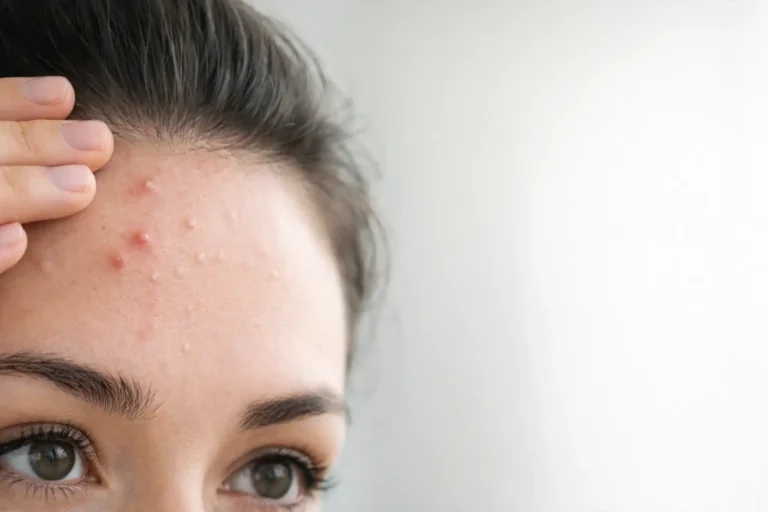
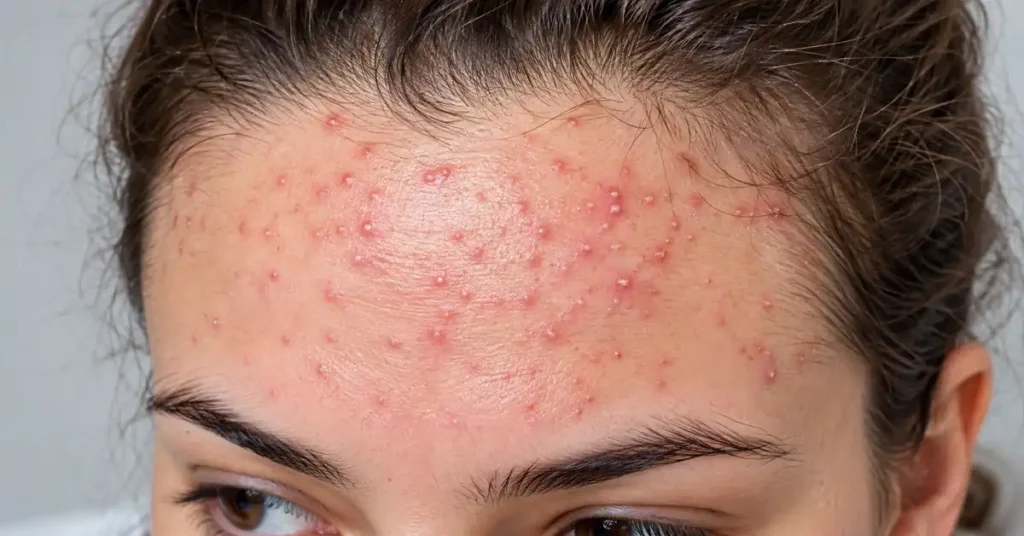
On the forehead, the eruption may look like rows or clusters of tiny red or skin-colored bumps near the hairline. Ohio State describes small, uniform follicular red bumps that can occur in symmetric rows on the forehead.
This is also where confusion with closed comedones is common. If you are trying to answer What Does Fungal Acne Look Like on the forehead, look at the whole pattern: are the bumps nearly identical and itchy, or are there also obvious blackheads, whiteheads, and larger pimples?
Hair products, occlusion, and ordinary acne can also create forehead bumps, so location alone does not prove Malassezia folliculitis.
If the visual pattern fits and you want to understand why it may have appeared, our guide to common triggers that can encourage Malassezia folliculitis explains the roles of heat, humidity, sweating, occlusion, antibiotics, and other risk factors without treating any one trigger as proof of diagnosis.
Chest and Upper Back
On the chest or back, Malassezia folliculitis often looks like a field of small, similar follicular papules or pustules. The eruption can be more widespread than facial involvement and may become especially noticeable after heat, humidity, or heavy sweating.
This location pattern can help answer What Does Fungal Acne Look Like, but chest and back acne vulgaris are also common. Check for mixed lesion types. Blackheads, closed comedones, and larger inflammatory lesions make ordinary acne more likely to be part of the picture.
Shoulders and Upper Arms
Shoulders and upper arms can develop similar clusters. On the upper arms, however, keratosis pilaris is another common look-alike. Keratosis pilaris usually feels rough and dry and tends to produce tiny follicular bumps rather than pustules.
That is why body location should always be interpreted with the bump type, itch, and overall distribution.
What Does Fungal Acne Look Like Compared With Regular Acne?
The difference is easier to understand by comparing patterns rather than individual pimples.
| Feature | Malassezia folliculitis | Acne vulgaris |
|---|---|---|
| Bump size | Often very similar | Commonly mixed sizes |
| Typical lesions | Follicular papules and pustules | Blackheads, whiteheads, papules, pustules, nodules |
| Itching | Common | Usually not the dominant feature |
| Blackheads | Usually absent | Common |
| Closed comedones | Usually absent | Common |
| Common areas | Forehead/hairline, chest, upper back, shoulders, upper arms | Face, chest, shoulders, back |
| Overall appearance | Monomorphic or uniform | Polymorphic or varied |
The table is a pattern guide, not a diagnostic checklist. Malassezia folliculitis and acne vulgaris can overlap, so real skin may not fit neatly into one column.
For a broader explanation of the condition itself, our guide to how pityrosporum folliculitis differs from regular acne covers terminology, symptoms, triggers, diagnosis, and why standard acne treatment may not solve a yeast-associated follicular eruption.
Why a White Tip Is Not Always a Whitehead
This is one of the easiest visual mistakes to make.
A tiny Malassezia pustule may have a pale center, but that does not make it a comedone. If you also see classic blackheads and flesh-colored clogged pores, acne vulgaris becomes more likely to be present.
When people search What Does Fungal Acne Look Like, this detail matters because “small bumps with white tips” is too vague to distinguish the two conditions.
Can You Have Both at the Same Time?
Yes. Malassezia folliculitis and acne vulgaris can coexist. That means one area may contain uniform itchy follicular bumps while another contains blackheads, whiteheads, or larger acne lesions.
Itching can add useful context, but it is not specific to Malassezia. Our guide to why an itchy breakout is not always ordinary acne explains how irritation, acne treatments, different types of folliculitis, and other conditions can all make bumps itch.
What Else Can Look Like Fungal Acne?
Several common conditions can imitate the same small-bump pattern.
Bacterial Folliculitis
Bacterial folliculitis can also create hair-centered red papules or pustules. It may be itchy, tender, or painful and can be difficult to distinguish from Malassezia folliculitis by appearance alone.
Closed Comedones
Closed comedones are true clogged pores. They often look like many small flesh-colored bumps, especially across the forehead.
Compared with Malassezia folliculitis, they are usually less itchy and may appear alongside blackheads and other forms of acne.
Heat Rash
Heat rash can produce tiny prickly or itchy bumps during hot, sweaty conditions. Because heat and sweating can also be associated with Malassezia flares, timing alone is not enough to separate them.
Keratosis Pilaris
Keratosis pilaris commonly causes rough follicular bumps on the upper arms and thighs. The bumps can be red but are generally dry and rough rather than pustular.
Irritation and Acneiform Eruptions
A new skin product, medication, occlusion, or heavy irritation can sometimes create a fairly uniform eruption. This is another reason not to diagnose “fungal acne” from visual similarity alone.
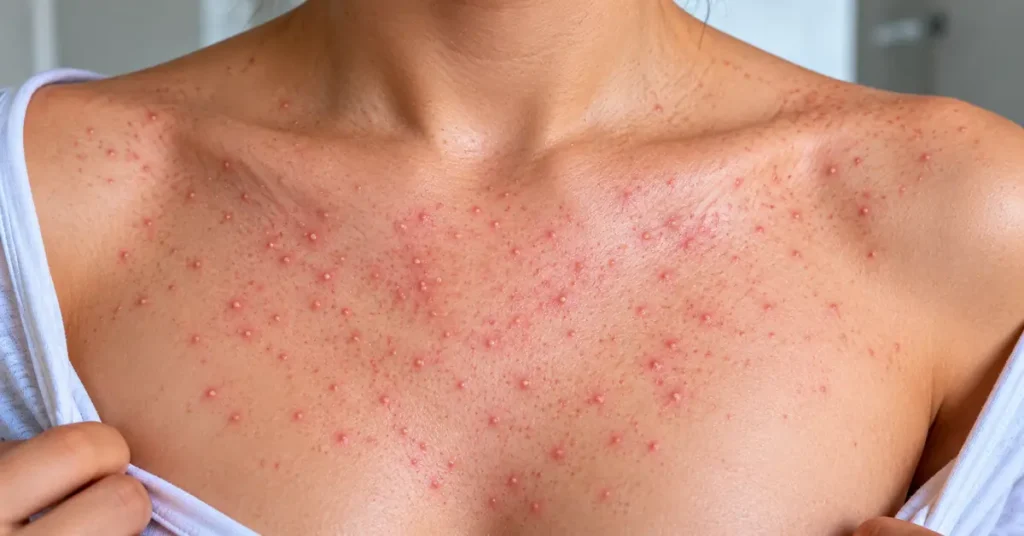
What Does Fungal Acne Look Like in Photos—and Can Pictures Diagnose It?
Photos can help you notice a pattern, but they cannot reliably confirm Malassezia folliculitis.
A picture may show small, monomorphic papules and pustules in a typical location, but acne vulgaris, bacterial folliculitis, steroid-related acneiform eruptions, and other conditions can overlap visually. The 2026 review of Malassezia folliculitis specifically highlights diagnostic confusion and the risk of inappropriate self-treatment.
When a clinician needs more certainty, diagnosis can involve the history and physical examination plus testing such as direct microscopy. Depending on the case, other diagnostic methods may be used to distinguish Malassezia folliculitis from look-alikes. Cleveland Clinic also notes microscopy and Wood’s lamp examination among possible diagnostic approaches.
So if you are using internet photos to answer What Does Fungal Acne Look Like, treat them as pattern-recognition examples, not proof that your own bumps are caused by Malassezia.
When the Pattern Makes Malassezia Folliculitis More Worth Considering
Malassezia folliculitis becomes more reasonable to consider when several clues occur together:
- Many bumps look almost identical.
- The lesions appear centered on hair follicles.
- Itching is prominent.
- Blackheads and classic closed comedones are absent.
- The eruption involves the forehead/hairline, chest, shoulders, upper back, or upper arms.
- Heat, humidity, sweating, or occlusion seem to coincide with flares.
- A breakout has not behaved like your usual acne.
- Antibiotic exposure preceded or worsened the pattern.
These are clues, not a home diagnostic checklist. Heat, sweating, antibiotic exposure, and occlusion are recognized risk factors, but none proves that an acne-like eruption is Malassezia folliculitis.
The most reliable answer to What Does Fungal Acne Look Like therefore comes from combining multiple clues rather than relying on one symptom.
When to Stop Guessing From Appearance
Professional evaluation becomes more useful when the eruption is persistent, very itchy, painful, recurrent, spreading, or not responding to the treatment you expected to work.
It also makes sense to get checked if:
- You are unsure whether the bumps are acne or folliculitis.
- You have been repeatedly switching treatments without improvement.
- The eruption developed after prolonged antibiotic use or medications affecting immunity.
- You have a weakened immune system.
- The area is increasingly painful, draining, or showing signs of a more significant infection.
The American Academy of Dermatology notes that folliculitis can resemble acne and that a dermatologist can help distinguish the conditions.
Once the diagnosis is reasonably clear, our guide to what fungal acne treatment may involve after the diagnosis is clear explains treatment approaches and supportive skin-care habits. Avoid jumping straight to antifungal treatment simply because an online photo looks familiar.
Frequently Asked Questions
What Does Fungal Acne Look Like on the face?
What Does Fungal Acne Look Like on the face most often means small, similar-sized follicular bumps, especially across the forehead or hairline. They may be red, skin-colored, or pustular and often itch. Classic blackheads and closed comedones are usually absent, but appearance alone cannot confirm Malassezia folliculitis.
Does fungal acne have whiteheads?
It can produce tiny pustules with pale or yellow-white centers, but these are not the same as classic closed-comedonal whiteheads. A true whitehead is a clogged pore, while a pustule is an inflamed follicular lesion.
Is fungal acne always itchy?
No. Itching is common and can be a useful clue, but not every case must itch intensely. Itching also occurs with other conditions, so it should be interpreted with lesion uniformity, location, and the presence or absence of comedones.
Can fungal acne look like tiny closed comedones?
Yes. This is especially easy to confuse on the forehead because both can create clusters of small bumps. Closed comedones are true clogged pores and are more consistent with acne vulgaris, while Malassezia folliculitis tends to be itchier and more monomorphic.
Can a dermatologist tell fungal acne just by looking at it?
Sometimes the clinical pattern is strongly suggestive, but visual examination does not always settle the diagnosis. When the picture is unclear, a clinician may use microscopy or other testing to distinguish Malassezia folliculitis from acne and other follicular eruptions.
Conclusion
So, What Does Fungal Acne Look Like? The classic pattern is many small, similar-looking follicular papules or pustules, often with itching and commonly involving the forehead or hairline, chest, shoulders, upper back, or upper arms. Blackheads and classic closed comedones are usually absent.
The pattern can tell you when Malassezia folliculitis is worth considering, but it cannot prove the diagnosis. If the bumps are persistent, unusually itchy, or not responding as expected, getting the condition identified correctly is more useful than repeatedly guessing from photos or trying stronger products.
Medical disclaimer: This article is for educational purposes and cannot diagnose a skin condition. A qualified healthcare professional can evaluate persistent, painful, spreading, or unclear acne-like eruptions.
References:
- Draelos ZD, Barbieri JS, Tanghetti EA, et al. Malassezia Folliculitis Presentation, Diagnosis, and Treatment: A Review of “Fungal Acne”. Journal of Drugs in Dermatology. 2026.
- Chalupczak NV, Lipner SR. Malassezia Folliculitis: An Underdiagnosed Mimicker of Acneiform Eruptions. Journal of Fungi. 2025.
- Cleveland Clinic. Fungal Acne: Malassezia Folliculitis, Pityrosporum Folliculitis.
- Ohio State Health & Discovery. What to Know About Fungal Acne.
- American Academy of Dermatology. Acne-Like Breakouts Could Be Folliculitis.