Dermatologist on Acne Scars: How Your Scar Type Shapes Treatment
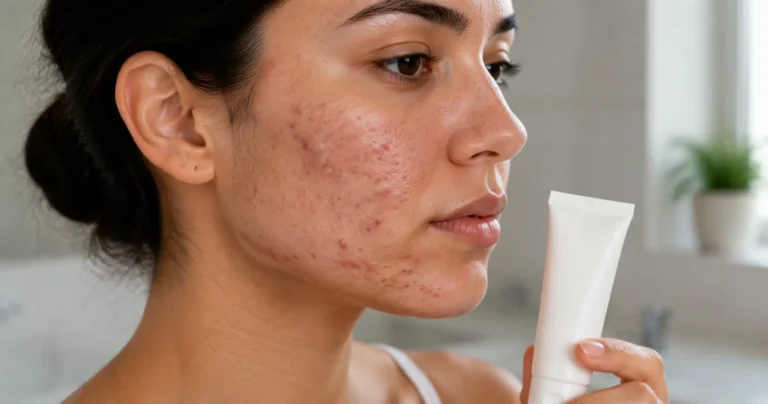
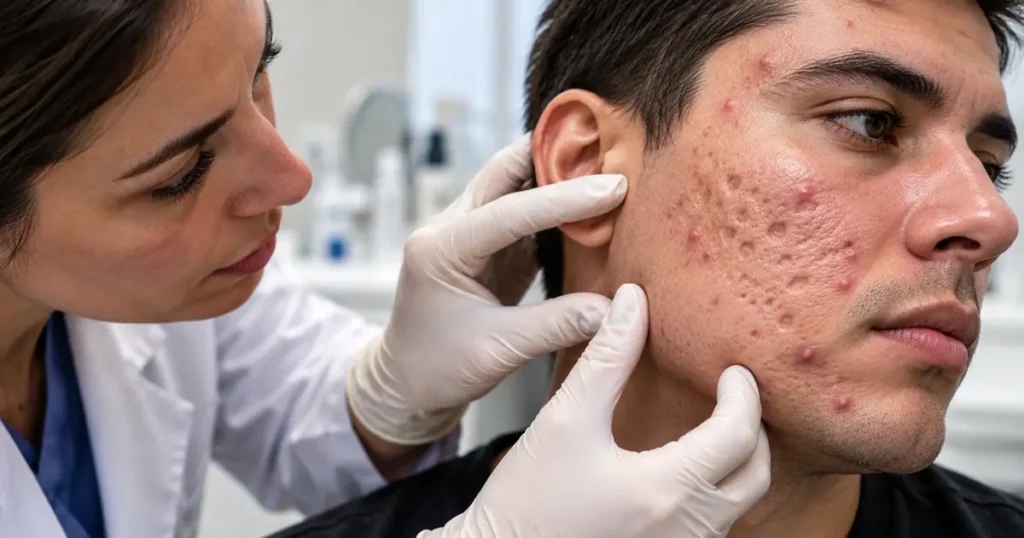
If you are looking for a dermatologist on acne scars, the most useful consultation usually starts before anyone talks about lasers, microneedling, or fillers. The first job is to work out what is actually on your skin: a flat post-acne mark, a depressed scar, a raised scar, or a mixture of several scar types.
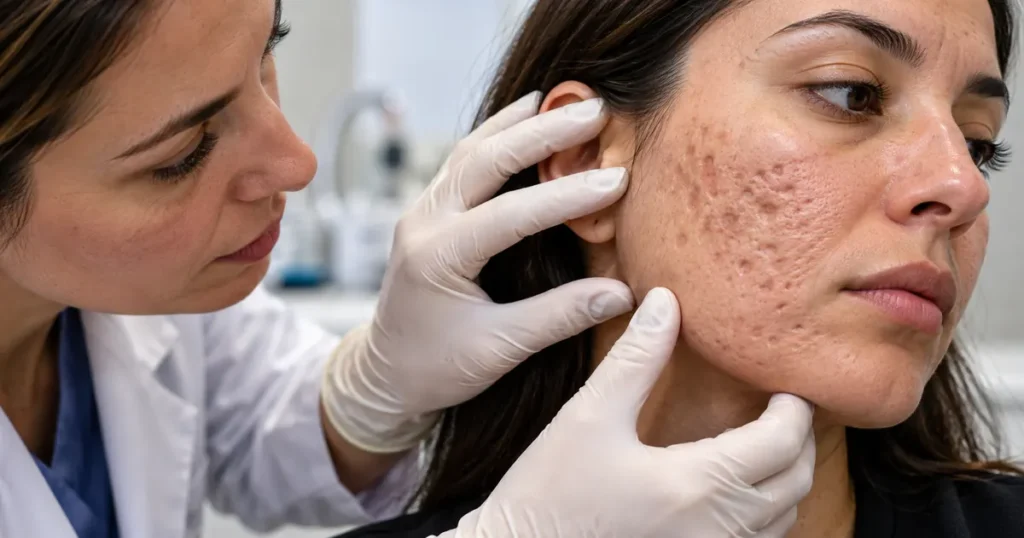
A dermatologist on acne scars typically looks at scar shape, depth, edges, tethering, location, active breakouts, skin tone, treatment history, goals, downtime, and budget before recommending a plan. That is why two people who both say they have “acne scars” can leave with very different treatment recommendations.
Table of Contents
Dermatologist on Acne Scars: First Decide Whether It Is Actually a Scar
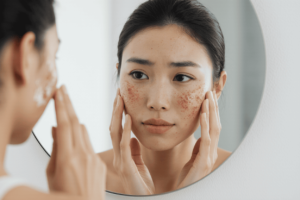
One of the most important parts of an acne-scar consultation is separating true structural scarring from flat color changes left after acne.
Post-inflammatory color changes can leave brown, gray, red, or pink flat spots after a breakout. These areas can be frustrating and long-lasting, but they are not the same as a scar that changes the shape or contour of the skin. The American Academy of Dermatology specifically distinguishes flat post-acne spots from true acne scars.
True acne scars generally fall into two broad structural groups:
- Depressed, or atrophic, scars, where the skin sits below the surrounding surface
- Raised scars, such as hypertrophic scars or keloids, where excess scar tissue forms above the surrounding skin
This distinction changes the treatment conversation. A flat pigment mark may be approached with sun protection, topical treatment, or pigment-focused procedures. A deep depression may require resurfacing, collagen remodeling, release of tethering, lifting, focal treatment, or a combination of procedures.
A dermatologist on acne scars therefore should not choose a procedure only because the skin looks “marked.” The first question is whether the problem is mainly color, texture, volume loss, excess scar tissue, or more than one of these.
How a Dermatologist on Acne Scars Assesses Scar Type
A scar name is useful, but it is only the beginning. During an assessment, a dermatologist may look at how wide a scar is, how deep it goes, whether its edges are sharp or sloping, whether it is attached to deeper tissue, and whether the skin changes when it is stretched.
The number and location of scars matter too. A person with a few deep focal pits may need a different strategy from someone with broad rolling texture across both cheeks. Mixed patterns are common, so treatment may need to address several structural problems rather than one. DermNet recommends an individualized approach based on features such as scar size, depth, type, location, skin type, goals, and budget.
A dermatologist on acne scars may also ask about:
- Whether you still have active breakouts
- Which acne treatments you currently use or have used recently
- Previous scar procedures
- Your tendency to develop dark marks or keloids
- How much downtime you can accept
- Your budget and treatment priorities
- Whether your main goal is smoother texture, less depth, softer edges, or reduced visibility
That is why acne-scar treatment should be individualized rather than built around the most popular device in a clinic.
Dermatologist on Acne Scars: Ice-Pick, Boxcar, and Rolling Scars
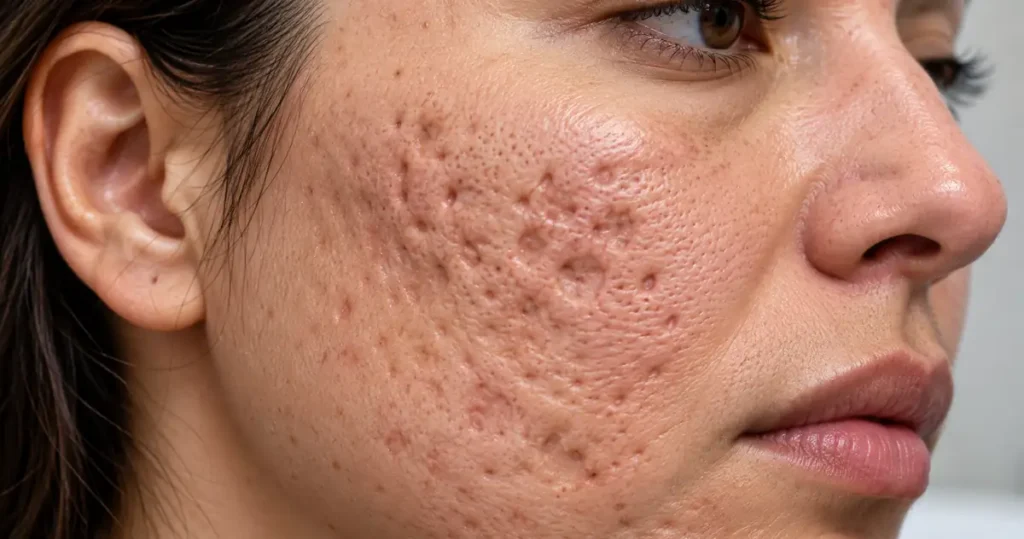
Most depressed acne scars are described as ice-pick, boxcar, or rolling scars. These names refer to different shapes and structural patterns, and the differences matter when planning treatment.
Ice-Pick Scars
Ice-pick scars are narrow at the surface and extend deeply into the skin. They can look like small punctures or deep pinholes.
Because the opening is small but the scar can be deep, broad surface treatments may not fully address the deepest part of the defect. A dermatologist on acne scars may therefore discuss focal approaches, scar surgery, resurfacing, or combination treatment depending on the exact scar.
The important point is not that one procedure is automatically “best” for every ice-pick scar. Depth, number, location, skin tone, and previous treatment all influence the choice.
Boxcar Scars
Boxcar scars are wider depressions with more defined edges. They may be round or oval and can range from shallow to deep.
A shallow boxcar scar may respond differently from a deep, sharply edged one. Resurfacing or collagen-remodeling treatments may help some boxcar scars, while deeper individual scars may need more targeted treatment.
This is one reason a dermatologist on acne scars does not treat every depressed scar as the same problem.
Rolling Scars
Rolling scars are usually broader and shallower, with sloping edges that give the skin a wavy appearance. Some are pulled downward by fibrous attachments under the skin.
If tethering is an important part of the scar, simply resurfacing the top may not address the full structural issue. A dermatologist may consider a release procedure such as subcision in selected cases, sometimes combined with another treatment to improve surface texture afterward.
What About Raised Acne Scars?
Not every acne scar is a depression. Some people develop raised scars because the healing process produces excess scar tissue.
Hypertrophic scars remain more closely related to the original damaged area, while keloids can extend beyond it. Raised acne scars are more common in some darker skin tones and can behave very differently from atrophic scars.
Treatment may include corticosteroid injections or other injected medication, laser treatment, freezing, prescription treatment, surgery, or combinations of approaches depending on the scar.
This is another reason diagnosis matters. A treatment designed to stimulate collagen in a depressed scar is not automatically appropriate for a raised scar that already contains excess scar tissue.
How a Dermatologist on Acne Scars Matches Treatment to Structure
The goal is not to memorize a rigid “scar type equals one procedure” chart. A better way to understand treatment is by what the procedure is trying to change.
Treatments That Remodel Collagen
Microneedling, radiofrequency microneedling, and selected laser treatments can encourage remodeling in depressed scars. These approaches may be useful when the goal is to improve texture and make scars less noticeable.
The American Academy of Dermatology describes microneedling and radiofrequency microneedling as options that can be used across skin tones, although individual suitability still needs to be assessed.
Treatments That Resurface or Soften Scar Edges
Laser resurfacing, chemical peels, and dermabrasion can improve the appearance of selected depressed scars by resurfacing or remodeling the skin.
The treatment depth and intensity matter. More aggressive resurfacing can bring more downtime and a greater risk of side effects, including pigment changes in some people. Mayo Clinic specifically notes greater pigment-related risk with some resurfacing procedures in darker skin.
For a deeper look at expectations, see what acne scar laser results can realistically look like.
Treatments That Address Tethering or Volume Loss
Some depressed scars are pulled down by fibrous bands or have lost volume beneath the surface.
A dermatologist on acne scars may discuss subcision or another scar-release technique when tethering is important. Fillers can also be considered for selected depressed scars where added volume could improve contour.
Treatments for Narrow or Deep Focal Scars
Deep, sharply defined scars may need more targeted procedures than broad resurfacing alone. Depending on the scar, a dermatologist may consider focal chemical techniques, punch procedures, or other scar surgery.
Treatments for Raised Scars
Raised scars require a different strategy. Injections, certain lasers, cryotherapy, medication, or surgery may be considered depending on whether the scar is hypertrophic, keloidal, or another raised type.
The practical takeaway is that a dermatologist on acne scars is trying to match the structural problem to the treatment mechanism, not simply pick the most powerful procedure available.
Why Mixed Acne Scars Often Need Combination Treatment
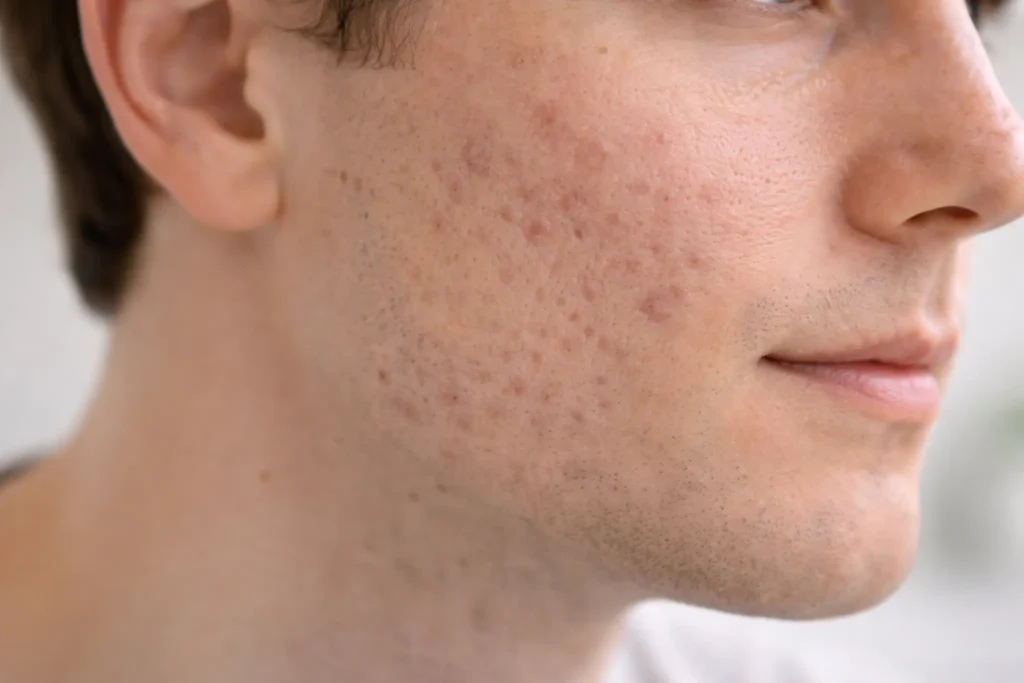
Many people do not have one neat scar type. One cheek can contain rolling scars, boxcar scars, narrow pits, post-inflammatory pigmentation, and active acne at the same time.
That makes combination treatment common. Both AAD and DermNet describe acne-scar care as potentially multimodal rather than relying on one procedure for every scar.
For example, a plan might address tethered rolling scars first, then use resurfacing or microneedling to improve broader texture. Deep focal scars may need separate treatment from the rest of the cheek. Pigment changes may need their own strategy.
Combination treatment does not mean every possible procedure should be stacked together. It means different problems may need different tools, sometimes in stages.
A dermatologist on acne scars should be able to explain what each part of the plan is targeting and why it is being done in that order.
For a broader overview of treatment categories, see how to get rid of acne scars.
Why Active Acne May Be Treated Before Scar Procedures
If you are still developing inflamed acne, scar treatment may not be the first priority.
The American Academy of Dermatology notes that acne treatment often comes first when breakouts are still active. The reason is practical: ongoing acne can keep producing inflammation and new scars while older scars are being treated.
This does not mean a dermatologist cannot assess your existing scars. It means the sequence of treatment may change.
A dermatologist on acne scars may first focus on reducing new breakouts, stabilizing the skin, and reviewing current medications. Once acne is better controlled, procedural scar treatment can often be planned more clearly.
This is especially important before procedures that should not be performed over certain active lesions. AAD, for example, advises delaying microneedling when painful, pus-filled, or deep pimples are present.
How Skin Tone Affects Acne Scar Treatment
Skin tone can influence both scar behavior and treatment risk.
People with darker skin tones are more likely to develop some forms of post-inflammatory hyperpigmentation and raised scarring after inflammation. That does not mean procedures are off-limits. It means treatment selection, device choice, settings, preparation, and aftercare deserve careful attention.
Some procedures, including microneedling and radiofrequency microneedling, are described by the American Academy of Dermatology as safe for all skin tones when appropriately performed.
Other treatments, especially some forms of laser resurfacing and deeper peels, can carry a higher risk of unwanted pigment change in darker skin. Provider experience with your skin tone therefore matters.
A dermatologist on acne scars should be able to discuss not only expected improvement but also pigment-change risk, downtime, and how the plan is adjusted for your skin.
What Results Can Treatment Realistically Aim For?
Acne-scar treatment is usually about improvement, not erasing every scar.
Realistic goals can include:
- Making depressions shallower
- Softening sharp scar edges
- Reducing a rolling or wavy appearance
- Improving overall texture
- Making scars blend more naturally with surrounding skin
- Flattening selected raised scars
- Reducing the contrast that makes scars stand out
Results vary by scar type, severity, skin characteristics, procedure, healing response, and how many treatments are appropriate.
A dermatologist on acne scars should be able to tell you which scars are likely to respond best, which may be more resistant, and what improvement would count as a successful outcome. Be cautious with any promise of perfectly smooth or permanently scar-free skin. AAD emphasizes that scar treatment commonly reduces visibility rather than guaranteeing complete removal.
Questions to Ask About an Acne Scar Treatment Plan
A consultation is more useful when you understand the reasoning behind the recommendation.
Consider asking:
- What scar types do I have?
- Which scar is each proposed treatment targeting?
- Do I still have active acne that should be controlled first?
- Why does this procedure fit my scar depth or structure?
- Does my skin tone change the risk or treatment settings?
- Would one procedure be enough, or are you recommending a combination plan?
- What degree of improvement is realistic?
- What downtime and aftercare should I expect?
- What are the main risks for my skin?
- If one scar type responds but another does not, what is the next step?
If microneedling is part of the plan, see what microneedling can and cannot improve.
For help evaluating a provider, see how to find an acne scar specialist.
Frequently Asked Questions
Can a dermatologist remove acne scars completely?
Usually, the realistic goal is to make scars less noticeable rather than guarantee complete removal. Some individual scars can respond strongly to targeted treatment, but mixed or deep scars often need several approaches. A good consultation should focus on likely improvement, limitations, risks, and how long the treatment plan may take.
Which treatment is best for ice-pick acne scars?
There is no single best procedure for every ice-pick scar. Because these scars are narrow and deep, a dermatologist may consider focal chemical techniques, punch procedures, scar surgery, resurfacing, or a combination. The choice depends on depth, number, location, skin tone, previous treatments, and the surrounding scar pattern.
Are rolling scars easier to treat than ice-pick scars?
Not necessarily. Rolling scars and ice-pick scars have different structural problems. Rolling scars may involve tethering under the skin, while ice-pick scars are narrow and deep. A treatment that works well for one may do little for the other, so “easier” depends on the specific scar and treatment plan.
Should active acne be treated before acne scar procedures?
Often, yes. If active acne is still causing inflamed lesions, controlling breakouts can reduce the chance of new scars forming while older scars are being treated. The timing depends on the procedure, current medications, acne severity, and your dermatologist’s assessment.
Does a dermatologist on acne scars use the same treatment for mixed scars?
No. A dermatologist on acne scars may recommend a combination plan when rolling, boxcar, ice-pick, raised scars, or pigment changes occur together. Each treatment should have a clear purpose. The best plan targets the specific structural problems rather than applying one procedure to every scar.
Conclusion
A dermatologist on acne scars does more than choose between laser, microneedling, fillers, or peels. The useful part of the consultation is identifying what kind of scar you have, how deep or tethered it is, whether acne is still active, how your skin tone affects risk, and what result is realistic.
That is why scar type shapes treatment without completely determining it. Two people can have similar-looking depressions and still need different plans because their skin, goals, history, and scar mix are different.
If you are considering professional treatment, ask the provider to identify which scar types they see and what each proposed procedure is meant to change. That explanation is often more valuable than the name of the device being offered.
This article is for educational purposes only and is not a diagnosis or a substitute for care from a qualified healthcare professional.
References:
- American Academy of Dermatology — Acne scars: Consultation and treatment
- American Academy of Dermatology — Acne scars: Signs and symptoms
- American Academy of Dermatology — Microneedling can fade scars, uneven skin tone, and more
- Mayo Clinic — Acne scars: What’s the best treatment?
- DermNet — Acne Scarring