Fungal Acne Vs Closed Comedones: Key Differences and Why Photos Aren’t Enough
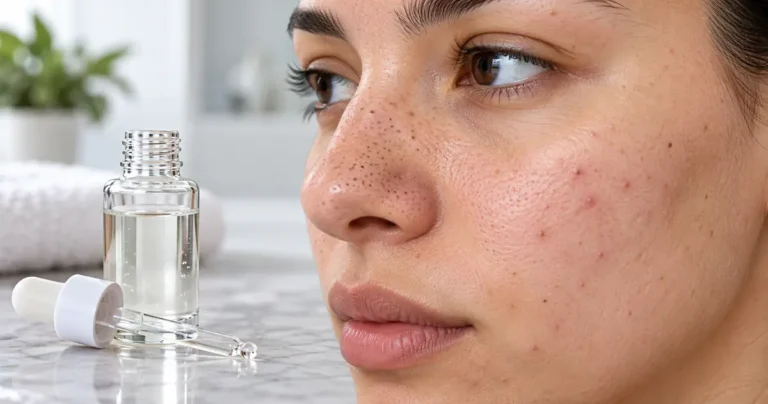
A forehead covered in tiny bumps can make you wonder whether you have clogged pores or “fungal acne.” Searches for fungal acne vs closed comedones often turn up photo comparisons, itching checklists, and suggestions to try dandruff shampoo. None of those can confirm what is happening in your skin.
Quick answer: Malassezia folliculitis, commonly called fungal acne, involves yeast-associated inflammation around hair follicles and often creates small, similar-looking itchy bumps or pustules. Closed comedones are plugs of oil and skin cells within follicles, usually appearing as small, noninflamed bumps. The patterns can overlap, and some people have both conditions. A correct diagnosis matters because treatment approaches differ.
This comparison focuses on the decision that matters most: what the clues suggest, what they cannot establish, and how to avoid treating the wrong condition.
Table of Contents
fungal acne vs closed comedones: What’s Different Beneath the Skin?
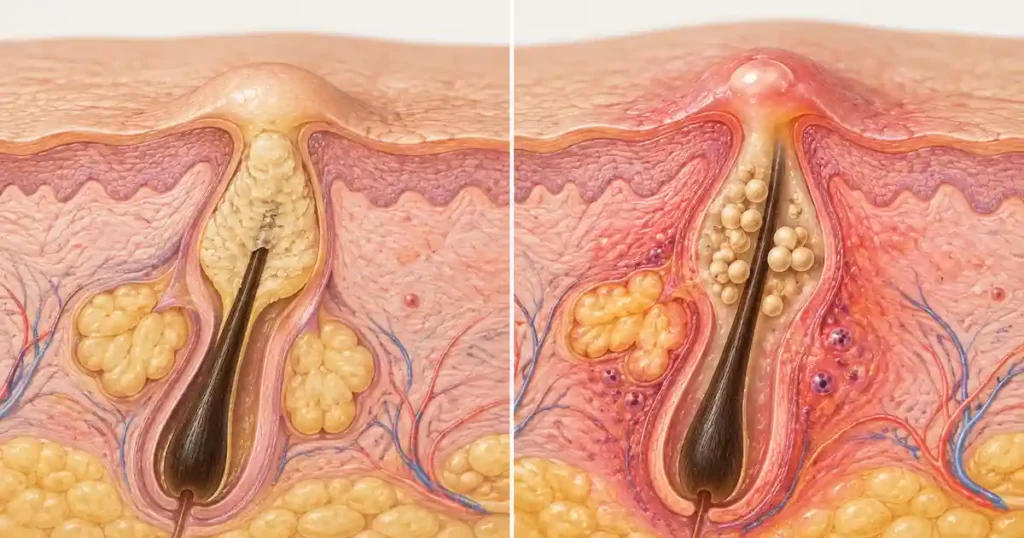
The essential distinction in fungal acne vs closed comedones is not simply whether a bump has a white tip. The processes inside the follicle differ.
Malassezia folliculitis is inflammation associated with yeast
“Fungal acne” is a popular name for Malassezia folliculitis, also known as pityrosporum folliculitis. Despite the nickname, it is not a type of acne vulgaris. Malassezia yeasts normally live on skin; under certain conditions, they can become associated with inflammation inside hair follicles.
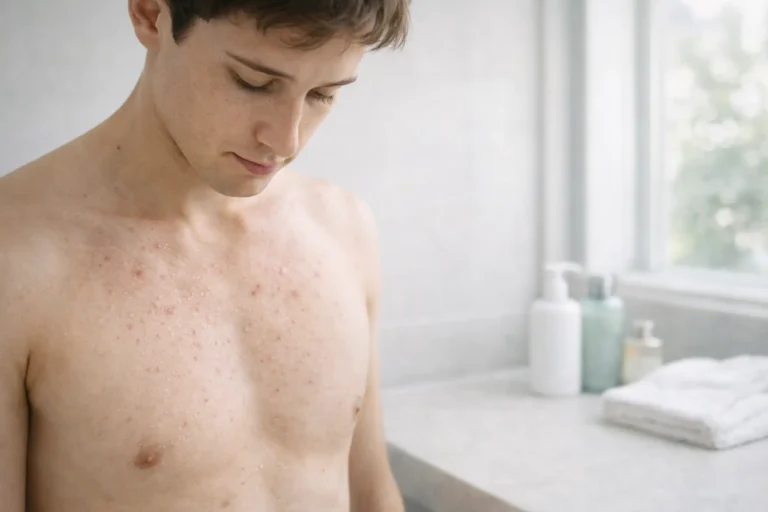
The resulting eruption commonly consists of small follicle-centered papules (raised bumps) and pustules (bumps containing inflammatory material). Warm, humid conditions, sweating, occlusion, certain medication exposures, and immune-system factors can increase susceptibility. None is a stand-alone diagnostic test.
Closed comedones are plugged follicles
A closed comedone, often called a whitehead, develops when skin cells and oil obstruct a follicle’s opening. Because the opening is closed, it usually appears as a small skin-colored or pale raised bump rather than an obvious blackhead. A blackhead is an open comedone; its dark color is not trapped dirt.
Closed comedones belong to acne vulgaris. They can occur on the forehead, chin, and cheeks, sometimes alongside blackheads and inflamed pimples. Unlike a pustule, a closed comedone does not necessarily contain pus. That distinction becomes important when a photo shows a tiny pale dot.
Why it matters: An acne medicine designed to prevent plugged follicles and an antifungal medicine intended for Malassezia-associated inflammation do not have interchangeable purposes. The right treatment starts with identifying which problem is present.
fungal acne vs closed comedones: Symptoms and Patterns Compared
Here is a practical fungal acne vs closed comedones comparison. These features describe common patterns, not rules that can diagnose an individual person.
| Feature | Malassezia folliculitis | Closed comedones |
|---|---|---|
| Typical lesion | Small follicle-centered papule or pustule | Small plugged, usually noninflamed bump |
| Bump size and pattern | Often many similarly sized lesions | May be clustered, with other acne lesion types nearby |
| Itching | Common, sometimes prominent | Usually not a leading symptom |
| Visible blackheads | Not produced by Malassezia folliculitis itself | May coexist as part of acne vulgaris |
| Usual locations | Upper chest, back, shoulders; also forehead and hairline | Forehead, chin, cheeks, and other acne-prone areas |
| Main treatment direction | Confirm diagnosis; consider appropriate antifungal management | Acne treatment targeting clogged follicles |
Why itching helps—but doesn’t settle the question
Itch is a useful clue in fungal acne vs closed comedones, especially when many similar bumps occur on the chest or upper back. But an itchy forehead is not automatically fungal. Contact dermatitis, bacterial folliculitis, ordinary acne with irritation, and heat-related eruptions may also itch. Conversely, someone with Malassezia folliculitis might not describe severe itching.
Think of itching as information to report, not a verdict. Ask whether there is burning, tenderness, a new product, or a rash beyond the bumps. Those accompanying details may change what a clinician considers.
Uniform bumps and their location
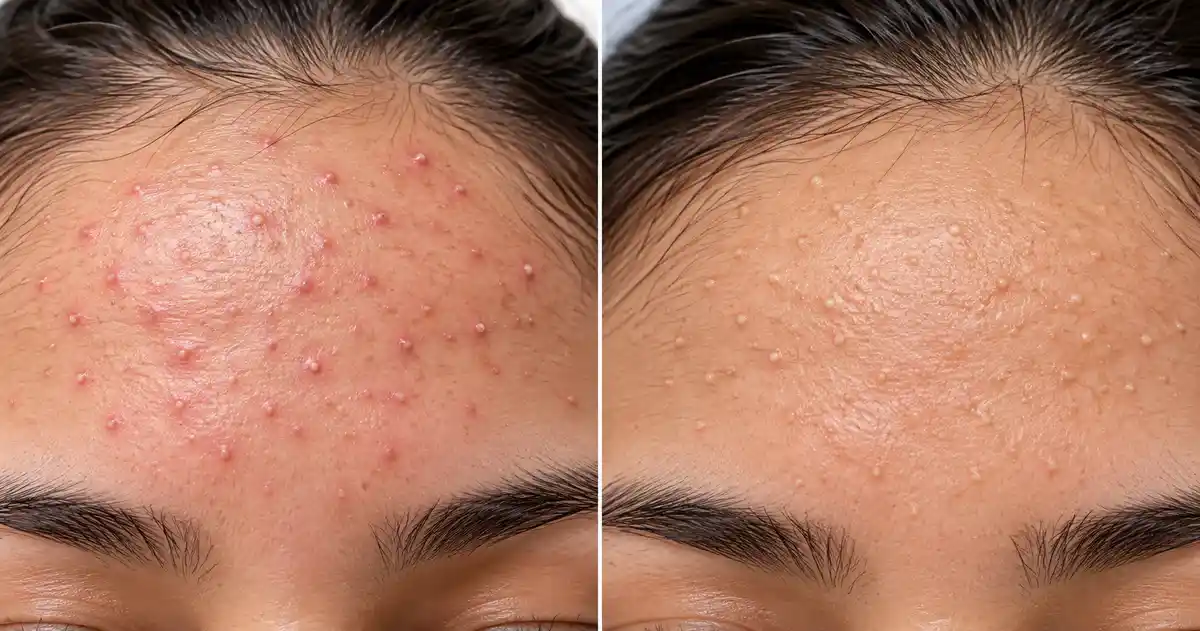
Doctors sometimes call a cluster of nearly identical lesions monomorphic. Malassezia folliculitis often has this pattern. Comedonal acne can also produce many similarly sized bumps, however, and steroid-related or other acne-like eruptions can look uniform too.
Location adds context but not certainty. Both conditions can affect the forehead. Folliculitis is also commonly described on the chest, shoulders, and upper back; ordinary acne can occur there as well. The combination of lesion types, symptoms, and history matters more than a single affected area.
Why Photos Cannot Diagnose the Difference
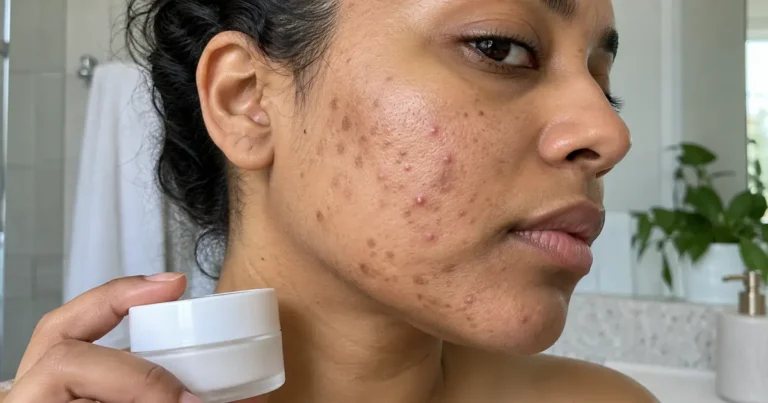
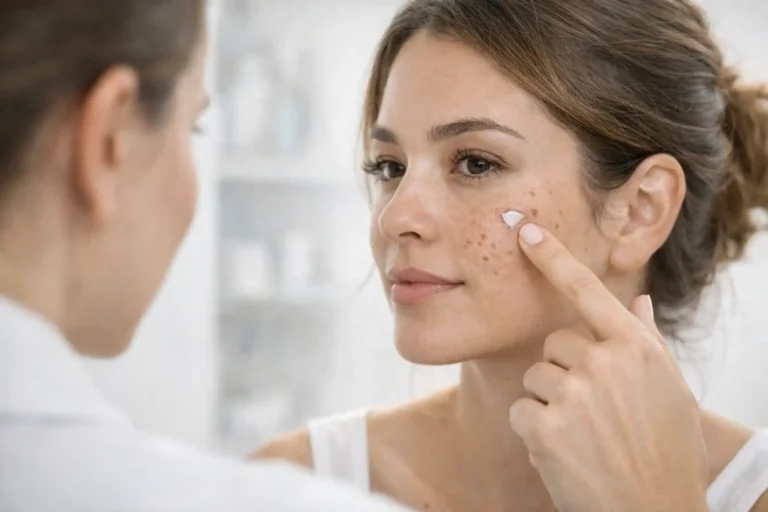
Online galleries make fungal acne vs closed comedones seem like a visual matching exercise. In practice, photos rarely show whether a follicle contains a keratin-and-oil plug or whether yeast-associated inflammation is present.
Lighting may wash out redness on some skin tones, while shadows exaggerate texture. A phone camera can miss a tiny pustule or make an ordinary comedone resemble one. Makeup, image smoothing, and the absence of a side view further reduce what can be seen. Even an accurate, unedited clinical photograph can only illustrate a typical presentation; it cannot diagnose your bumps.
A white tip isn’t always a whitehead
The term whitehead is frequently used for any pale-tipped pimple, but dermatologists distinguish a closed comedone from a pustule. The latter is an inflamed lesion containing pus, and it can occur with several kinds of folliculitis or with acne vulgaris.
Do not squeeze or puncture a bump to find out what it contains. That can injure skin and introduce additional irritation or infection without identifying the underlying condition.
Look-alikes matter
The same small-bump picture might also represent bacterial folliculitis, irritation from a skincare product, heat rash, a medication-related acneiform eruption, or another condition. Our guide to what fungal acne looks like in different areas provides broader visual context; the purpose here is to decide what to do when appearances are ambiguous.
fungal acne vs closed comedones: How Dermatologists Make the Diagnosis
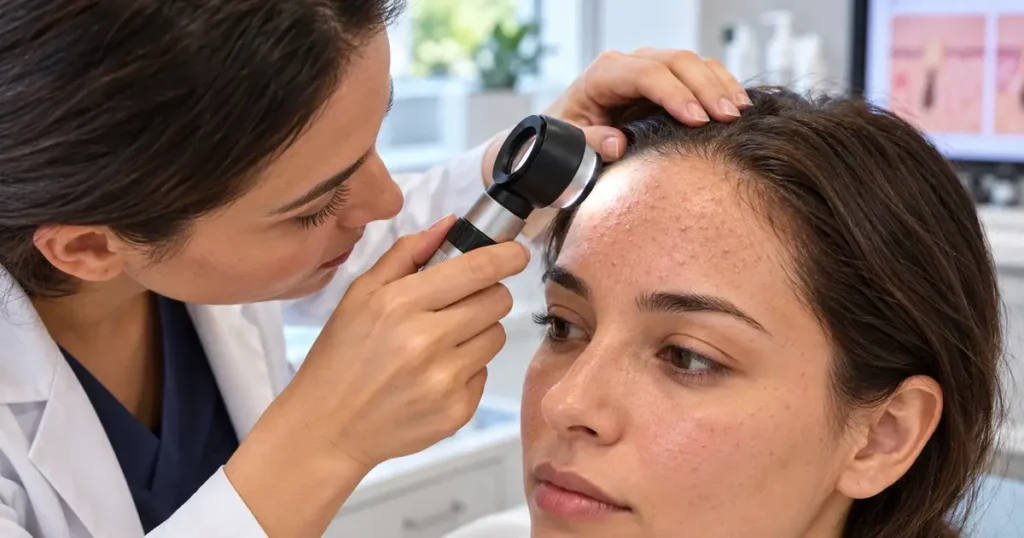
The most reliable fungal acne vs closed comedones assessment considers several details together. A clinician looks at whether individual bumps are comedones, papules, or pustules; where they appear; whether they itch; and whether sweat, medication changes, occlusion, or skincare changes preceded the eruption.
Examination usually identifies comedonal acne
A dermatologist can often recognize typical closed comedones through a skin examination. Blackheads or a mixture of common acne lesions may provide additional evidence. Testing is not automatically required for straightforward comedonal acne, but atypical or persistent bumps warrant a wider evaluation.
When microscopy and other testing help
Malassezia folliculitis can be harder to establish clinically because it resembles other follicular eruptions. Depending on the situation, a clinician may collect suitable follicular material and examine it microscopically, sometimes using a potassium hydroxide (KOH) preparation. Other methods, including a biopsy in selected cases, may help resolve persistent uncertainty.
Importantly, Malassezia is a normal skin inhabitant. Detecting yeast somewhere on the surface does not, on its own, prove that it is responsible for the eruption. The test result must fit the examination and history. Patients should not attempt skin scrapings or other procedures themselves.
Why dandruff shampoo isn’t a home diagnostic test
You may encounter advice to put antifungal shampoo on your forehead and see whether the bumps disappear. That is not a definitive way to settle fungal acne vs closed comedones.
A change after using a product can reflect many things: the condition’s natural fluctuation, simultaneous skincare changes, the formula itself, or an effect on one condition when two coexist. Failure to improve also does not rule out Malassezia folliculitis. Some scalp formulations may irritate facial skin or have directions that do not cover facial use.
A clinician may consider treatment response alongside other evidence, but a self-directed shampoo experiment is not equivalent to a confirmed diagnosis. Avoid repeating potentially irritating applications just to test a theory.
Can Fungal Acne and Closed Comedones Coexist?
Yes. Fungal acne vs closed comedones is not always an either-or choice. Someone can have comedonal acne and Malassezia folliculitis at the same time, in nearby areas or even overlapping regions.
Imagine a person with familiar blackheads and skin-colored bumps along the chin who later develops a cluster of itchy, similar-looking follicular papules across the upper chest. Both processes could be considered, but this example alone proves neither diagnosis. A clinician would need to evaluate the actual lesions and history.
Coexistence also explains why a single treatment may improve part of an eruption while other bumps remain. It does not necessarily mean the product failed or that an entirely new product should be added immediately. Before escalating treatment, establish what remains to be treated.
fungal acne vs closed comedones Treatment: Why the Choice Matters
A treatment comparison is useful only when it is clear what the treatment is meant to target. The goal of a fungal acne vs closed comedones treatment decision is not to choose whichever product has more enthusiastic reviews; it is to match the approach to a reasonably established condition.
If closed comedones are the main problem
Acne treatments that help prevent or clear clogged follicles are usually most relevant. Topical retinoids such as appropriately labeled over-the-counter adapalene, along with prescription retinoid options, can help prevent comedones. Salicylic acid is another option for mild pore congestion. A clinician may recommend other approaches depending on whether inflammatory lesions are present as well.
These products are not interchangeable, and they can cause dryness, peeling, or irritation. Follow the actual OTC label or your prescriber’s instructions rather than stacking several acne actives at once. Improvement is generally gradual, not an overnight change. For more detail on one ingredient, see salicylic acid for clogged pores and whiteheads.
⭐ Differin Gel 0.1% Adapalene — Targeted Acne Treatment for Clogged Pores
Dealing with persistent closed comedones or recurring whiteheads? If your bumps have been identified as comedonal acne, Differin Gel 0.1% Adapalene is an evidence-supported over-the-counter treatment worth considering.
Unlike a regular exfoliating scrub, Differin contains 0.1% adapalene, a topical retinoid that helps regulate skin-cell turnover, clear clogged pores, and prevent new acne lesions from forming.
Why consider it?
- ⭐ 0.1% Adapalene: An FDA-approved over-the-counter acne medication.
- Targets Clogged Pores: Helps manage blackheads, whiteheads, and other acne lesions.
- Preventive Approach: Works on the processes that contribute to recurring acne.
- Established Treatment Category: Topical retinoids are recommended in dermatology acne guidelines.
Important: Differin is designed to treat acne vulgaris, not Malassezia folliculitis. It may cause dryness, irritation, or temporary worsening of acne. Follow its label, and ask a healthcare professional before use if pregnant or breastfeeding.
👀 See Differin Gel & Check Price on Amazon ➜
If Malassezia folliculitis is confirmed or strongly suspected
Antifungal treatment is a principal management approach. Clinicians may use appropriate topical antifungals, including certain azole medicines, or other suitable formulations according to the diagnosis, treatment site, and individual circumstances. Some cases need additional evaluation or different treatment, and recurrence is possible.
Oral antifungal medicines require professional supervision because of potential adverse effects, interactions, and, for some drugs, liver-related precautions. A shampoo sold for scalp use should not be assumed to be suitable for every facial rash. Our dedicated guide to treatment options for fungal acne covers the broader condition without replacing an examination.
What if treatment seems to help both?
The two conditions share some aspects of follicular biology and may coexist. Recent clinical literature notes that certain conventional acne topicals could have a role in selected cases of Malassezia folliculitis, but this does not make an acne medicine a universally effective antifungal treatment. Likewise, an antifungal improving itchy follicular bumps does not establish that every remaining bump is a closed comedone.
This is why choosing products solely by an online fungal acne vs closed comedones checklist can cost money, delay appropriate care, and expose sensitive skin to unnecessary actives.
What to Do Before Buying Another Treatment
If you are weighing fungal acne vs closed comedones because your current routine is not helping, make the next step an information-gathering one, not another product experiment.
- Describe the lesions accurately. Note whether you see obvious blackheads, skin-colored bumps, inflamed pustules, or a mixture. Avoid calling every pale bump a whitehead.
- Record symptoms and timing. Include itching, tenderness, sweating, recent medication changes, and when the eruption began. A photograph over time can document changes but cannot confirm the cause.
- Check your existing products. Identify any new leave-on acids, scrubs, rich cosmetics, or medicines. Multiple simultaneous changes make reactions harder to interpret.
- Avoid aggressive self-treatment. Do not combine strong acids, extract bumps, or repeatedly apply antifungal shampoo to prove a diagnosis.
- Seek an appropriate examination. A dermatologist or qualified clinician can decide whether the pattern is typical acne or merits folliculitis testing.
- Choose treatment for the diagnosed problem. Check intended use, label directions, tolerability, and follow-up needs before purchasing.
You may need earlier assessment if bumps are spreading quickly, unusually painful, repeatedly returning, or associated with marked inflammation. Deep nodules, scarring, significant distress, and acne that does not improve with suitable treatment also warrant professional care. Seek prompt care for a rapidly spreading painful rash accompanied by fever or feeling unwell.
Frequently Asked Questions
1. Can fungal acne and closed comedones appear in the same area?
Yes. Malassezia folliculitis can coexist with comedonal acne, including in nearby or overlapping regions. That makes fungal acne vs closed comedones less straightforward when some bumps are clogged pores and others are inflamed around follicles. A mixed presentation deserves assessment rather than assuming one product should remove everything.
2. Does every white-tipped bump count as a closed comedone?
No. A closed comedone is a plugged follicle, while a pustule has inflammatory material and may be caused by acne or folliculitis. The appearance of a pale center, especially in a smartphone photo, cannot reliably distinguish the two.
3. Can an ingredient checker identify fungal acne or clogged pores?
No. An ingredient checker may help you review a product’s composition, but it cannot examine a follicle, detect an infection, or establish whether the bumps are comedones. Claims that an ingredient list proves a product will cause or prevent “fungal acne” are too broad.
4. What should I bring to a dermatologist appointment for persistent forehead bumps?
Bring the names of your skincare products and medications, when symptoms started, whether the bumps itch or hurt, and what treatments you have tried. Photos documenting changes may help with the history, even though they are not diagnostic tests by themselves.
5. How can I tell whether treatment is working if the original diagnosis was uncertain?
Discuss the response with the clinician who assessed you. Note which lesion types improved, whether irritation developed, and whether new bumps continue appearing. A partial response does not confirm a diagnosis, and worsening symptoms may call for reassessment rather than a stronger product.
Conclusion
The practical lesson from fungal acne vs closed comedones is that similar-looking bumps can have different causes—and occasionally more than one cause at once. Use itch, lesion type, and location as clues, not proof. If the diagnosis remains uncertain, getting the bumps properly assessed is more useful than buying another treatment based on a photo or shampoo trial.
This article is for educational purposes and is not a diagnosis or a substitute for advice from a qualified healthcare professional.
References
- DermNet — Malassezia (Pityrosporum) Folliculitis
- DermNet — Comedonal Acne
- European Academy of Dermatology and Venereology — Position Statement: Recommendations on the Diagnosis and Treatment of Malassezia Folliculitis
- Draelos et al. (2026) — Malassezia Folliculitis Presentation, Diagnosis, and Treatment: A Review of “Fungal Acne”
- American Academy of Dermatology — Acne: Diagnosis and Treatment
- Cleveland Clinic — Fungal Acne: Malassezia Folliculitis